Breitsprecher Seedlings
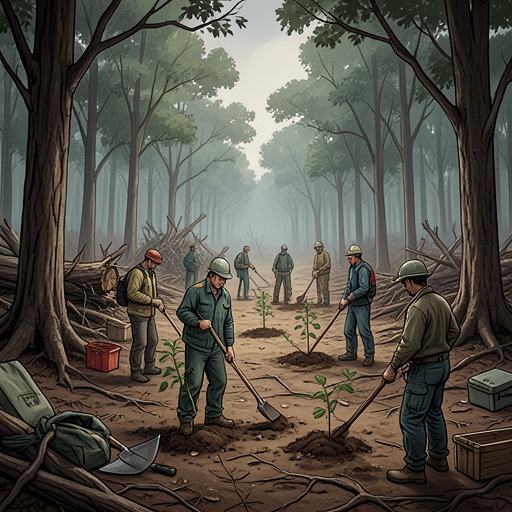
BarkskinsBreitsprecher Seedlings is the nursery enterprise that survives the rise and collapse of Breitsprecher-Duke, carrying forward an alternative to the company’s extractive business: cultivating trees, preparing sites, and planning for forests beyond the lifespan of any one generation. Dieter Breitsprecher’s conservation division establishes that purpose; after Charley’s death, Conrad Breitsprecher develops it into a more deliberate program of forestry study and seedling production.
Origins in Conservation
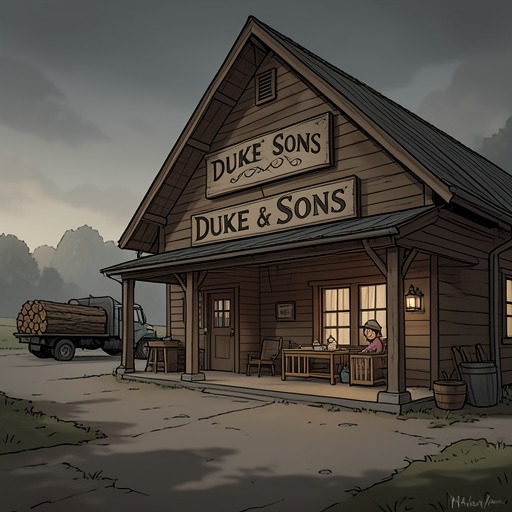
Dieter’s approach emerged within a company whose expansion was shadowed by the damage it caused. When James Duke celebrated the discovery of Michigan’s vast pine forests as a supply too large for a thousand men to exhaust in a thousand years, Armenius Breitsprecher recognized that Duke & Sons meant to clear the continent. He objected to clear-cutting, waste, soil destruction, erosion, and the assumption that another forest would always be available. His own compensation—scattered parcels of land too small and inconveniently separated to sell easily—also exposed how the benefits of the company’s expansion were distributed.
After Dieter and Lavinia Duke married and their businesses combined, Dieter asked that cutover pinelands not be sold to speculators. He proposed a separate division, Maintenance Timberland, which he would oversee and use to replant and manage those lands, in addition to acreage he had kept outside the merger. This was the first visible sign that conservation might become part of the company’s identity, though it existed alongside, rather than in place of, its continued commercial ambitions.
Dieter argued before the board that timber could become scarce and more valuable than the company then anticipated. Holding land and maintaining forests could support future lumber and paper businesses, while older Breitsprecher land planted two decades earlier already showed the value of allowing trees time to grow. The proposal required directors to think in decades rather than months or years. Its underlying measure of success was not immediate return alone, but whether the land could sustain future production.
A Long Horizon for Trees
Dieter’s outlook also shaped the couple’s New Zealand forestry survey. He distinguished Lavinia’s interest in harvesting kauri from his own interest in replanting what had been taken, and asked whether young kauri might be planted as mature trees were cut. Ahorangi Oval explained that the largest trees were thousands of years old and that replacing one fallen giant with a seedling would take many human generations. Dieter’s answer framed planting as a responsibility to the world and to people not yet born, even when the planter would never see the mature tree.
That long horizon stood in sharp contrast to the commercial model visible in New Zealand. Logging stations combined camps and trading posts dealing in flax, spars, and lumber; associated warehouses, sawmills, and shipyards drew European enterprises into the region. After taking the most valuable shore timber, operators moved on, leaving waste and burned forest behind. Against that pattern, a nursery represented a different kind of forestry enterprise: not simply a source of timber, but a means of sustaining future tree growth.
Conrad’s Reorganization
Charley Breitsprecher’s will gave the nursery its next custodian. Before dying in Manaós, Charley asked that his last notebook be sent to Conrad and that his fortune, inherited from Lavinia, together with Dieter’s seedling nursery, be held in trust for the boy until he reached twenty-one. The bequest joined material resources to a record of Charley’s doubts about a human-centered view of nature, placing the nursery within an inheritance that carried both wealth and criticism of how wealth had been accumulated.
When Conrad later examined the greenhouse operation with McErlane, he recognized how much he did not know about seedling propagation, cloning, forest genetics, and site preparation. He decided to study forestry rather than pretend that inherited facilities were enough. The greenhouses could continue serving existing clients while he learned how to make a new plan; he concluded that seedlings were essential to keeping forests alive.
His questions were practical as well as ecological. Bare-root pine and spruce seedlings advertised as suitable for any site often died when planted on rough logged-over land. Site preparation could improve their prospects, but required labor and machinery that companies might not be willing to pay for. Conrad investigated which species would suit different sites, how seedlings should be prepared, and how forests might regenerate on burned ground without being overtaken by grasses or other plants. His inquiry made the nursery a place for developing forestry knowledge, not merely growing stock for sale.
Conrad saw that nursery work alone could not solve poor regeneration. Timber companies and lumbermen had to accept that their future supply depended on planting among the stumps, rather than relying on a few remaining wild trees to reseed barren cuts. He therefore decided that Breitsprecher would offer site preparation as a service, making the work required for successful planting part of the business itself. He also considered research into seedlings grown in soil-filled kraft-paper cylinders, which had performed better than bare-root plants in the same planting conditions. Questions of labor, time, nursery space, species, and price remained open, and Conrad was already considering using Charley’s legacy for philanthropy rather than judging the work solely by profit.
Survival After the Company
The old corporate structure did not endure. Breitsprecher-Duke eventually passed to International Paper; the former company was reduced to boxes of papers and several portraits. Breitsprecher Seedlings remained as a separate entity. Its survival preserved a distinct institutional strand of the family enterprise after the timber company itself had risen and fallen.
That separation gives the nursery a significance beyond business continuity. The timber concern treated forests as supplies to be acquired and converted, while the nursery’s strongest rationale depended on knowledge, site-specific care, and a time scale extending across generations. It could not undo the destruction associated with industrial logging, and the evidence does not establish the final scope of its operations. But its continued existence leaves open a different use for inherited capital and expertise: cultivating the conditions under which forests might return.