Orphanage
BlondeThe Orphanage is a remembered childhood place whose roof offered a view toward Hollywood while its routines left their mark on Norma Jeane Baker. In the novel, it is at once a vantage point for dreams of another life and the origin of a private technique for withdrawing from the present.
The Rooftop and the Hollywood Lights
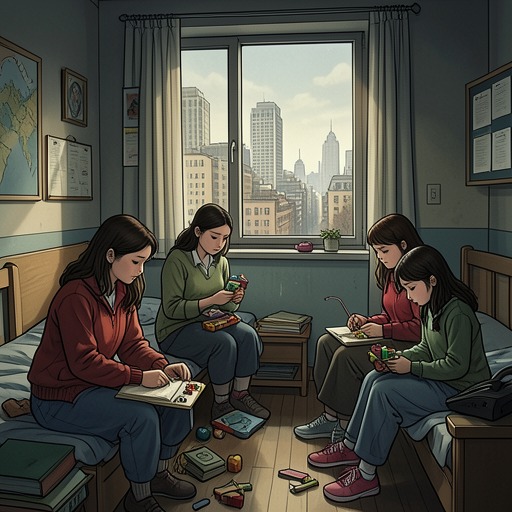
In September 1947, as Norma Jeane’s hopes seemed to have come true, the narrative recalls the orphan girls gathered on the Orphanage roof, looking toward the RKO antenna and the lights of Hollywood, miles away. The roof makes their distance from the film world visible: they can see its signal and glow, but remain far from the life they imagine. For Norma Jeane, the image becomes part of a sharp contrast between the childhood vantage point and the moment when she declares that her new life as an actress has begun.
A Learned Way to Disappear
The Orphanage survives in Norma Jeane’s later life not only as a remembered setting but as the source of a practiced gesture. When she is distressed, she presses her fingertips against her eyelids to make the people before her disappear. The narration traces the trick back to the Orphanage and compares it to the lever of the Time Traveler’s machine: a means of leaving the immediate scene without physically going anywhere. After keeping her eyes shut for nearly a quarter of an hour, she opens them at the Montezuma Drive residence. The remembered childhood habit thus carries into an adult crisis, offering temporary escape rather than resolving what has unsettled her.
Longing, Beauty, and Memory
The rooftop vision places the Orphanage inside a larger tension between exclusion and the glamour of Hollywood. The passage’s following section is framed by Sigmund Freud’s observation that beauty has no obvious function or cultural necessity, yet civilization cannot do without it. Beside the image of orphan girls watching Hollywood from afar, that reflection sharpens the pull of a world organized around beauty: its promise is powerful even to those kept outside it. The Orphanage remains significant through this double inheritance—an image of distant aspiration and a remembered place from which Norma Jeane learned how to shut out the world for a while.