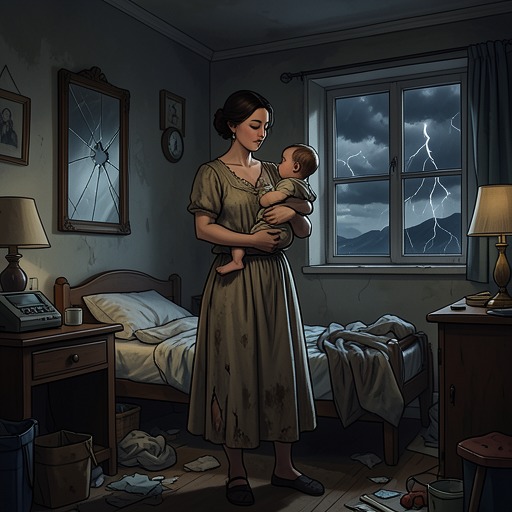
Lakewood Home
BlondeLakewood Home is the institution where Norma Jeane Baker’s wish for an ordinary, reciprocal relationship with her hospitalized mother repeatedly meets Gladys Mortensen’s silence and confusion. The visits turn the residence into a measure of the distance between them: Norma Jeane arrives with gifts and hopes, while Gladys’s responses remain uncertain. A later gift of a white spinet makes the same space briefly hospitable to music, but does not erase that distance.
Setting and Visits
Norma Jeane makes one visit alone after the Studio suspends her for refusing a new film. She drives to Lakewood Home in a plum-colored Studebaker convertible with whitewall tires; her husband, the Ex-Athlete, had offered to accompany her, but she declined, explaining that her mother was ill and that he would not like her. The choice places the visit outside the couple’s shared life: Norma Jeane goes to see Gladys without asking her husband to mediate the encounter.
At the residence, the staff greet her with restrained excitement. She presents herself as Norma Jeane Baker rather than Marilyn Monroe, wearing a modest mauve gabardine suit and low heels. Yet the blonde celebrity remains recognizable in her wake. She brings the staff a five-pound box of assorted Swiss chocolates. For Gladys she has chosen fruit—mandarins and black grapes—along with National Geographic and a copy of Screenland whose cover presents Marilyn Monroe’s marriage and honeymoon. Gladys inspects the gifts and appears to have expected sweets, an early sign that Norma Jeane’s careful preparation cannot ensure that mother and daughter want the same thing from the visit.
A Mother-Daughter Encounter
Gladys has recently come through a bad period and is described as nearly recovered. Her hair has been washed before the visit; she wears a pink robe and matching slippers Norma Jeane bought at Bullock’s. Norma Jeane notices the robe’s stained collar but chooses not to draw attention to it. The slippers are arranged neatly beneath the bed. Such details make the visit intimate in a practical, domestic way, even as the institutional setting and Gladys’s illness place limits on that intimacy.
A new image hangs behind Gladys’s desk: Jesus with a flaming Sacred Heart. Norma Jeane regards it as a possible gift from another patient and feels, in effect, that she is looking down an abyss toward a tiny figure who may be her mother. Yet she also finds the wedding photograph she had sent Gladys, showing Norma Jeane in an ivory dress beside the Ex-Athlete. The sacred image and the carefully preserved photograph register two different kinds of connection: Gladys’s religious surroundings and her daughter’s attempt to make her marriage part of their shared life.
Norma Jeane embraces Gladys gently and kisses her cheek, withholding the warmth she longs to show because she expects Gladys might stiffen. During a later visit she reads a letter aloud in a calm, clear, neutral voice. Gladys says nothing. At the end, Norma Jeane kisses her again and tells her she loves her; Gladys neither answers nor looks at her, turning instead toward the Sacred Heart image. The residence thus becomes the setting for an affection that is expressed plainly but not returned in kind.
Correspondence, Treatment, and Hope
Their relationship also extends beyond the visiting room. After Gladys leaves a telephone call abruptly, Norma Jeane writes that she worried whether her mother was angry or had become unwell. She invites Gladys to visit her whenever she likes and stay as long as she wants. The invitation imagines a freer, more mutual relationship than the calls and institutional visits have allowed.
In the same letter, Norma Jeane describes Gladys’s treatment in optimistic terms. She reports that a new doctor has prescribed chloral hydrate to help her sleep and calm her nerves, and that the doctor believes medication can help when someone feels depressed. Norma Jeane recounts their discussion of whether relief from the blues might also take away what gives music its meaning, while insisting that there must be a middle way between suffering and preserving life. The letter presents her as trying to understand treatment not only as care for her mother but as a question of how to live with emotional pain.
She promises that one day the new house on Helena Drive will be full of grandchildren for Gladys. She has declined a magazine’s request to photograph Marilyn Monroe there because she does not yet feel the house is truly hers. The imagined family and the guarded home belong to the same hope: fame should not prevent a private life in which Gladys can be present. The promise remains prospective, but its direct address to her mother gives Lakewood Home an importance beyond the visits themselves; it is the place from which Norma Jeane continues to imagine bringing Gladys into a family future.
The Piano and the Later Visits
In a later phase of Gladys’s life, Norma Jeane arranges for a white spinet to be delivered to Lakewood Home’s visiting room as a gift in Gladys’s name. Gladys is then sixty-two, has not recently tried to escape, and is no longer considered a danger to herself or a source of trouble for patients or staff. Described as a model patient, she seems confused when the gesture is explained. She declines repeated invitations to sit and play, but hesitantly touches the keys and sounds a few chords.
The piano, once owned by Fredric March, gives the visit a public ritual as well as a private meaning. Norma Jeane tells the director and assembled staff that she has tried to keep the instrument in good condition and invites them to appreciate its sound. The improvised scene goes better than she expects: the director expresses gratitude, and staff and patients gather around the famous visitor. They call her Miss Monroe, and she no longer insists on being addressed by her birth name. The shift from Miss Baker at the earlier visit to Miss Monroe here shows how difficult it has become to keep the daughter’s identity separate from the celebrity’s, even in a place she enters for her mother’s sake.
The spinet’s presence also changes the visiting room’s atmosphere. Among its severe, heavy furniture, the white instrument shines like a memory. Norma Jeane speaks to the gathered patients about music’s importance to sensitive and lonely people; a young nurse says that the piano will let her teach the patients to play. Gladys herself does not become an eager participant, but she touches the instrument and plays a few chords. The gift creates a use for the room that can outlast the visit and reach other patients.
Before leaving, Norma Jeane embraces and kisses Gladys, who does not return the gestures but allows them and smiles. Norma Jeane promises to call and stay longer next time, then puts on sunglasses so the people there will not see her eyes. The nurse accompanies her to the parking lot and talks about learning piano. Lakewood Home therefore holds both the unfinished private exchange between mother and daughter and a small act of care that extends beyond it: the instrument remains available to the patients, even when Norma Jeane must leave.