Film Studio
BlondeFilm Studio is the Hollywood institution that gives Norma Jeane Baker(Marilyn Monroe)a route into screen acting and helps manufacture her public identity, while keeping decisive control over her work and the conditions of her visibility. Founded by Mr. Z as a star-making enterprise, it is both a physical complex, with executive offices and restricted private rooms, and a system that converts performers into contract labor and marketable images.
Origins and Star-Making
Mr. Z’s career is presented as a history of inventing attractions and creating audiences for them. He had begun making silent films in a Lower East Side warehouse before moving to Hollywood in 1928 and founding the company that became Film Studio. By the time Norma Jeane encounters him, his reputation rests on an extensive roster of stars and celebrated performers, including Sonja Henie, the Dionne Twins, Rin Tin Tin, Myrna Loy, Alice Faye, Nelson Eddy, Jeannette MacDonald, and June Haver. The scale of that roster makes the studio seem less like a workplace alone than a factory for public recognition: it could build names, images, and audiences as parts of one enterprise.
The studio’s institutional power reaches beyond the screen. Mr. Z is described as a master of creating sensations, and the company’s history is recounted in stories that take on the air of Hollywood legend. Norma Jeane’s first visit to his office places her inside that mythology, but from the vulnerable position of a newcomer waiting to be assessed. She has prepared what to say, yet there is no script for the meeting and no assurance that her rehearsed lines will help her. The studio is where opportunity is offered, but its senior figures determine the scene.
Offices and Access
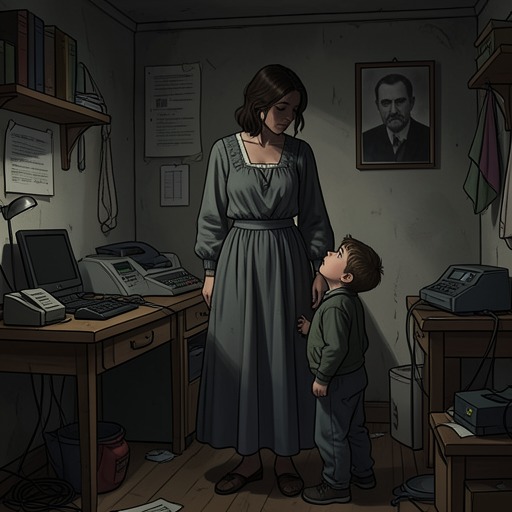
The executive offices give physical form to the hierarchy. A secretary makes Norma Jeane repeat her name before she is admitted to Mr. Z’s large office, furnished with velvet curtains, teak furniture, and crystal. Beyond it lies his private apartment, accessible to very few people. Even I. E. Shinn, Norma Jeane’s agent, has not been admitted there; his appointments with Mr. Z take place in the office or the executives’ dining room instead. The contrast between the public-facing office and the guarded apartment marks a boundary of privilege within the studio itself.
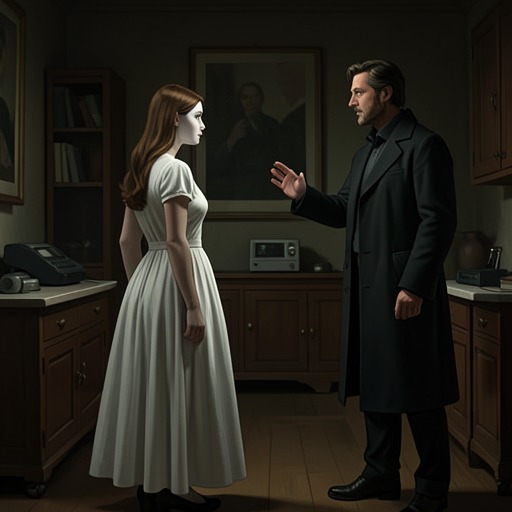
For Norma Jeane, entering the office is also an encounter with the difference between acting and real life. She imagines the meeting as a scene in which a blonde girl approaches a distinguished man behind a desk, but the scene offers no musical cue or known script. When Mr. Z asks her to follow him into the private area, her prepared words fail her. She catches sight of herself in a smoked mirror, sees the white satin dress in which he is viewing her, and tries to keep her fear from showing. Her stumble prompts his laughter, and she laughs along without knowing whether his remark is a joke. The studio’s rooms are thus not neutral backdrops: they organize who may enter, who is watched, and who has the authority to define what is happening.
Contract, Work, and Early Roles
Norma Jeane arrives at Film Studio after gaining work as a model through the Preene Agency. Her employment is divided between that agency’s assignments and her beginnings as a studio actress; the two kinds of work offer income but different forms of exposure. She tells Gladys that she has a contract at the place where her mother once worked, and that the photographs already provide enough to live on. The confidence of this account contrasts with the pressure of a career that depends on photographers, clients, the agency, and the studio continually judging her.
Her screen debut is modest. After Otto Öse helps bring her to I. E. Shinn and secure a renewable studio contract, she is cast in a light comedy with June Haver. Her four minutes of work are cut to a few seconds, and the surviving glimpse places the blonde newcomer far off in a rowboat with Haver, too distant to be recognized. The episode establishes an early imbalance between the promise of a studio contract and the small amount of screen presence it actually provides. The name Marilyn Monroe begins to circulate, but the first film appearance gives the emerging star almost no space in which to be seen.
The studio’s contract also limits the kinds of images its actresses may make. Nude photographs are treated as incompatible with the moral terms imposed on performers under contract, and such conduct could bring suspension or termination. That rule becomes especially consequential because Norma Jeane had earlier sold the rights to a nude photograph for fifty dollars, under financial pressure, without retaining control of its negative. The Film Studio’s power over her career therefore coexists with a larger market in images that it cannot simply prevent others from publishing.
Publicity, Exposure, and Consequences
As Norma Jeane becomes famous, the studio’s publicity system makes Marilyn Monroe difficult to avoid. Her name and photographs appear in newspapers, magazines, posters, and advertisements; a giant billboard on Sunset Boulevard gives the manufactured image a public scale. This circulation helps make her a star, but it also sharpens the divide between the polished publicity pictures distributed by the studio and the earlier anonymous image that reappears without her authorization.
When the old calendar photograph is identified and publicized, the resulting scandal raises an immediate professional threat: the studio’s rules forbid contracted actresses from posing nude, and the publicity questions whether Norma Jeane’s contract can survive the disclosure. The photograph had been sold for a small sum, while later attention and commercial value accrue to others. The studio appears as both a gatekeeper of respectability and a producer of the star image whose fame draws further exploitation. Its significance lies in this contradiction: Film Studio supplies the contract, roles, and publicity through which Marilyn Monroe becomes visible, yet visibility does not give Norma Jeane ownership of every image or control over the terms on which the public encounters her.