Captain’s House
BlondeCaptain’s House is a centuries-old New England residence perched above the Atlantic, where Marilyn Monroe and the Playwright begin a short period of married life and imagine a private future. Its contrast between sunlit ocean views and a low, lightless cellar gives the house a decisive role: the same home that shelters their intimacy also becomes the setting of the miscarriage that destroys their hope of having Baby.
Setting and Architecture
Known locally as Captain’s House and sometimes as Yeager House, the residence was built in 1790 for a long-distance sea captain on a promontory overlooking the ocean. A tall lilac hedge screened it from Route 130, whose summer traffic could be heavy. The landscape thus offered a degree of separation from the road, though not a complete removal from the outside world.
The house is described as a typical New England structure, two stories of wood and stone weathered by salt air, with steep roofs, narrow mullioned windows, and unusually elongated rectangular rooms. Upstairs, the bedrooms were small and drafty. The large stone fireplaces could contain a standing man, while rope rugs covered floors whose age made them seem like faded witnesses to another era. Handmade baseboards and a hand-built stair rail joined the plain, practical furniture: seventeenth-century New England chairs, tables, and cupboards, with flat surfaces and restrained lines that suggest Puritan reserve.
The downstairs rooms carried a densely accumulated past. Their walls held seascapes and portraits of awkwardly rendered men and women, examples of folk art; crocheted cushions and hand-sewn patches added to the impression of a house shaped by repeated use rather than polished display. Several antique clocks stood among the furnishings: tall clocks, ship’s clocks, German mechanisms under glass, musical clocks, and porcelain and black-enamel pieces dulled by time. Marilyn noticed that they had all stopped at different hours. The image makes the house’s age feel less like a single historical period than a collection of interrupted times.
Domestic Life and the Ocean View
The residence had been renovated repeatedly and at considerable expense. Its kitchen, bathrooms, and electrical equipment were comparatively modern, yet the house still seemed to smell of age, carrying an impression of both time’s damage and its accumulated wisdom. The coexistence of modern conveniences and worn, handmade interiors defines its character: the building could be updated, but its past remained palpable.
At first, the couple’s life there appears to promise a retreat. They sit on the porch a few metres from the ocean, drink lemon soda, hold hands, and talk about the months ahead. The telephone has not yet been connected. They imagine doing without it, though the Playwright’s deep attachment to his work makes a connection unavoidable. Their fantasy of excluding callers is therefore temporary: domestic privacy already contends with the demands of his professional life.
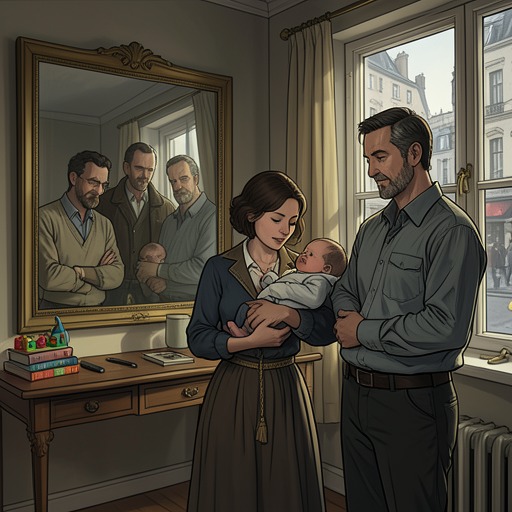
They unpack in the largest and airiest bedroom, with its stone fireplace, relatively new-looking wallpaper, and spectacular view of the ocean. The enormous canopy bed has a carved walnut headboard, and an oval mirror hangs opposite it. In the reflection, the couple appear happy and share a secret: Baby. Marilyn carefully protects her sensitive skin from the sun with a broad-brimmed straw hat, while the Playwright has been sunburned. She rubs cream onto his face and forearms and kisses the backs of his hands. In this room, the mirror reflects not only their affection but also the future they believe they are keeping between them.
The Cellar and the Miscarriage
The cellar is the house’s sharpest spatial contrast to the bedroom and porch. Low, windowless, and dirty-floored, it is reached by a wooden staircase with unsteady steps. A flashlight barely penetrates the thick curtains of cobwebs, and the air carries a pungent, sweet, damp smell like rotting apples. During the summer, the boiler there is not needed, giving the couple an immediate reason to avoid the basement. Its darkness is present in the house but can, for a time, be left below.
After three idyllic weeks at Captain’s House, a passing thunderstorm wakes the Playwright before dawn. The worst of the storm soon seems to have passed, and vaporous morning light fills the windows. Marilyn has already left the enormous bed; only her scent and a few bright hairs remain on the sheets. Her pregnancy brings sudden bouts of sleep, but she also wakes very early, driven by the thought that Baby is hungry and wants its mother to eat. The house’s quiet morning, the storm’s retreat, and the absent figure in the bed briefly frame the home as a place of ordinary domestic promise.
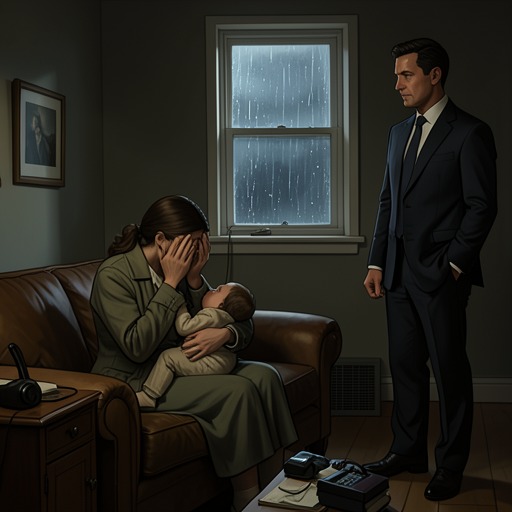
Later, while the Playwright is upstairs writing, he hears a cry and immediately understands that something has happened. He runs downstairs and finds Marilyn at the bottom of the cellar staircase, groaning and twisting in pain. The flashlight has fallen from her hand, its beam pointing into the cellar’s vague darkness. She begs him to save her and the child, gripping and pulling at his hands as if asking him to bring the baby into the world. He calls an ambulance, and she is taken to Brunswick General Hospital. The pregnancy ends in miscarriage at fifteen weeks; the date is August 10.
Narrative Significance
Captain’s House holds two opposed images of a shared life. Above, the bedroom mirror, carved bed, and ocean view give shape to the couple’s happiness and their secret hope for Baby. Below, the cellar’s unsafe stairs and obscured darkness become the setting in which that hope is lost. The house does not merely provide a backdrop for the relationship: its arrangement of inviting rooms and neglected depths gives physical form to the gap between the future the couple imagines and the suffering that overtakes them.
The sequence also changes the meaning of the domestic idyll. The porch and bedroom had made privacy feel protective, but the unconnected telephone could not make the couple self-sufficient, and the cellar could not remain an unused corner of the house. Once the Playwright hears Marilyn’s cry, the home’s spaces lead directly into emergency and separation: he summons help, and she is carried from the residence to the hospital. Captain’s House is therefore remembered both as the place where the couple tried to establish a home and as the place where their anticipated family life came to an end.