Norwalk State Hospital for Gladys
BlondeNorwalk State Hospital for Gladys is the institution where Gladys Mortensen was confined for years and where her illness became part of the official record governing her daughter’s future. More than a setting for treatment, it stood between Gladys and Norma Jeane Baker: a place whose diagnoses could be disclosed to prospective adoptive parents, whose medical judgments framed the prospect of reunion, and whose separation left Norma Jeane to imagine a mother she had not seen in a decade.
Confinement and Clinical Record
By the time Norma Jeane Baker considered visiting, Gladys Mortensen had been hospitalized for ten years. The account of her condition combines institutional language with evidence of long-term management: several courses of electroshock had substantially reduced her episodes, while an intensive medication regimen was intended to prevent depressive and manic attacks. Hospital records also stated that Gladys had not attempted to harm herself or others for years. The reported improvement was real within those terms, but it did not erase the fact of prolonged confinement or restore the mother-daughter relationship.
The hospital’s diagnosis had consequences beyond the treatment ward. When Norma Jeane was among children considered for adoption, prospective parents could be given Gladys’s diagnosis and the hospital’s account of possible neurological damage associated with alcohol and medication abuse. Norma Jeane had already been considered for adoption by three couples, despite being nine, then ten, and then eleven, and despite her mother being alive. Norwalk’s record thus followed Gladys into decisions about whether her daughter might belong to another family: private illness became information with the power to shape a child’s prospects.
The Distance Between Mother and Daughter
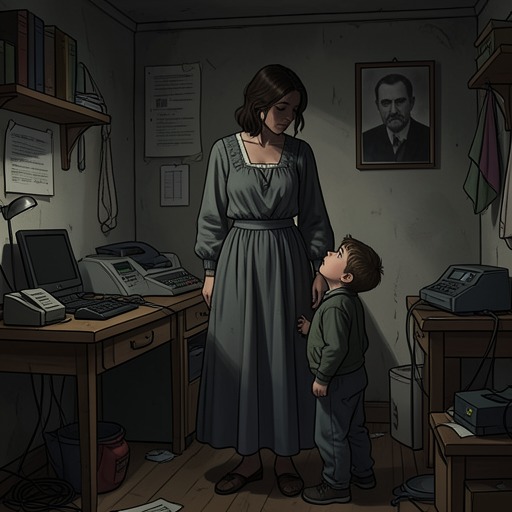
Norma Jeane Baker had not seen Gladys Mortensen for ten years when she asked whether a visit might cause difficulties. The psychiatrist’s reply turned the question back toward both of them, making the uncertainty of reunion explicit without resolving it. Norma Jeane arrived at the hospital and recognized her mother immediately: Gladys was thin and worn, dressed in a faded green gown whose hem hung unevenly or whose buttons were done up incorrectly.
The encounter did not match Norma Jeane’s later memory of a mutual embrace and shared tears. In the scene as narrated, Gladys neither returned the awkward hug nor pulled away; Norma Jeane alone wept, surprised by the force of her own emotion. She smiled at her mother repeatedly in the visiting room, where about ten strangers were also present. The hospital offered a formal place for contact, but not the intimacy Norma Jeane had longed for. She later connected the encounter with a new ability to cry on command in acting lessons, turning an involuntary response to her mother into a resource for performance.
A Promise of Return
The hospital’s role persisted in Norma Jeane’s hopes after the visit. She had promised I. E. Shinn not to tell anyone that her mother was in a psychiatric hospital, yet she believed that Gladys would one day come to live with her and had sworn that she would make it happen. Her promise held together two opposing facts: Gladys’s institutional care was a secret Norma Jeane guarded, while the possibility of bringing her mother home remained an imagined future.
That hope is presented alongside Norma Jeane’s painful awareness of their unequal bond. She remembered her mother as once young and hopeful, and imagined the baby she had been passed among strangers in a smoke-filled room. Yet she also knew that outsiders might not discover that Gladys Mortensen was her mother because they did not share a surname. Norwalk was therefore not only the address of Gladys’s confinement; it marked a separation Norma Jeane concealed even as she tried to claim the relationship.
Norwalk and the Later Hospitalization
A later crisis takes place elsewhere and should not be mistaken for a return to Norwalk. When Norma Jeane Baker went to Lakewood, Gladys had disappeared from that clinic and was found asleep in a Catholic church, confused and disoriented. Police returned her to the clinic, where Norma Jeane broke down and held her. The episode recalls the older pattern of institutional separation, but the location is Lakewood, not Norwalk State Hospital for Gladys.
Across these episodes, Norwalk is defined as much by what its records and separation do as by its treatment of Gladys. Its medical judgments affect adoption decisions; its assessment of improvement precedes a reunion that remains emotionally one-sided; and its presence in Norma Jeane’s guarded hopes reveals how the institution became inseparable from her effort to imagine a future with her mother.