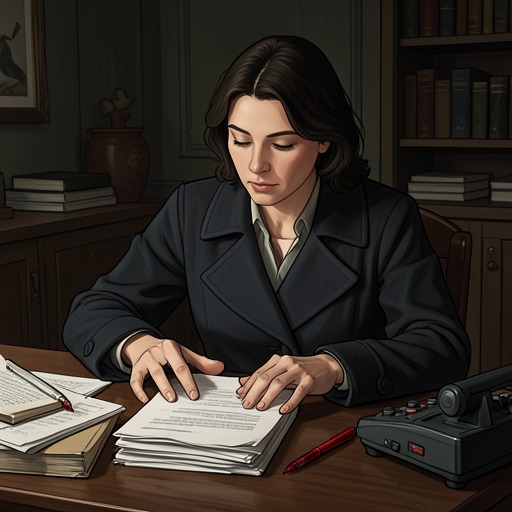
Hilda Chilmark
BloodhoundsHilda Chilmark, usually addressed as Miss Chilmark, brings a sharp sense of literary distinction and a readiness to judge others into the investigation of the Penny Black theft. Her objections to tourist buses and commercial uses of literary names sit beside a more active interest in detective fiction: she proposes that her group apply its experience of stories to an unsolved crime in Bath. Her confidence in that exercise, and her suspicion of Rupert, make her both a participant in the discussion and a source of claims the investigators must assess.
Identity and Public Disposition
Miss Chilmark dislikes Bath’s open-top tour buses, regardless of their color. Her house stands on a bus route, and she is convinced that passengers on the upper deck can look into bedrooms. Her objection is not only practical. She considers it deplorable that Jane Austen’s name should appear on the back of a bus, a judgment that presents her as protective of literary culture from what she regards as its casual commercial use.
That sensibility makes her own name being called from an amplified tour bus especially jarring. Crossing Pierrepont Street at ten thirty in the morning, she hears herself addressed from one of the vehicles she despises; the call is loud enough to carry across Parade Gardens. The episode turns her private irritation with the tours into a public encounter, and the contrast is pointed: the bus packages the city’s history and literary associations for visitors, while Miss Chilmark resists that treatment of cultural names and, unexpectedly, becomes part of the spectacle herself.
Detective Fiction and the Stamp Theft
Miss Chilmark is not merely a critic of popular presentation. At the start of a meeting, before the discussion descends into chaos, she takes the initiative and suggests using the group’s experience of detective stories to consider the theft of the stamp from the Postal Museum. She explains that a report in the Chronicle made the crime seem particularly suited to their interests: for once, they could test their reasoning against a real unsolved case in their own city.
The proposal reveals an important distinction in her approach. She values detective fiction not just as a source of literary pleasure but as a method of thought that might be brought to bear on actual events. Yet the meeting’s subsequent disorder also marks the limits of that ambition: applying fictional detection to a real crime does not ensure that the conversation will remain orderly or that suspicion will become proof. Her interest therefore connects the group’s literary identity to the police inquiry without making her judgments equivalent to a solution.
Suspicion and Judgment
When Shirley-Ann Miller reports that a detective considered the crime the work of someone of high intelligence, Miss Chilmark’s visible outrage eases. She counters that the act suggests low cunning instead and says she knows whom she suspects. Asked whether she means Rupert, she confirms that he is her choice, treating him as the obvious candidate.
The exchange shows both her decisiveness and the difference between a theory and established evidence. She moves quickly from a general assessment of the crime to a named suspect, while the investigators’ work requires them to test what can be known. Her response also resists the flattering implication that the theft demonstrates exceptional cleverness: she recasts apparent sophistication as mere cunning. The scene gives her a firm interpretive voice, but it does not establish that her suspicion is correct.
Property and the Investigation
The inquiry also turns to Miss Chilmark’s house and finances. Julie Hargreaves seeks information from a bank, but confidentiality rules prevent the bank from disclosing anything without authority. She does obtain details through an estate agent other than the one Miss Chilmark used, noting that local agents know one another’s business. According to that information, the house was sold to Mrs. Nugent-Thomas in January 1993 for £330,000, with a clause allowing Miss Chilmark to remain there as a tenant for life.
That arrangement separates ownership from continued residence: the property has been sold, but the clause secures Miss Chilmark’s right to stay for her lifetime. The sale gives the investigation a concrete financial and domestic circumstance to examine, while the bank’s refusal leaves other financial details undisclosed. The house thus connects the public figure encountered on the bus route with a less visible matter of property, tenancy, and restricted financial information; the evidence presented establishes those circumstances without, by itself, resolving what they imply about her motives or position.
Narrative Role
Miss Chilmark links the novel’s debate about detective stories to the practical uncertainty of investigating crime. Her literary standards appear first in her disdain for the bus’s use of Jane Austen, then in her confidence that the group can apply its knowledge of fiction to the Postal Museum theft. That connection gives her more than a role as an eccentric complainant: she articulates why the crime attracts the group and how they hope to approach it.
At the same time, her suspicion of Rupert demonstrates the hazards of turning interpretive confidence into accusation. She speaks with certainty, but the account of her view remains distinct from proof. The novel places her cultural judgments, investigative enthusiasm, and private property arrangements alongside one another, leaving the reader to see both the force and the limits of her perspective.