Peter Diamond
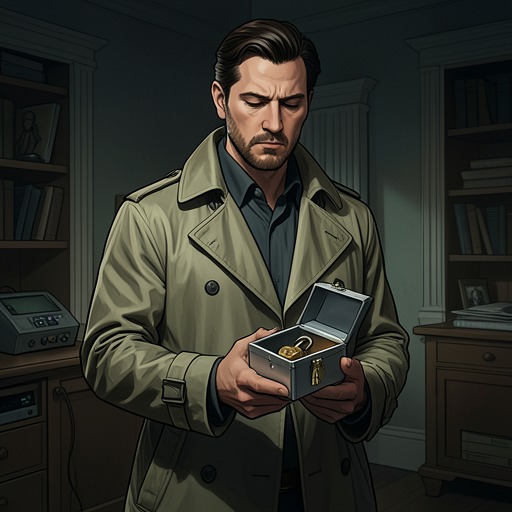
BloodhoundsPeter Diamond, Detective Superintendent and head of the murder squad, is the investigator at the center of the linked Penny Black theft and Sid Towers murder cases. His importance lies not in an effortless display of certainty but in the way he works through an apparent impasse: he separates the question of how a locked room could be staged from the harder question of who was responsible, and eventually connects the theft, the padlocks, and Sid’s fatal encounter aboard Milo Motion’s boat.
Rank and Introduction
Diamond first appears being driven toward Bath along the Keynsham bypass in the rear seat of a police car, with the headlights on full beam, blue light flashing, and siren sounding. His warning to the driver about foolish motorists, answered by the driver’s reminder that everyone can hear them coming, establishes an impatient, direct voice in the middle of urgent police work. The scene makes his authority visible through his role in a speeding response, while his blunt exchange keeps him grounded in the practical hazards of the job.
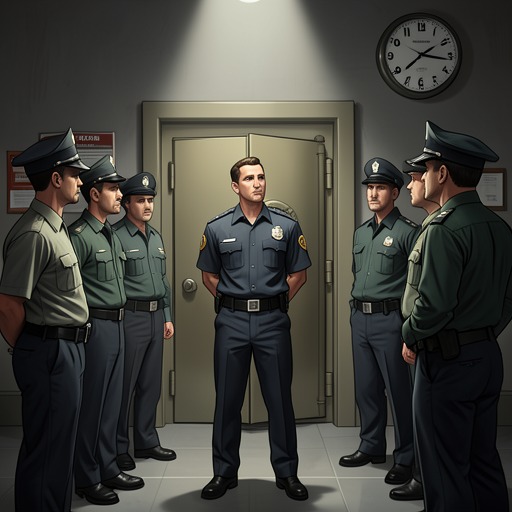
At the police station, the Assistant Chief Constable greets him as though the assembled officers are waiting for news Diamond has not yet received. Later, Diamond goes looking for John Wigfull with a scrap of newspaper in his pocket, reminding himself what he had written before entering an office crowded with faxes and files. Wigfull, hunched over his desk and preparing for a press conference, looks exhausted and bloodshot. Diamond recognizes the strain and feels sympathy, but also makes clear that he has come because of the press conference. The moment places him alongside a rival investigator without reducing their professional relationship to simple antagonism: he notices Wigfull’s condition even as he pursues his own purpose.
The Cases Converge
The investigation changes scale when Diamond announces that Sid Towers, a forty-six-year-old night watchman, has been murdered. Towers was last seen alive in central Bath at 8:45 p.m.; his body was found at about one in the morning aboard a narrowboat at Dundas Boatyard. He had been struck on the head with a heavy object, possibly a spanner, which had not been recovered. The divers were already searching the water, although Diamond doubted that the killer had simply thrown the weapon away.
The locked cabin makes the murder inseparable from the stamp theft. Milo Motion had locked his boat at 6:45 p.m. to attend a meeting in Bath; when he returned with Wigfull, the padlock was still in place and the victim was inside. The Penny Black had also been handed in by Milo. Diamond presents the murder and theft as linked rather than as separate incidents, and the apparently intact lock turns the boat into a puzzle as well as a crime scene. His early account makes the essential contradiction plain: the cabin had been secured, yet a killing had taken place within it.
Diamond’s work is not confined to the puzzle’s ingenious surface. By midday, reports from interviews with Bloodhounds members and preliminary findings from the Scenes of Crime team are arriving faster than two civilian computer operators can process them. He delegates the autopsy to Julie Hargreaves, ostensibly as a request but in practice as an order. The reason is personal and concealed: Diamond cannot bear the sight of a dissecting knife, a weakness known to most of his colleagues, and has repeatedly found ways to avoid post-mortems. His command of the investigation therefore coexists with a carefully managed vulnerability; he gets the necessary work done by assigning it to someone he trusts.
Testing the Locked-Room Story
Diamond interviews Milo repeatedly, including a third interview after lunch. Milo is temporarily staying at a bed-and-breakfast opposite Manvers Street Police Station and wants to know when he can return to his floating home. Diamond brings him back to the padlock and the seeming impossibility of the murder. Milo insists that the boat was secure and that someone must also have broken in earlier to plant the stamp in his copy of John Dickson Carr. Diamond rejects the unsupported break-in theory: no door or window shows interference, and nothing has been broken. He is careful not to let a proposed explanation become a fact simply because it would make the puzzle easier.
The accumulating evidence nevertheless leaves him feeling boxed in. The questions include an apparently impossible murder, a dead man associated with riddles, and Hilda Chilmark’s unexplained financial circumstances. Diamond’s earlier confidence that Sid had written the Penny Black riddles is unsettled when he learns that the writing on the paper bag is only a list of rhyming words, not finished verses. He calls the evidence conflicting and decides that the investigation needs the whole picture, not another quick choice among suspects.
That decision sends him and Julie to speak with Shirley-Ann Miller. Diamond regards her as the least likely suspect at that stage, but potentially the most useful witness: as a newcomer to the Bloodhounds, she may have noticed the members’ antagonisms, suspicions, alliances, and connections before familiarity dulled her attention. He reasons that her observations across the meetings might illuminate events leading to the murder. This is a characteristic shift in method: instead of forcing the available clues into a single theory, he seeks a fresh account of the group’s relationships.
The brown paper bag supplies another strand. Sid had produced it when Hilda Chilmark was hyperventilating at a meeting, and Jessica Shaw used it to help her recover. Jessica kept the bag in case the episode recurred, then forgot it in her handbag; Diamond recovered it and showed it to his colleagues. The bag itself is not the point. Its surface bears the list of rhyming words that had supported the theory about Sid and the riddles, but Diamond later recognizes that this is not conclusive proof of authorship. The object’s changing significance illustrates the case’s central evidentiary problem: a clue can be real without proving the interpretation first attached to it.
The Breakthrough and Reconstruction
Diamond eventually separates the mechanism of the locked room from the identity of the murderer. While discussing the case with Julie, he offers an alternative account in which the killing was not planned. The Penny Black’s extraordinary appearance had drawn Sid, a devotee of locked-room puzzles, to inspect the narrowboat. Diamond’s decisive response comes when Julie asks what the murderer was doing there. Her question gives him the missing route into the puzzle: it redirects attention from how someone could escape a sealed cabin to why the person responsible was at the boat at all. He recognizes that Julie has supplied the solution to the locked-room mystery without naming the culprit.
The physical evidence keeps the solution from being a purely abstract trick. Among Sid’s bagged possessions is a padlock of the same make as the one on the boat. Wigfull objects that this cannot settle matters: the boat’s padlock was still on the door when they opened it, Milo had only one key, and the divers had recovered Milo’s old keys from the canal. The locksmith had also said that identical keys could not explain the apparent substitution. Diamond has to account for this history of tested and rejected theories, not merely point to a resemblance between two locks.
In his later reconstruction, Diamond describes a scheme that had been meant to impress Hilda Chilmark. A.J. had given her much of the money he had taken from her, but sought a more spectacular demonstration of cleverness. The Penny Black theft, its appearance at the Bloodhounds meeting, the riddles, and the padlock business were parts of that display. The plan went wrong when Sid, fascinated by the locked-room puzzle, came along the towpath while A.J. was replacing the padlock. Diamond believes A.J. heard him, hid inside the cabin, and seized a windlass as a weapon. Panicked and frightened, A.J. struck Sid, probably intending to incapacitate him rather than kill him; the blow proved fatal. Diamond’s account makes the murder a consequence of discovery, followed by actions intended to conceal what had happened.
Investigative Character and Narrative Role
Diamond’s investigation repeatedly turns on the difference between a persuasive story and a demonstrated fact. He corrects Milo’s claim of a break-in because the doors and windows provide no evidence for it; revises his confidence about Sid’s authorship when the bag’s writing proves less conclusive than he had thought; and admits to Wigfull that he has solved how the locked-room effect was achieved without yet knowing who did it. His progress is therefore not a straight march from clue to answer. It depends on acknowledging what remains uncertain, then asking a better question.
His relationships within the squad reinforce that method. He gives Julie Hargreaves responsibility for the autopsy despite his own aversion, asks for her assistance in sorting the case, and credits her question with the breakthrough. With Wigfull, he combines rivalry and scrutiny: he watches the chief inspector’s silence during a discussion of evidence, but also recognizes the burden of the press conference and the investigation. In the end, Diamond’s defining strength is his ability to revise the frame of a problem. The locked boat initially appears to demand a trick of entry and escape; his solution makes the decisive event a confrontation at the moment the padlock was being changed. The puzzle’s ingenuity remains, but its answer is inseparable from fear, an unintended death, and the cover-up that followed.