Arnold Musgrave
BloodhoundsArnold Musgrave is a senior officer in Avon and Somerset police whose genial manner makes him a receptive audience for competing police theories. In the investigation surrounding the Penny Black theft and the apparently locked narrowboat, he is present first as John Wigfull’s confident superior and later as the official confronting the collapse of a neat explanation. His characterization depends less on detective work of his own than on the contrast between his fair-minded receptiveness and the certainty of the men who bring him their conclusions.
Position and Character
By common consent, Musgrave is the most approachable of Avon and Somerset police’s three assistant chief constables. His florid face and portly build attest, in the narrator’s wry description, to convivial pints shared with colleagues. More important to his professional character, he is a good listener, fair in his dealings, and appreciative of work well done. The combination makes him an apt senior presence when an investigation appears to have reached a decisive moment: he can hear a case out without his rank making the encounter feel like a foregone verdict.
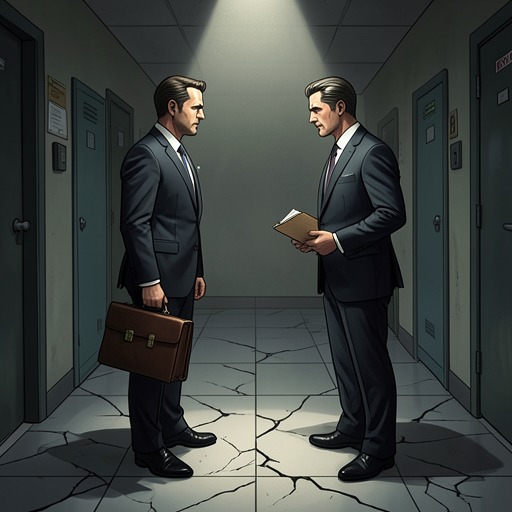
That receptiveness is visible in his exchanges with Wigfull and Peter Diamond. When Wigfull invokes the detective stories of John Dickson Carr, Musgrave admits that he reads such books but does not retain their authors or plots. He then notices Diamond at the door and greets him warmly. The exchange gives Musgrave a lightly comic ease, but also places him between the two detectives’ contrasting positions: Wigfull arrives with the air of a man expecting recognition, while Diamond says he is beset by problems. Musgrave’s friendliness does not settle the dispute; it lets both claims enter the room.
Hearing Wigfull’s Theory
Wigfull lays out a planned sequence behind the Penny Black theft. He distinguishes the theft itself from the later events on the narrowboat, arguing that the crime began the previous week: a mistaken tip-off from Bristol came on Thursday, the first rhyming riddle followed on Friday, and the stamp was stolen that same morning. In his account, the tip-off to Sergeant Plant, the riddles, the theft at the Postal Museum, and the planting of the stamp in Milo Motion’s copy of The Hollow Man all dovetail. He portrays the operation as a high-risk scheme designed to return the stamp after making fools of the police and the Bloodhounds.
Musgrave’s presence gives Wigfull’s presentation an institutional audience, but the assistant chief constable is not simply swept along by its theatrical confidence. When Wigfull describes the planning as worthy of the SAS, Musgrave remarks that most crimes are planned. The dry response punctures the flourish without dismissing the possibility of a larger design. It marks him as a listener who can distinguish a claim’s persuasive performance from the evidence offered for it.
The Bag and the Competing Case
Diamond’s intervention shifts the scene from Wigfull’s account to an object recovered from Jessica Shaw. He explains that the brown paper bag had been used on Monday evening when Miss Chilmark was hyperventilating. Sid Towers had produced it and handed it to Jessica, who held it against Miss Chilmark’s face; after the attack stopped, Jessica kept it in case the trouble recurred. Miss Chilmark remained at the meeting, and in the confusion afterward Jessica put the bag in her handbag and forgot it. Diamond recovered it that afternoon.
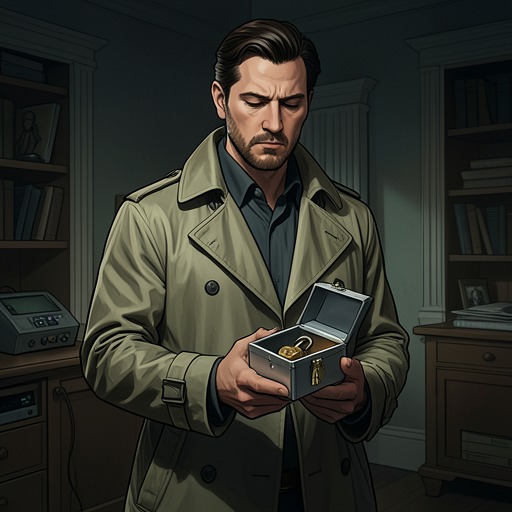
Musgrave asks whether the bag matters. Diamond distinguishes the object from what can be seen on it, smooths it against Wigfull’s desk, and passes it to Musgrave. This small, carefully staged exchange places the senior officer in the role of examiner: Wigfull’s theory has been stated, Diamond has answered with a specific item and its chain of custody, and Musgrave is invited to look. The evidence catalog records the handover, not the subsequent interpretation, so the significance of the markings cannot be specified here. What the scene does establish is that Musgrave receives the challenge directly rather than relying on Wigfull’s confident summary.
The Reversal and Narrative Role
Later, Musgrave sits behind his desk with his hands covering his eyes while Wigfull and Diamond watch, aware that the explanation they had patiently assembled has been unraveled. He takes a deep breath, draws his fingers down his face, and rests his chin on clenched fists before summing up the position: the inquiry has returned to the locked-room mystery with which it began, and Wigfull’s neat theory about the narrowboat has been blown apart. Wigfull answers with a sideways glare at Diamond, revealing that the reversal has not ended the rivalry between the investigators.
Musgrave’s response gives the reversal its official weight. Earlier, his office seemed an auspicious place for Wigfull to wrap up his part of the case; now the same senior figure voices the loss of that apparent solution. He does not claim to have solved the mystery. Instead, his fairness and willingness to listen make him a measure of the investigation’s changing state: a theory can sound complete before the facts sustain it, and a confident account can return the police to the very puzzle it seemed to have explained.