Milo Motion
BloodhoundsMilo Motion’s enthusiasm for detective fiction turns into an unsettling proximity to real crime: the Penny Black appears in his book during a Bloodhounds meeting, and Sid Towers is later found murdered aboard Milo’s narrowboat. A retired civil servant and habitual joiner of clubs, Milo is at once the group’s literary showman and a central witness in the police investigation.## Identity and Social Presentation Milo prefers to be addressed by his first name and dislikes his surname because, as he explains, schoolmates at prep school used it to call him unpleasant things. His preference contrasts with Miss Chilmark’s pride in a surname associated, according to her, with seven centuries in the West Country. The exchange establishes two different ways of carrying a name: Milo would rather loosen its hold on him, while Miss Chilmark treats hers as an inheritance worth defending.
Polly Wycherley describes Milo as someone who probably attends the Bloodhounds for companionship, while adding that he joins nearly every organization he can. He is a long-standing member of the Sherlock Holmes Society and belongs to societies devoted to Agatha Christie, Dorothy Sayers, Edgar Wallace, and the Saint, among others. The breadth of his memberships makes the Bloodhounds one part of a wider social life organized around crime fiction. Polly also identifies him as a retired civil servant, a detail that places his enthusiasm in retirement rather than in a professional detective’s work.
Milo’s literary interests are not merely conversational. He brings books to meetings and performs the role of an eager presenter: before the Bloodhounds, he brandishes The Hollow Man and introduces its locked-room chapter as a special reading. His relish for the occasion gives the meeting the atmosphere of an amateur detective-fiction ritual, even as the book produces evidence in a real investigation.## The Meeting and the Penny Black At a Bloodhounds gathering in a church crypt, Milo prepares to read chapter seventeen, titled The Locked-Room Lecture. He describes the kind of setting he would have preferred for the chapter: an after-dinner gathering around a lamp, with wine and coffee and snow outside. The crypt is his less-than-ideal substitute, but he treats the reading as an event for which his audience has been prepared.
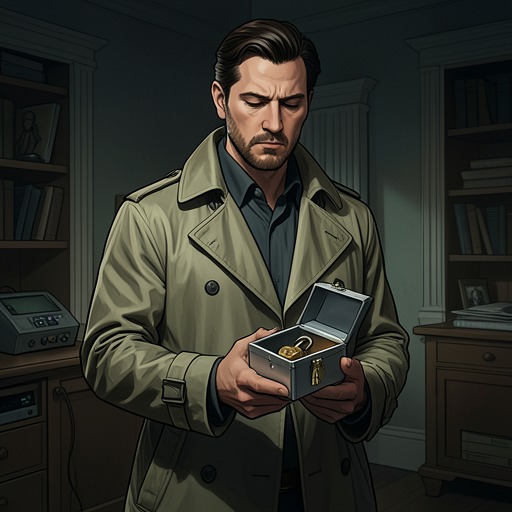
When he opens the book, however, he notices an envelope between its pages that he does not remember using as a bookmark. The envelope is yellow with age, and its copperplate address has faded almost beyond legibility. A Penny Black, bearing Queen Victoria’s head against a black background, remains attached; a PAID cancellation mark and a clear BATH postmark are also visible. The discovery interrupts Milo’s planned performance and places an extraordinary historical stamp in the hands of a group gathered to discuss fictional puzzles.
Milo subsequently walks into Manvers Street Police Station to report that the missing Penny Black has come into his possession. He says it turned up in a book while he was reading from it at a Bloodhounds meeting and that he does not know how it got there. Peter Diamond’s response links the recovery to a second crisis: a body has also been found. The stamp’s appearance in Milo’s book therefore does not conclude the theft investigation; it makes his book, his account of the meeting, and the circumstances of its discovery matters for police inquiry.
During a later interview, Milo identifies the book as the first English edition of The Hollow Man, published by Hamish Hamilton in 1935. He says his copy has no wrapper, which would otherwise make it worth a few pounds. Its bibliographical identity gives the object a particularity beyond its role as a hiding place: it is a cherished example of the kind of detective fiction whose puzzles Milo enjoys, now entangled with an actual theft.## The Narrowboat and Sid Towers’s Death After the meeting, Sid Towers is found dead aboard Milo’s narrowboat, the Mrs. Hudson. Milo is not there. The Bloodhounds know that he has gone directly to the police station about the stamp, and Polly reasons that Sid knew Milo would be away for some time while officers questioned him. Shirley-Ann Miller likewise concludes that the group’s members were among the few people who knew the boat would be unoccupied. These are the group’s deductions, not proof of who attacked Sid, but they make Milo’s absence a crucial condition of the crime.
Polly notes that Sid was not alone on the boat: the attacker was there too. Shirley-Ann reconstructs the circumstances from the meeting, Sid’s journey to the boatyard at Limpley Stoke, and the discovery of his car nearby. The explanation for Sid’s visit remains uncertain in their conversation. Diamond proposes that Sid, a student of locked-room puzzles and trained in security, may have gone to inspect the boat out of curiosity and work out how the apparent locked-room problem had been achieved. Polly agrees that this is possible, but the motive is presented as a theory rather than an established fact.
The boat’s security is the central difficulty in Milo’s interviews. He has maintained that it was completely secure, yet a murder took place inside. When Diamond raises the contradiction, Milo says that the event is beyond his understanding and suggests that someone must have broken in earlier to put the stamp inside his copy of John Dickson Carr. Diamond counters that there is no evidence of an earlier entry: no door or window was interfered with and nothing was broken. Milo’s explanation thus articulates the apparent puzzle, while the physical inspection described by Diamond resists the break-in scenario Milo proposes.
After lunch, Diamond interviews Milo for the third time. Milo is temporarily staying in a bed-and-breakfast opposite Manvers Street Police Station and has come to ask when he can return to his floating home. The interview’s small, practical purpose—finding out when he can go back—sits against the unresolved murder investigation. Diamond observes Milo’s abundant black beard and challenging tilt of the chin, registering a conspicuous physical presence in a conversation where Milo’s central account is that he cannot explain what happened.## The Padlock and the Investigation The padlock becomes the concrete object around which Milo’s claim of security can be tested. He has shown the Bloodhounds its key, explained where he bought it, and said that obtaining a spare was impossible. Later, Diamond returns to the boat’s lock with Wigfull and asks him to compare it with a padlock bagged among the dead man’s possessions. Wigfull recognizes the same make but points out that the comparison alone proves little: the lock on the boat was still there when it was opened, Milo had only one key, and the locksmith had said that identical keys could not be made.
One complication is the recovery of Milo’s old keys from the canal by divers. As Wigfull recalls, the recovered set fitted Milo’s padlock. That fact supports the claim that Milo’s missing keys had been in the water, but it does not by itself explain the murder or the stamp’s placement. Diamond’s effort to test the other padlock against the boat’s lock shows the investigation moving from a general locked-room dilemma toward comparison of physical evidence. The lock is no longer simply the device Milo says made entry impossible; it is an object whose identity, keys, and relation to the boat must be examined.
The circumstances repeatedly make Milo’s account important without establishing that he understands the crime. He reports the stamp, owns the book in which it is found, describes the boat as secure, and is away from it at the time Sid is killed. Each fact connects him to a question the police must answer, but the supplied evidence does not make him the attacker or resolve the full mechanics of the crimes through his testimony. His position is that of a witness whose possessions and routines have become part of the evidence.## Character and Narrative Role Milo’s attachment to locked-room fiction gives the story an ironic point of contact between literary puzzles and criminal investigation. He prepares to read about an impossible enclosure; soon afterward, the boat he calls secure becomes the setting of a murder that appears to reproduce the same kind of problem. He is not simply a reader standing outside the puzzle. The book that anchors his reading contains the missing stamp, and the boat that gives the group its Christmas-party setting becomes a crime scene while he is absent.
That overlap also distinguishes Milo’s enthusiasm from police knowledge. The book offers an elegant fictional model, and Milo proposes an earlier break-in as a possible explanation, but Diamond insists that the doors and windows show no sign of one. Likewise, Milo’s confidence in the padlock’s security cannot settle how the murder occurred. The detective-fiction devotee is surrounded by the materials of a puzzle—an old stamp, a valued edition, lost keys, and a locked boat—yet each object demands physical scrutiny rather than the satisfaction of a literary solution.
Milo consequently occupies several roles at once: club member seeking companionship, advocate for detective fiction, owner of the recovered stamp and the narrowboat, and witness repeatedly questioned by Diamond. His return to the police station and his wish to return home keep ordinary needs visible within an investigation increasingly shaped by apparently impossible arrangements. The contrast gives his character its narrative force: a man accustomed to gathering around fictional mysteries finds the boundaries between story and evidence collapsing around the very book and boat that organize his life.