Sid Towers
BloodhoundsSid Towers first appears as a figure almost designed to escape notice: a quiet member of the Bloodhounds whose private curiosity carries him from the club’s discussion of detective fiction to the locked boat where he is killed. His apparent insignificance is central to the mystery. He contributes little to the group’s conversations, yet his interest in the puzzle exposes the crime’s hidden mechanism and brings him into direct contact with its perpetrator.
Identity and First Impressions
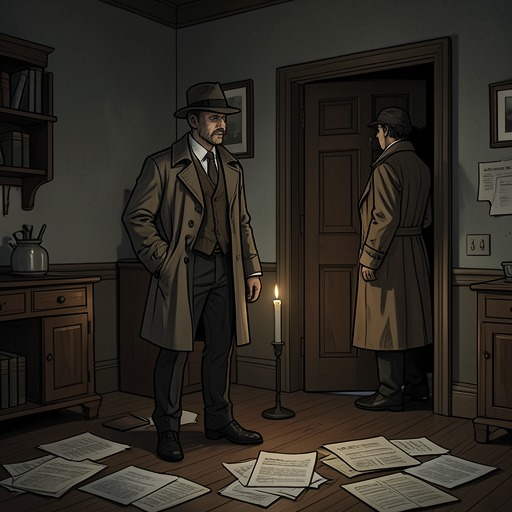
At a Bloodhounds meeting in St Michael's Church Crypt, Sid is already present when Shirley-Ann Miller arrives. He steps out from behind a pillar in a fawn raincoat and raises a hand in a gesture that Shirley-Ann reads as an awkward, almost defensive wave. He says nothing, and the other members pay him little attention. The moment establishes the difficulty of reading him: he is physically there, but behaves as if he would rather not be seen.
His silence breaks briefly when the group discusses crime and burglary. After Rupert Darby challenges the others about whether any of them have ever had a house burgled, Sid answers that he has. The single word turns heads precisely because he is so inconspicuous. He then lowers his eyes to the flat cap on his knees and gives no further explanation. Shirley-Ann, who has until then overlooked him, studies him more closely: his shoulders are bowed, but his frame seems powerful; his eyes are hooded and blue-grey, and his teeth small and even. His reserve, rather than any obvious feature of his appearance, is what makes him difficult to approach.
Place in the Bloodhounds
Sid belongs to the Bloodhounds, a literary society that meets to discuss detective stories. The evidence presents him as a regular enough presence to be included in the group, but not as an active conversationalist. Polly Wycherley later describes him as dead wood because he contributed very little. The remark is particularly uncomfortable in retrospect: it reflects how easily his quietness was mistaken for a lack of importance, even by people who knew him.
That limited participation is not the same as a lack of interest. Sid is especially absorbed by locked-room puzzles, and his knowledge of detective fiction gives him a distinctive way of responding to the club’s discussion. When Milo Motion reads from a book on that subject, the missing Penny Black is found between its pages. The discovery turns a literary meeting into a real mystery, and Sid’s enthusiasm for the puzzle soon takes him beyond the role of a passive listener.
Work, Home, and Private Circumstances
Sid is forty-six and works unsocial hours as a night watchman. The investigation also establishes that he lived in a modest, depressing flat in Oak Street, in the shadow of the viaduct. These details give his unobtrusive presence a material context: he is not introduced as a celebrated detective or a man of obvious social standing, but as someone with a night job and an unremarkable home.
His earlier burglary comes up as the investigators consider whether it might explain a breakdown, but no cause is established. Nor do they find evidence that he received appreciable sums of money. These uncertainties matter because the detectives test several possible explanations for his death, including blackmail, without treating speculation as fact. What does become clear is that Sid had both an interest in security and a particular appetite for the kind of intellectual challenge the boat seemed to present.
The Locked-Boat Mystery and His Death
After the Penny Black appears in Motion’s book, Sid becomes fascinated by the apparent locked-room puzzle aboard the narrowboat. Detective Peter Diamond considers whether Sid drove to the boatyard simply to satisfy his curiosity and work out how the supposed impossibility had been managed. The boat’s padlock had been presented as secure, with no spare key available; to a student of locked-room mysteries who also had security training, the discrepancy between the locked boat and the body inside was an invitation to investigate.
Diamond’s eventual reconstruction places Sid at the boat while A.J. is replacing the padlock. Sid approached along the towpath and encountered the person responsible for the deception. Diamond believes A.J. heard him coming, hid inside the cabin, and took the boat’s windlass as a weapon. Sid was struck over the head. Diamond’s account allows that the blow may have been intended only to incapacitate him, but it killed him; the subsequent actions were taken to cover up what had happened. The murder, on this reading, was not planned in advance. Sid died because his curiosity brought him to the scene and he discovered what the criminal was doing.
Narrative Role and Aftermath
The circumstances of Sid’s death make him more than the victim at the center of a locked-boat puzzle. The apparent impossibility draws attention to the mechanics of the crime, while his known interest in that very kind of mystery supplies a plausible reason for his presence at the boatyard. His intellectual enthusiasm, initially visible only in the context of a book-club discussion, becomes the link between the staged puzzle and the murder.
His quietness also shapes how the people around him interpret events. At the meeting, a one-word answer is enough to startle the room; later, the investigators learn that he had made an independent decision to examine the boat. The contrast is not that Sid suddenly becomes a detective, but that the group’s underestimation of him leaves his curiosity easy to overlook until it has fatal consequences. His death turns the Bloodhounds’ fictional subject into a real crime, and the puzzle he went to solve helps Diamond understand how the locked-room deception worked.