Gilbert Jones
BloodhoundsGilbert Jones, known as Bert and as Bert Jones, is revealed as the criminal who converts the Bloodhounds’ fondness for detective puzzles into a real campaign of theft, framing, and murder. His apparent challenge to the group’s intelligence is not merely a game: as he acknowledges, it is revenge, and the people caught in his design suffer consequences that no fictional puzzle can contain.
Identity and Public Position
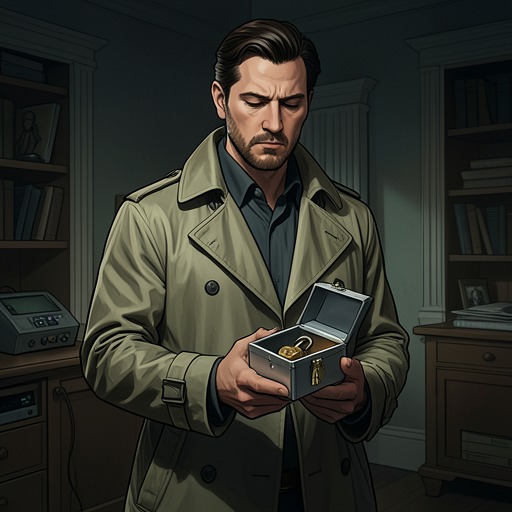
Jones is an employee of the Sports and Leisure Center. During the emergency search for Julie Hargreaves, Peter Diamond describes him to officers as about thirty, five foot nine, dark-haired and brown-eyed, with a bodybuilder’s physique. He is thought to be wearing a dark blue tracksuit. The police do not know him to be armed, but suspect him of violent crimes and are told to treat him with extreme caution. The description turns an ordinary workplace connection into a practical lead in a search involving two missing people.
At the recorded interview, Diamond asks whether his full name is Gilbert Jones, since most people know him as Bert. Jones answers with a nod. The exchange establishes that Bert is not a separate identity but the familiar name behind the suspect’s formal one. Diamond also identifies him as having joined the Bloodhounds four years earlier under the name Gilbert. That detail connects his public place in the group to the identity he later uses in the police interview: he had not simply wandered into its orbit under an assumed name.
The Bloodhounds and the Revenge
Jones agrees with Diamond’s account that he chose to confront the group with a genuine locked-room puzzle, hoping to prove that a reader of James Bond could frame its members using one of their favourite plots. The agreement is qualified—Jones says it was something like that—but Diamond’s formulation captures the performance Jones wanted: to turn the group’s intellectual pleasure into a demonstration of his own superiority.
The interview also strips that performance of its harmless appearance. Jones’s actions were never merely an intellectual exercise; Diamond identifies them as revenge by a deeply embittered man. The distinction matters because Jones has borrowed the structure of a story while acting in a world where other people can be injured or killed. His puzzle is not simply a test with a clever answer. It is a means of making the Bloodhounds participants in a danger they did not choose.
Theft and the Locked-Room Scheme
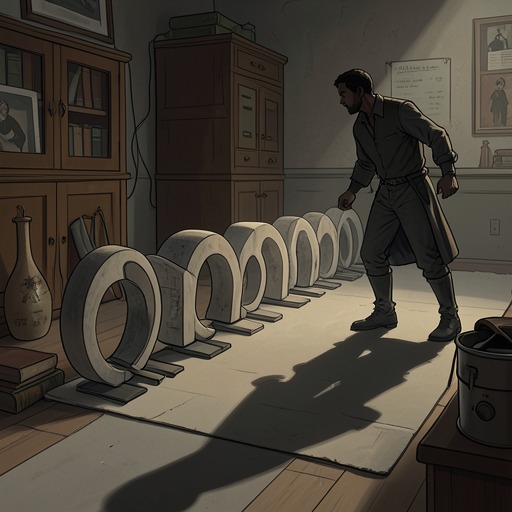
Diamond reconstructs how Jones could have stolen the Penny Black from the Postal Museum. The proposed opportunity is a morning when window cleaners were out in force: Jones could use a ladder and bucket without attracting notice, especially because morning jogging already formed part of his routine. Diamond further proposes that Jones had visited the museum beforehand and identified a weakness in its security, then placed the ladder at the window, entered, and taken the stamp. In this passage, these details are presented as Diamond’s account and put to Jones for confirmation, not as a separately narrated scene of the theft.
That reconstruction gives the scheme its material counterpart to the locked-room idea. The puzzle’s apparent ingenuity depends not on an impossible crime but on advance observation and an ordinary disguise for unusual activity. Jones’s ambition is to make the group see a real crime through the conventions they enjoy in fiction—and to make the apparent solution reflect on their ability to solve it.
Sid Towers and Rupert Darby
Jones’s design is disrupted when Sid Towers becomes curious and drives to the boatyard while Jones is replacing the original padlock. Diamond tells him the plan would have been a perfect crime if Sid had not arrived at that moment. Jones does not deny the encounter. He admits that he struck Sid from behind, saying he had wanted only to get away and believed Sid had not seen him. He adds that, had Sid survived, the police would have been none the wiser. His explanation distinguishes the immediate purpose of the blow from its fatal consequence, but it does not undo the violence: a real witness, rather than a fictional obstacle, has been left dead.
Rupert’s killing is different. Diamond presses Jones on why Rupert had to die when he had not insulted Jones’s intelligence and had not even belonged to the Bloodhounds when Jones joined. Jones’s answer is chillingly practical: Rupert was a stranger. Because Jones had never met him, the choice was not constrained by a personal history or a prior dispute. Diamond says Jones marked Rupert with spray paint and recognized him by his beret; Jones’s plan was to have someone else blamed for the graffiti. He identifies Rupert as a better choice than Jessica, with the death made to appear to be suicide. Unlike Sid’s death, which Jones describes as unintended, Rupert’s was planned.
Arrest and Narrative Role
After the ordeal on the roof, Julie Hargreaves insists on attending Jones’s interview despite being entitled to go off duty. She still wants answers. Jones sits with his arms folded, maintaining a defiant posture while Diamond proceeds through the formalities of the recorded interview. The contrast between that performance and the accumulating admissions gives the questioning its force: the man who wanted to prove that no one else could solve his puzzle must face the consequences of its solution.
Jones’s role exposes the moral gap between detective fiction and real crime. He borrows a locked-room plot to frame people, but his supposed proof of cleverness entails an opportunistic assault, a death he did not intend, and a second killing arranged to redirect suspicion. His reasoning about Rupert—strangerhood as a reason for choosing him—shows how completely the puzzle has displaced ordinary human regard. The interview does more than identify the offender: it reveals that the challenge was revenge disguised as an intellectual contest, and that the distinction between a solved fictional mystery and an actual crime is measured in lives.