Barnaby Shaw
BloodhoundsBarnaby Shaw is Jessica Shaw’s husband, a maker of miniature ceramic buildings, and an important financial supporter of the Walsingham Gallery. His role joins domestic life, business, and the gallery’s precarious finances: he is present at its sales table, helps sustain its operations, and becomes a person Peter Diamond checks on as the inquiry turns back toward the suspects and their movements. The available scenes present him less as a forceful public figure than as a quiet, practical participant whose connections carry more weight than his sales tally suggests.
Identity and Introduction
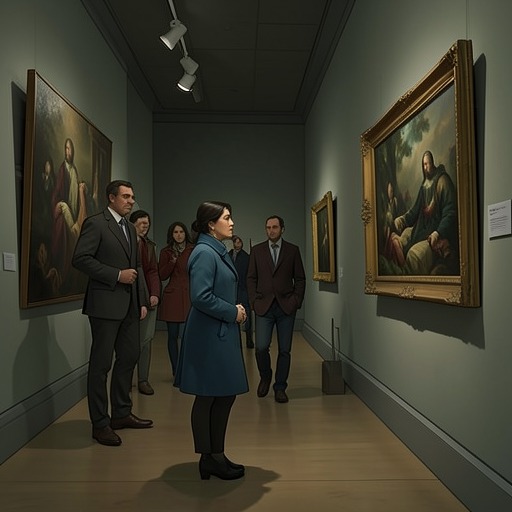
At a gallery gathering, Shirley-Ann Miller meets Barnaby when Jessica introduces him as her husband and indicates that he is supposed to be handling sales. Jessica moves on quickly, leaving Shirley-Ann to discover him seated behind a table with an account book. He is described as about forty-five, tired-looking, with tinted brown hair and a dark-blue, broad-white-pinstripe suit. The narration’s comparison of the suit to clothing worn by MPs on the far right of the Tory party is an impression of his appearance, not evidence of his political affiliation.
A.J. is beside Barnaby, in charge of the cashbox, and the two seem relaxed together. Their ease is visible in the division of work: Barnaby sits with the accounts and reports that he has sold three pieces, while A.J. is attending to the money. A.J. complains that none of his own work has sold and disparages the pen-and-ink drawings that do attract buyers. Barnaby’s small sales total gives the scene a concrete measure of the gallery’s commercial limits, even as the pair continue to manage its event.
Work and the Gallery
Barnaby runs a ceramics business from a rented unit at the Locksbrook Trading Estate, west of the city. When Diamond visits, he waits in a showroom filled with miniature buildings: houses, stately homes, churches, pubs, and castles arranged on slowly revolving display stands. The finely made stock makes the room difficult for the large, clumsy detective to navigate. On entering Barnaby’s managerial suite, Diamond trips on an Afghan rug and nearly pulls Barnaby down with him; china rattles, but none of it breaks. The awkward mishap places Barnaby amid the fragile, carefully fashioned products of his trade without turning the encounter into a damaging accident.
His work and his support for Jessica’s gallery are linked but distinct. Barnaby says that he helps with the gallery financially and has a large stake in the business. He explains that Jessica might struggle to keep it operating without his help, while his own ceramics profits could not cover its costs. He contributes when he can, but describes the overheads as substantial, identifying business rates, heating, and publicity among the expenses. A.J. takes care of those practical matters. Barnaby’s role is therefore not merely that of an exhibitor hoping to sell his own work: he helps underwrite an enterprise whose continuing operation depends on support beyond the income from his ceramics.
Marriage, Absence, and the Inquiry
Diamond asks Jessica whether Barnaby was at home when she returned that evening, seeking someone who could confirm when she arrived. Jessica says he was not there and did not return until late. Her brief reference to lions leaves Diamond puzzled; she says that Barnaby describes them as lively, but the exchange does not establish where he was, what he was doing, or what the lions signify. The scene records an absence relevant to Jessica’s account while withholding any fuller explanation of Barnaby’s late return.
Later, after Rupert Darby has been hanged and the inquiry team treats him as the likely murderer, Diamond orders further checks of suspects and their associates, including their movements since seven the previous evening. Diamond chooses to begin at Barnaby’s ceramics unit before going to the Walsingham Gallery. The visit makes Barnaby part of the renewed inquiry, but the supplied scenes do not disclose a finding that establishes his guilt or innocence. His importance here is partly procedural: as Jessica’s husband and a person whose movements may bear on the investigation, he is among the people Diamond insists on checking rather than accepting the team’s premature certainty about Rupert.
Graffiti and Relationships
The gallery-window graffiti brings Barnaby into another strand of the inquiry. At the gathering, a rat is found drawn on the window; Jessica is upset that guests may have seen it while she was greeting them inside. Shirley-Ann says she did not notice the mark on arrival and that nobody was discussing it, leading her to think it was made after the party began. Barnaby joins in with reassurance: from inside, the lighting makes the writing difficult to see, and he cannot say when it was done. A.J. rubs one of the letters with a fingertip. Later, Shirley-Ann tells Diamond that she saw the words sprayed on the Walsingham Gallery window and that Barnaby, as Jessica’s husband, cleaned them off. She identifies the wording as an accusation concerning Sid Towers’s death. Barnaby’s act of cleaning the message removed it from the window, while the later account of its wording gave Diamond evidence to pursue; the scenes do not establish that Barnaby wrote it or knew who had.
Barnaby also offers Diamond an interpretation of the connection between Jessica and A.J. When Diamond raises their intellectual flirting, Barnaby explains that attraction may be channelled into other forms of expression, including music or food, or into a shared game that gives two intelligent people amusement and fulfilment. He presents the relationship as a form of ritualized intellectual play rather than asserting that it is a sexual affair. This account complements the outward ease between him and A.J. at the gallery, but it does not resolve Shirley-Ann’s earlier suspicion that A.J. might be Jessica’s secret lover. Barnaby’s role in the novel’s social web is thus marked by a contrast: he is both materially involved in sustaining Jessica’s business and perceptive enough to describe the bond between her and A.J. without treating it as simple evidence of betrayal.