John Wigfull
BloodhoundsJohn Wigfull is a senior officer in Avon and Somerset whose changing responsibilities place him both beside and in competition with Peter Diamond. After Diamond’s recall, Wigfull moves from heading the murder squad to leading CID operations, a promotion in responsibility that does not make him a contented figure. His story follows the strain of that position through a burglary-prevention campaign, a baffling murder linked to a stamp theft, and a later overnight security operation. He is not simply the comic foil to Diamond’s confidence: he offers his own readings of the clues, sometimes with conspicuous self-assurance, while continuing to carry out the watchful, unglamorous work the case requires.
Identity and Position
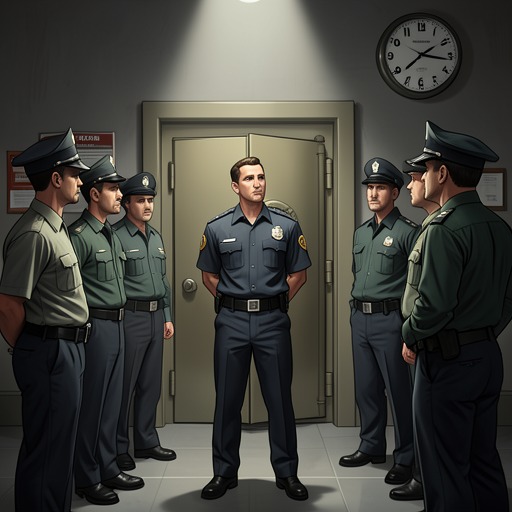
Wigfull had been head of the murder squad until Peter Diamond returned to the force. He now functions as head of CID operations, and the change leaves him unhappy. His professional standing is visible in the way others address him as Chief Inspector, but his new role also puts him in the hot seat when senior management reviews police work. Diamond’s presence sharpens the contrast between them: at one meeting Diamond remarks that he wants a traditional mystery rather than bodies at every turn, while Wigfull is left to handle the operational agenda.
That agenda includes Operation Bumblebee, the burglary-prevention publicity campaign Wigfull has taken over. At a meeting with the Assistant Chief Constable, he reports that the campaign has reduced crime and explains that reported break-ins go into what he calls the hive. His prepared account is convincing enough to carry the discussion, even as the Assistant Chief Constable’s puzzled response exposes the campaign’s jargon. When another meeting is called at short notice to address an urgent matter, Wigfull is again the officer associated with the earlier crime-prevention report. The sequence establishes a man expected to account for police performance as well as investigate crime.
Under Pressure
The demands of the job become physical in the incident room. When Diamond looks for him, Wigfull is entrenched behind a desk piled with files, fielding a phone amid a stream of incoming faxes and paperwork. His hunched posture, hand curled behind his head, lopsided moustache, and glazed, bloodshot eyes register the cost of the workload. A sergeant explains that a press conference is imminent; Diamond has come because of that press conference, not to add another routine demand. The scene gives Wigfull a human vulnerability that sits alongside the official title: the officer at the centre of activity is also visibly exhausted by it.
That exhaustion does not remove him from the investigation. When police learn that the returned Penny Black is connected to a killing, the briefing identifies Sid Towers, a forty-six-year-old night watchman, as the victim. Towers was last seen in central Bath at 8:45 p.m.; his body was found at about 1 a.m. aboard Milo Motion’s narrowboat at Dundas Boatyard, across from the Viaduct pub. The killer had struck him with a heavy object, perhaps a spanner, which had not been found. Wigfull had discovered the body, and he adds the crucial circumstance that Towers was inside the cabin while the boat’s padlock remained in place. His contribution helps define the apparent locked-room problem that will dominate the inquiry.
Reading the Riddles and the Lock
Wigfull takes the riddles seriously as clues rather than treating them as a sideshow. When he approaches Diamond, he says he has worked out part of the second riddle, specifically its final lines directing the reader to look for a lady in a locked room at seventeen. Diamond quiets the surrounding officers so Wigfull can be heard. The small exchange marks a temporary reversal in their usual balance: it is Wigfull who has a possible interpretation to offer, and Diamond gives him the floor.
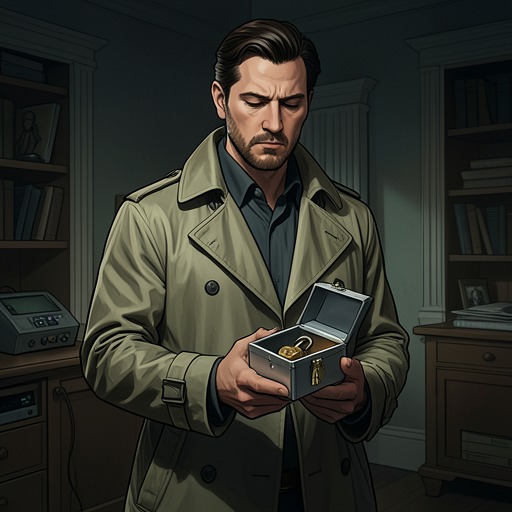
Later, Wigfull summons Diamond to his office while Arnold Musgrave, an Assistant Chief Constable, is present. He believes he has cracked the case and is eager to explain his part in it, introducing his reasoning through the locked-room tradition of detective fiction. His reconstruction proposes that Sid Towers had planned the crime for weeks or months and needed a way to enter Milo Motion’s boat while Milo was away. Wigfull points to Towers’s attendance at the Bloodhounds’ Christmas party aboard the Mrs. Hudson the previous year. Though shy, Towers could have moved around the boat and examined its locks and bolts; as a professional security officer, he might have recognized the padlock or learned its manufacturer. These are Wigfull’s deductions, presented as a theory about how the apparent locked room could have been engineered, rather than as independently established facts.
The inquiry’s material evidence gives the lock puzzle a more tangible form. Diamond later takes the padlock that was on the Mrs. Hudson on the night Towers was found and tests it with the keys Milo Motion had dropped into the canal. Rust falls as a key turns and the shackle springs open. That demonstration establishes that the recovered keys fit the relevant lock, and it confirms Milo’s account of where he lost them. The scene belongs to Diamond’s investigation, not to an action Wigfull performs, but it clarifies the practical problem around which Wigfull’s riddle-reading and theory of access have been organized.
Persistence and the Museum Watch
Wigfull’s work is not confined to theories and briefings. One night he parks opposite the Bath Spa Hotel, crosses Sydney Gardens, and enters the Holburne Museum through a side door. He deliberately avoids parking near the building so that his presence will not give anyone a clue, including his own officers. Six policemen are posted inside and on the roof, in radio contact. Wigfull checks on them repeatedly by radio and visits them every half-hour. The museum’s vulnerabilities make the watch consequential: its open frontage, low wall, and climbable rear drainpipes offer possible approaches, while its alarm system and security lights provide modern protection. Wigfull’s vigilance is methodical; the account makes clear that nobody sleeps on duty, though the night earns him no new friends.
During that watch, a dog approaches and then bolts with a black beret in its mouth. Wigfull sees the object clearly and gives chase. A beret alone could have belonged to anyone, but he knows that few people in Bath wear one and can think of a particular owner. He later tells Diamond that he picked it up near the railway bridge, describing it as chewed by an animal and producing it from his pocket. He does not explain the difficulties the dog caused him. The detail turns a stray object into a possible lead: Wigfull’s attention to what could easily be dismissed as litter links the museum patrol to the investigation around Rupert Darby.
Partnership and Narrative Role
Wigfull’s dealings with Diamond combine rivalry, irritation, and practical cooperation. Diamond teases him about his workload and, when Wigfull approaches with an interpretation of the riddle, makes room for him to speak. In turn, Wigfull seeks Diamond out when he believes he has solved the case and invites him to hear the explanation in front of Arnold Musgrave. Their relationship is not presented as effortless agreement; the narrative lets their difference in confidence and status remain visible while repeatedly bringing them back to shared police work.
Near the end, after Diamond has had Jessica Shaw and her boyfriend brought in, Wigfull is visibly enlivened when he hears that Diamond has cracked the case. He says that he had more than once considered the possibility that two people were involved, and that the hanging of Rupert Darby from a bridge made collaboration seem necessary. The exchange gives him a final, qualified place in the solution: he has not led the decisive arrest in this moment, but he recognizes what the staging implies and offers a reading of the case’s two-person structure. Across campaign reports, clue interpretation, physical evidence, and the long museum watch, Wigfull represents the persistent institutional work of the investigation, with its mixture of ambition, fatigue, fallible theorizing, and close attention to details others might miss.