Jessica Shaw
BloodhoundsJessica Shaw is the forceful public face of the Walsingham Gallery and a member of the Bloodhounds, but the investigation gradually reveals that the apparent victim of an attack on the gallery was also entangled in the deception surrounding the case. Her visible command of the gallery’s display contrasts with the concealed actions she later admits: protecting A.J. and taking part in a scheme that implicated Rupert Darby.
Public Role and Introduction
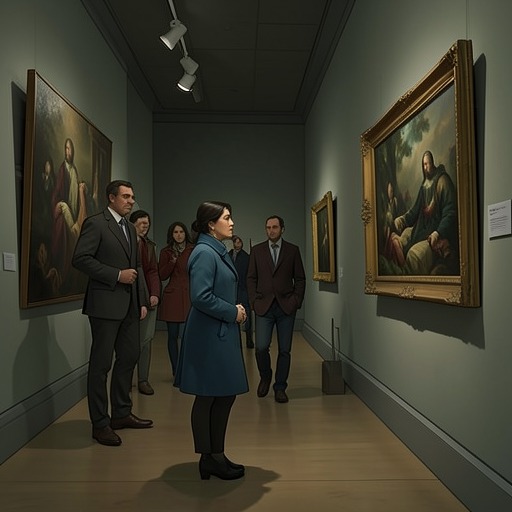
Jessica first appears directing the dressing of the Walsingham Gallery window. She gestures to a man on the other side of the glass, placing a painting on an easel, while a small crowd gathers to watch. The flagstoned passage in Northumberland Place is so congested that it is difficult for people to pass. Jessica seems aware that the installation has become street entertainment, and her vivid cherry-red wool dress and thick white cardigan make her stand out among the bystanders in drab padded jackets and wind-cheaters. The scene establishes her as someone comfortable directing attention in a public space; the window is both a gallery display and a performance she is managing.
When Peter Diamond addresses her, she initially carries on giving instructions rather than turning to answer. During the questioning, an ill-judged remark from Diamond earns him a cold stare. Jessica neither blushes nor shows embarrassment; she simply gives him a look that makes him retreat quickly to his first question. Her response is controlled and direct, not an invitation to treat her private life as a joke. Later, her husband Barnaby Shaw calls her unusually clever, an assessment that fits the investigative evidence that she could work out what A.J. had done without being told by him.
The Bloodhounds and the Bag
Jessica joined the Bloodhounds the previous winter and says that she was among the last to join, apart from the newer member Shirley-Ann Miller, who had attended only a couple of times. She therefore enters the group after Sid Towers is already a member. In her account, Sid had been encouraged to join on his doctor’s advice: he was painfully shy and interested in crime fiction, and the hope was that the group would give him a reason to contribute. In practice, he hardly ever spoke. When he did, the other members turned to look, which Jessica recalls as frightening him further. Her account gives the reader a picture of Sid’s isolation inside a club ostensibly built around shared interest.
A bag becomes a small but consequential part of Jessica’s evidence. She recalls keeping it beside her after a dog had been removed from the meeting by Rupert Darby, because she did not want to take chances if the trouble started again. She says she may still have kept it and that it was probably in her handbag, where she tended to carry things for years. Asked about the bag’s history, she adds that Sid produced it in the first place. Diamond postpones asking her to fetch it, keeping the interview on course. These details establish a chain of custody and a reason for the bag’s presence with Jessica, but they do not by themselves settle who made the writing associated with it.
That uncertainty becomes important when the investigators consider whether Jessica could have written the lists. One line of reasoning places the bag in her handbag and raises her as a possible author. Julie Hargreaves objects that Jessica handed the bag over; if she had used it to make the lists, Julie argues, she would have destroyed it rather than surrender it. The bag thus shifts from a seemingly straightforward clue about Sid’s authorship into a test of how the evidence was handled and what Jessica might have been concealing.
The Gallery Window and Suspicion
The gallery window later becomes the site of a public accusation. Jessica summons attention to the outside of the gallery and pushes through her guests to the door, with Shirley-Ann following. There, Barnaby and A.J. stand examining the window. Jessica demands to know who could have done this to her. The message, sprayed in large, crude white letters across the main window, turns the display space she had been directing into a scene of apparent injury and public scrutiny.
Shirley-Ann later tells the police that she saw the words sprayed on the window and that Barnaby cleaned them off. The accusation named Sid: the message read “She did for Sid.” Barnaby admits that he considered, if only briefly, whether it might be true that Jessica had killed Sid. He could not think of a reason she would commit such an immature act, and he emphasizes that his wife is unusually clever. His response captures the tension between the message’s blunt certainty and the absence of an evident motive. At this stage, the graffiti seems to make Jessica its target, while also directing suspicion toward her.
Protection of A.J. and the Deception
The later account changes the meaning of Jessica’s apparent position as the person attacked by the graffiti. Jessica admitted that she had been covering for A.J. She was not slow, the account stresses: she had worked out that he was responsible, even though she did not think he had told her what he had done. Her protection of him therefore rests on her own deduction, not simply on being an uninformed spouse or bystander. The account also connects the writing associated with the bag to the possibility that Jessica made the lists, recasting a detail that had seemed to support Sid’s authorship as part of the effort to conceal A.J.’s actions.
The deception did not stop with the first explanation of Sid’s death. When that account began to unravel, a second plan was devised to frame Rupert and make his death look like suicide. By the time of Rupert’s killing, Jessica and A.J. were both involved. The gallery graffiti was staged, and Rupert was made to appear conspicuously sprayed before he was surprised as he came out of his local. A.J. is identified as the likely attacker, while Rupert had not met him. The available account therefore places Jessica within the later joint deception, without making her the person who carried out every action in it.
Character and Narrative Function
Jessica’s role is built around a reversal between public appearance and private complicity. She commands the gallery window in full view of a crowd, then appears as the object of a crude attack on that same window. Yet the accusation and the display of apparent victimhood belong to a larger deception: she is protecting A.J. and participates with him in the later effort to frame Rupert. Her public confidence is not proof of guilt, but it makes the contrast sharper when the investigation exposes what she concealed.
The bag and the window also offer different kinds of evidence. The bag invites close reasoning about possession, authorship, and whether its owner would have handed it over; the graffiti is a conspicuous sign that seems to assign blame at once. Neither can be read safely in isolation. Jessica’s testimony about Sid helps establish the man’s shyness and the group’s response to him, while her connection to the bag complicates the apparent provenance of the riddles. The investigation’s changing interpretation of these objects makes Jessica more than a witness or a suspect: she is a participant in the manufacture of misleading clues, whose intelligence helps her recognize A.J.’s actions and whose choice to protect him helps extend the deception to Rupert.