A.J.
BloodhoundsA.J. is an artist who works in and around Jessica Shaw’s Walsingham Gallery, shifting readily between conversation, hospitality, and practical duties. His quick wit and relaxed familiarity with Jessica make him a memorable presence, while his role beside Barnaby Shaw at a gallery gathering complicates Shirley-Ann Miller’s first impression of him as a possible secret lover. The encounters offer hints and suspicions, but no confirmation of a romantic relationship.
Identity and Work
When Shirley-Ann visits the gallery hoping to see Jessica, A.J. appears from behind a desk arrangement of blue and yellow irises. Dressed casually in a check shirt and black jeans, with dark curls and brown eyes, he initially strikes her as someone who could play a heartbreaker in a television soap, though she does not recognize him as an actor. He explains that Jessica is shopping and invites Shirley-Ann to wait. His strikingly regular teeth and composed manner add to the impression of someone accustomed to being noticed, but the scene identifies him as part of the gallery’s everyday life rather than as a public figure.
A.J. introduces himself by that name and declines to explain what it stands for, saying he dislikes the name he was given. He offers tea or the cheap sherry Jessica keeps, then makes tea and brings it to Shirley-Ann in a white porcelain cup and saucer. The two floating tea leaves make the small act feel deliberately attentive: he has not used a teabag. His welcome is not solemn hospitality, however. He turns the exchange into banter, teasing Shirley-Ann about whether she is in a hurry and joking that Jessica’s talkative nature makes time pass pleasantly.
He is also a figurative painter. When Shirley-Ann guesses this from his appearance, A.J. jokes about paint on his jeans or a brush behind his ear before confirming it. He distinguishes his work sharply from the clown paintings in the gallery window: his own pictures are tasteful nudes, heavily shadowed over the exposed areas, several of which Jessica has upstairs. He recalls that demand for them had once been strong, but says the recession flattened the market; his final remark marks the claim as a joke. His account presents an artist conscious both of his style and of the economic fortunes of his work.
At the Gallery with Shirley-Ann
A.J.’s teasing is part of his manner, but Jessica warns Shirley-Ann not to reveal too much about herself: he is a dreadful tease who will use whatever he discovers. Jessica also says he can be fun in small doses and is extremely rude about work other than his own. The warning gives his humor an edge. He is socially engaging, but his playful attention can also make other people’s disclosures material for further teasing.
Jessica’s familiarity with him is plain when she tells him to give it a rest and then asks for a fresh pot of tea. A.J. describes himself as one of the New Men and points out that he has made Shirley-Ann a superb cup. Jessica, left alone with Shirley-Ann, apologizes that he was in charge and says she will get rid of him before showing her around in peace. This exchange suggests that A.J. is a regular, trusted presence who can be assigned the work of welcoming visitors, while also showing that Jessica expects to manage his interruptions herself.
Art, Sales, and Police Questions
Later, during Peter Diamond’s visit to the gallery, A.J. is sent to fetch and unwrap more pictures while Jessica complains that police questioning is interfering with her livelihood. When coffee is wanted, he carries it in on a lacquered tray, serving it in bone china cups. The narration notes how efficiently he distributes the cups and observes that he has performed the task before. Hospitality and sales belong to the same working environment: potential art buyers are to be cosseted, and A.J. knows how to help maintain that welcome.
Diamond nevertheless watches him closely. A.J.’s poise and confidence seem at odds with the menial tasks he is performing; his movements suggest a capacity for a Chaplinesque trick with the tray, and his manner carries a hint of anarchy. At the same time, Jessica is content to treat him as a domestic, despite having spoken approvingly of him earlier. The contrast leaves Diamond intrigued. A.J. appears at ease in a subordinate practical role without seeming defined by it, and he and Jessica behave comfortably together.
Relationships and Ambiguity
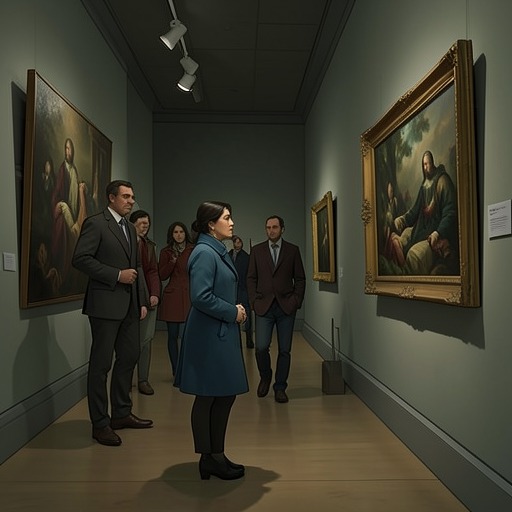
Shirley-Ann’s uncertainty about A.J.’s connection to Jessica begins at their first meeting. His husband-like manner and ease in the gallery lead her to wonder how he fits with Jessica’s account of being married to Barnaby, and she privately tries to reconcile his name with the husband’s. At a later gathering, Jessica introduces Barnaby simply by bringing him over and speaking the guests’ names. Barnaby, about forty-five and tired-looking, sits behind an account book; A.J. is beside him in charge of the cashbox. The two appear relaxed together.
That scene sharpens but does not resolve Shirley-Ann’s earlier suspicion. She had thought A.J. might be Jessica’s secret lover; seeing him alongside Barnaby, she considers that possibility again, while also allowing that he could be performing innocence or that Barnaby might be unusually tolerant. These are Shirley-Ann’s conjectures, not established facts. A.J. makes the moment more socially tangled by telling Barnaby that Shirley-Ann had corrected his leisure reading and put him under orders to read American female private-eye fiction instead of graphic novels. Shirley-Ann immediately protests that she said no such thing. The exchange shows A.J. turning a previous conversation into a teasing introduction, consistent with Jessica’s warning that he makes use of what he learns.
Later Appearances and Narrative Role
At the gathering, A.J. is not merely accompanying Jessica: he is helping with the sales, working beside Barnaby and handling the cashbox. When Jessica discovers damage to the Walsingham Gallery window, she pushes through the guests to the door; outside, Barnaby and A.J. are already standing together examining it. A.J.’s presence links the gallery’s sociable interior, where art is displayed and sold, to the disturbance at its public-facing window. The evidence does not assign him responsibility for the damage or disclose what he thinks of it.
Across these appearances, A.J. remains defined by a productive tension between performance and service. He jokes, cultivates an air of playful unpredictability, and speaks about his art, yet also makes tea, carries coffee, unwraps pictures, and helps handle sales. His ease with both Jessica and Barnaby gives Shirley-Ann grounds for speculation but not certainty. The character’s significance lies in that unresolved social position: he is intimate enough with the gallery’s household to seem more than an ordinary helper, while the concrete scenes keep his precise private relationship to its owners open.