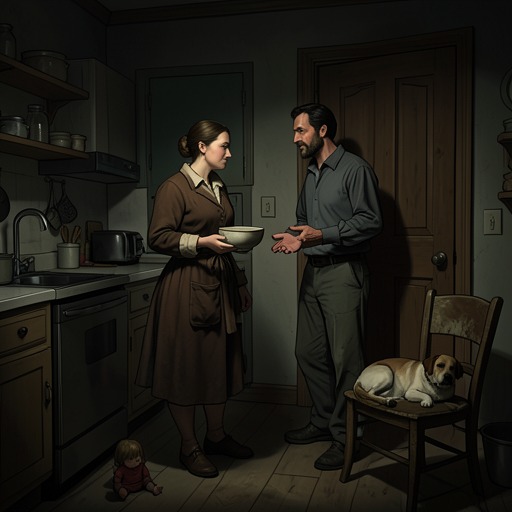
Bert
BloodhoundsBert is Shirley-Ann’s partner, a Bath local whose dry reserve and practical questions make him her closest domestic sounding board as the Penny Black investigation unfolds. His own theories help frame the mystery, but it is Shirley-Ann—not Bert—who eventually imagines that Sid and Jessica may have acted together.
Identity and Relationship
Bert has the flat in Russell Street, where he and Shirley-Ann have been together for almost six months. He was born and raised in Bath; Shirley-Ann arrived in the city only the previous year and sometimes feels self-conscious among people with deeper local roots. Their relationship is close enough that she tells him everything, including developments in the Bloodhounds’ investigation, and she expects his attention even when his response is far less animated than hers.
That difference in temperament is a recurring feature of their exchanges. Shirley-Ann approaches news with enthusiasm and vivid anticipation, while Bert listens quietly and is difficult to impress. When she tells him the Penny Black has been found, he waits until she has finished before suggesting that the police may next come asking questions. His remark does not confirm that they are suspects, but it immediately gives her an alarming picture of the visit and of the incriminating-looking objects that might be noticed in their home.
Work, Habits, and Ambition
Bert spends his working days at the Sports and Leisure Center, and exercise also structures his time outside work. He jogs in the mornings, while his job keeps him in shape; even weekends are filled with refereeing football. His athletic build is part of Shirley-Ann’s affectionate appraisal of him, though she recognizes that comparing him to Arnold Schwarzenegger exaggerates the resemblance. At night, by contrast, his exertion leaves him physically tired and not much interested in sport.
His eating habits reflect the same division between disciplined activity and an ample evening meal. During the day he lives on dried fruit, pulses, and apple juice; after work he has a substantial dinner and a glass of red wine. On the evening Shirley-Ann recounts the stamp’s discovery, that dinner is a full-sized steak and kidney pie heated in the microwave. These concrete routines establish Bert as someone whose active life is practical and bodily, rather than an extension of the intellectual excitement Shirley-Ann finds in crime fiction and the Bloodhounds’ puzzle.
He repeatedly urges Shirley-Ann to seek full-time work, but she answers that she is waiting for him to realize his own long-promised business plan. Bert hopes to partner with a top hotel in Bath and equip it with a private health club, including gym facilities, a swimming pool, steam rooms, saunas, and sunbeds. Shirley-Ann imagines herself in a white suit as the club’s receptionist. The obstacle is financial: the bank has so far refused to provide a loan. Their imagined division of roles makes the scheme a shared prospect, even though it remains unrealized.
The Penny Black and Bert’s Theories
Bert is not a member of the Bloodhounds, but Shirley-Ann brings him the group’s developments and asks what he makes of them. When he asks whether Milo stole the stamp, Shirley-Ann says she would be astonished if Milo had done so. Bert counters that the theft was not necessarily a foolish crime: the public rhyme about Victoria had turned it into a challenge, and he considers the possibility that Milo wanted to display his ability by appearing to solve it in the manner of Sherlock Holmes.
The stamp’s discovery in a book seems, to Bert, to fit that theory while also exposing a blunder. He reasons that Milo might have hidden the stamp there for safekeeping and then forgotten that he was using the same book to read from. In Bert’s account, the recovery could have been staged as a demonstration of Holmes-like detection, but the accidental-looking placement undercuts the performance: Milo, if responsible, would not have shown Holmes’s command of a crime. This remains a conjecture between the couple, not established knowledge about Milo.
Sid’s Murder and Shirley-Ann’s Inference
After the writing on the Walsingham Gallery window, Shirley-Ann again tells Bert what has happened. She does not claim to know who wrote it and cautions against drawing conclusions simply because Milo and Rupert attended the party; the perpetrator might not have been there. Bert is already tired, and he has not met Jessica, but he nevertheless says that, from all Shirley-Ann has told him, he thinks she capable of murder. His judgment is second-hand, prompted by her accounts rather than by personal knowledge of Jessica.
His comment prompts Shirley-Ann to examine how Jessica might have become involved in Sid’s death. At first, she struggles to imagine Jessica acting violently. Then, past midnight, with her cocoa mug on the bedside table and Bert breathing more evenly beneath the quilt, she develops a different explanation: perhaps Jessica and Sid were collaborators in the Penny Black challenge. In Shirley-Ann’s conjecture, Sid’s security expertise and Jessica’s intelligence could have enabled them to overcome the Postal Museum’s cameras and locks, enter Milo’s boat, and place the stamp in his book. She further speculates that Jessica might have followed Sid when he returned to the boat and killed him after fearing he would compromise their scheme. These are Shirley-Ann’s deductions, not conclusions Bert reaches or facts he confirms.
Narrative Role
Bert’s contribution to the mystery is indirect but consequential. His restrained response to the stamp’s recovery turns Shirley-Ann’s excitement toward the possibility of police scrutiny; his account of a staged Holmes-like performance offers one way to interpret the theft; and his blunt assessment of Jessica helps set off Shirley-Ann’s late-night reconstruction. Yet the exchange preserves the boundary between prompting and solving: Bert supplies questions and possibilities, while Shirley-Ann does the imaginative work of assembling Sid, Jessica, the museum’s security, Milo’s boat, and the book into a single proposed scheme. Their difference in energy and method makes the flat a private counterpoint to the Bloodhounds’ public puzzle-solving, without making Bert an investigator or establishing the truth of their theories.