Polly Wycherley
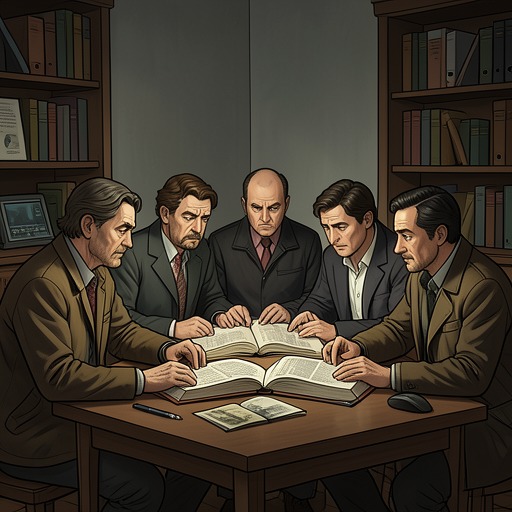
BloodhoundsPolly Wycherley is a founder and chair of the Bloodhounds, a Bath book group whose close-knit reading circle becomes a focus of police attention after a stolen Penny Black resurfaces and Sid Towers is murdered. Warm, hospitable and unusually attentive to the club’s history, she helps make it a social home for its members; when that home is shadowed by real violence, her instinct that Sid should tell the police brings the group’s literary fellowship into direct contact with the investigation.
Identity and Presence
Polly first enters a meeting late after dropping her car keys down a drain. She explains that she spent twenty minutes trying to retrieve them before a taxi driver stopped and helped. The mishap is familiar enough to prompt her wry observation that it happens quite often, then she turns immediately to the practical business of washing her hands and urges the others to begin without her. The episode establishes a combination that recurs in her conduct: embarrassment softened by humor, followed by an effort to keep other people at ease.
To Shirley-Ann Miller, Polly looks like a favorite aunt: short and chunky, with silver hair, a pale green Dannimac coat, and a face whose features retain a reassuring softness and mobility. Her breathing sounds asthmatic after her hurried arrival, though the narration does not establish a diagnosis. She appears older than most of the other attendees, bringing the group’s average age closer to sixty. This kindly, domestic impression is not mere decoration: Polly repeatedly acts as the person who welcomes, steadies and gathers the club around itself.
Her interest in mysteries also belongs to a longer personal history. She tells Peter Diamond that she and her husband travelled frequently, leaving her less time for reading while he was alive; in the twelve years since, she has become deeply absorbed in detective fiction. That enthusiasm leads her to create the Bloodhounds after meeting other readers at a function and discovering how much they shared. Her account presents the club not as a formal institution but as a community made by the pleasure of finding fellow enthusiasts.
The Bloodhounds and Its History
Polly and Milo Motion are the Bloodhounds’ founding members. Polly dates the group’s beginning to a dinner at the Pump Room in October 1989, and later describes the club as having enjoyed six years together. She remembers its original, informal meetings in a corner of the Roman Bar at the Francis Hotel. The arrangement changed after Rupert Darby became particularly noisy one evening; the group was asked to move, and its meetings transferred to the crypt. The venue shift therefore reflects the club’s gradual adaptation to the personalities it gathered, including Rupert’s love of argument and animation after a few drinks.
Polly’s memory supplies a social history as well as a membership roll. More than fifteen people had left, while six remained: the founders, Polly and Milo; Miss Chilmark, who joined soon after; Rupert, who arrived looking like a convict after two weeks on the run; Sid, introduced by his doctor; and Jessica Shaw, who had joined only the previous year. The departures had varied explanations. Annie Allen found the winter evenings too cold; Alan Jellicoe preferred films to books; the Pearce sisters had a clash with lacemaking classes; Colonel Twigg mistakenly thought the meeting concerned crime prevention; and Marilyn Slade-Baker’s probation officer stopped her attending. Polly also recalls Gilbert Jones leaving after only three weeks because he was out of his depth. Her catalogue resists a simple account of the club as a group from which people merely fled because of Rupert: members had left for different reasons, and Polly is careful to make those distinctions.
That care also shows in her practical role. She is identified as chair, though Miss Chilmark’s assessment is measured: Polly does her best. When a new member joins, Jessica takes her for a drink after the first meeting, and Polly follows with an invitation to coffee at Le Parisien. She meets the newcomer twice for coffee and gives the impression of taking her chairing duties seriously. Polly’s leadership is expressed through personal welcome and attention rather than command; she works to make membership feel possible in a group with a history of departures.
The Penny Black and Sid Towers
When Milo opens his book and finds the Penny Black, Polly’s response is to propose ending the meeting early. It is only 8:45, but nobody objects; Milo is the first to leave. The discovery has placed the club under an unfamiliar pressure, and Polly’s suggestion closes the gathering rather than allowing the members to improvise a response in the charged moment. Shirley-Ann Miller later recalls that the group discussed whether Milo should simply return the stamp to the Postal Museum and avoid involvement. Sid said he could stay quiet, while Polly and Miss Chilmark insisted that he had a duty to go to the police. Most of the others were inclined to turn a blind eye. Polly’s position makes disclosure, not private containment, her decisive intervention in that discussion.
After Sid is murdered, Polly tells Shirley-Ann that Milo could not have been involved in the killing: he had been at the police station reporting the missing stamp. She is visibly shaken, fumbling for a tissue and trembling as she speaks. The next morning she explains that police officers came to her soon after nine and questioned her about the meeting and the Bloodhounds. They did not tell her Sid was dead, even when she spoke about him. She had thought their questions concerned only the Penny Black and regrets having made an insensitive remark before learning the news. Her distress is personal as well as procedural: she identifies closely with the club, and the death turns its familiar history into evidence sought by investigators.
Polly’s place within the investigation is not settled by the warmth of her manner. No one can vouch for her presence at home on the night of the crime. She says she watched News at Ten and an old Stewart Granger film, but this provides no alibi. At Diamond’s request, she dictates the names of the Bloodhounds from the club’s beginning, apparently recalling them with striking accuracy. Yet she pauses when she reaches Rupert’s name, and is asked how he came to join. Her account links his arrival to the club’s informal days at the Roman Bar and to the disruption that eventually sent the group to the crypt. Her memories are useful, but the absence of an alibi leaves her within the field of suspicion rather than outside it.
Conflict, Memory and Unresolved Threads
Polly’s attachment to the Bloodhounds is especially visible when Rupert’s dog disrupts a meeting. She objects not only to the animal’s behavior but to Rupert’s refusal to make concessions to what she considers decent conduct. She recognizes that he sees the group as bourgeois and enjoys shocking it, yet rejects that attitude as an excuse for misbehavior. Her hand shakes as she lifts her coffee cup. The episode unsettles her because she identifies so closely with the club that an affront to its shared space feels personal; Shirley-Ann’s reassurance that she was not bothered does not remove Polly’s agitation. As the conversation continues, it becomes clear that the dog is not the only matter weighing on her.
Polly’s recollection of the club’s past partly serves to explain the people who stayed and those who left. She repeats the story of the founding dinner and the reasons for departures, including the account of Gilbert Jones, before summing up the survivors as people with many different motives for remaining. The breadth of that memory gives her a particular authority over the group’s history, but it also makes her sensitive to how the club might be judged from outside. Her chairing role, her concern over Rupert’s conduct, and her insistence that Sid report the stamp all arise from a wish to preserve the group as a place for books and fellowship rather than let it be defined by disorder or concealment.
A separate, only partly explained episode adds an unresolved strand to her history. Polly says that about two years earlier she received a letter from someone who knew the birth date and place, and the name, of her cousin Emma, who had died in 1990. The writer asked Polly to meet at a specified time by the west door of the Abbey. She did not describe the letter as exactly threatening, but its intimate knowledge was enough to persuade her to go. The available account does not identify the correspondent or explain what followed. That limited disclosure nevertheless underlines a contrast central to Polly’s character: she is open and sociable in the community she has built, yet her past contains knowledge guarded closely enough that an anonymous letter could summon her to a private meeting.