C City
DecodedC City is the provincial capital where the Rong family’s ambitions in education became public institutions and where generations of family members encountered changing political authority. Its significance in the story lies not only in the schools established there, but in the way the city connects the family’s learning, public service, political sacrifices, and later scientific work.
An Academy and a New Educational Order
The first major Rong institution in C City was Lillie’s Academy of Mathematics. Its founder, Young Lillie, was able to establish the school after returning from studies abroad: Grandmother Rong had promised him the silver hidden behind a sliding panel in her room as a reward for filial devotion, and he used the money to open the academy. The school became the predecessor of University N, making C City the starting point of an institution that would later carry a much wider reputation.
The academy began attracting attention while it was still new because Young Lillie insisted, despite opposition, that women be admitted. In the prevailing feudal climate, the decision exposed the school to gossip and the possibility of being shut down. Visitors to the provincial capital treated the academy as a spectacle, coming to look at its women students. According to the Rong family genealogy, the early female students belonged to the family’s principal branch. Keeping admission within the family helped shield the school from the scandal that might otherwise have ended it; the controversy instead made the academy better known.
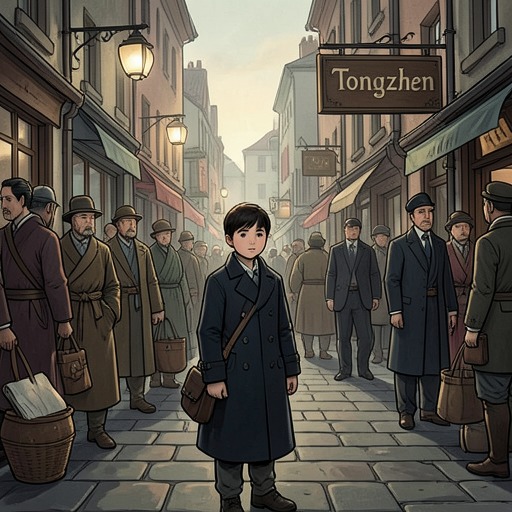
C City’s educational reach also drew Rong family members away from their ancestral home in Tongzhen. Many moved to the provincial capital to study at Young Lillie’s academy. That migration helped diminish the family mansion and weakened the continuity of its old commercial life: few of the young people who left wished to return to the family business. The city thus represented an opening toward scientific learning and a source of strain on inherited family arrangements.
Education, Family Wealth, and Patriotism
The family’s move toward education unfolded alongside the decline of its wealth. A government salt monopoly deprived the Rong family of its principal source of income, while many of those who studied with Young Lillie became committed to scientific method and the pursuit of truth rather than commercial gain or luxury. Within a decade, the family had lost nearly all its former property. Its public reputation, however, was also tied to a sacrifice made in response to events in C City.
When the National Revolutionary Army reached the city, Young Lillie saw students collecting money in the streets for the Northern Expedition. Moved by their efforts, he returned to Tongzhen that night and sold the family’s docks and half its shops to buy ammunition for the campaign. The family received a plaque recognizing its support. The episode links the capital’s student activity to the family’s material loss: political commitment was not an abstraction, but a decision to convert inherited businesses into support for the cause.
The plaque later became a source of conflict with the government. After the general who had written its calligraphy became a wanted criminal, the authorities offered to replace it with another bearing identical wording and gilding but different handwriting. Young Lillie refused. The family’s relations with the government subsequently brought further trouble for its business, but he insisted the plaque would remain. The stand made the household’s patriotic honor inseparable from its refusal to accept an official revision of that honor.
A University City and Public Service
In a later period, the Rong family’s fortunes improved. The People’s Government’s recognition of the family’s long service to science, learning, and patriotism accompanied a moment when a senior Rong figure held both the position of vice-chancellor of University N and the office of deputy mayor of C City. The city’s academic institution and municipal administration therefore converged in one public career. The period was described as the happiest of his life, a return of good days after the family’s long decline, though his intellectual manner led some people to suppose that he did not appreciate his circumstances.
The family’s presence at University N did not mean that its members were routinely favored for academic posts. During the years when the same senior figure was chancellor, he refused positions to Rong relatives, including a family member recommended more than once for promotion to assistant dean. He also directed a brother who had returned from abroad with a physics doctorate to seek work elsewhere. In C City, that meant taking a post at the Normal University, where the working conditions and students’ level were described as inferior; the following year, the brother moved to a university in Shanghai. His wife believed the decisions were forcing the family apart.
That record of refusing family appointments makes the later recruitment of Rong Jinzhen especially striking. When the new N University computer research unit was formed, the candidates interviewed by the chancellor did not meet his standard, and Rong Jinzhen became its first recruit and, in practice, its essential researcher; the other employees mainly assisted with daily work. The decision prompted gossip that the internationally ambitious unit had been monopolized by the Rong family. The chancellor’s stated reasons were more specific: Jan Liseiwicz’s letter mattered, but Rong Jinzhen’s graduation thesis persuaded him that the project was possible and gave him confidence to make a concrete contribution to science.
A City Under Political Restriction
C City also appears as a place that Jan Liseiwicz could pass through without being free to visit University N. During a journey to take his failing mother-in-law back to her hometown, he was accompanied by two minders, one Chinese and one from X Country. Their supervision governed where he went and how quickly he travelled. He was treated less like an ordinary mathematician than like a closely guarded national asset, even though his passport identified him simply as a mathematician.
The restrictions reflected the hostility between China and X Country at the time, when even small movements could be interpreted as evidence of aggressive intent. Jan Liseiwicz was not allowed near the university, so Master Rong had to visit him at his hotel. Their conversation took place under observation: each had two other people beside them, listening and recording, and every sentence had to be spoken clearly enough for all four to hear. In that atmosphere, ordinary conversation risked being construed as espionage.
Jan Liseiwicz had wanted to see Rong Jinzhen, who by then had left University N and could not be found. Master Rong told him that Rong Jinzhen had stopped working on Artificial intelligence and moved on to something else. Jan Liseiwicz reacted with visible anger and called the decision appalling. C City, which had once drawn the family toward education and institutional life, had become the constrained meeting place where an old mathematical relationship encountered the unexplained disappearance of its central figure.