China
DecodedChina is more than the setting in which the novel’s characters live: it is a country where political power can decide a family’s fate, scientific achievement carries public responsibilities, and the work of cryptography leads into places ordinary relatives cannot know. The story sets visible life—university appointments, newspaper slogans, family reunions—against a hidden world whose address and operations remain beyond the narrator’s reach.
Public life and political power
China’s political atmosphere appears through decisions that individuals cannot readily influence. When Jan Liseiwicz tries to save his father-in-law from execution, he approaches professors and students, including Young Lillie and the narrator, asking them to write a joint appeal to the government. They refuse, not because they wish the old man harm, but because they believe a small protest cannot change a matter governed by state policy. Young Lillie nevertheless speaks to the mayor; the answer he receives is that only Chairman Mao can save the condemned man. The episode presents political power not as distant rhetoric but as the hard limit on what private loyalty and local influence can accomplish.
The outcome overturns that apparent limit by bringing another country into the negotiations. The government of Country X sends a special envoy to Beijing, and the discussions reach the highest political level. The exchange secures the release of Liseiwicz’s father-in-law and allows two Chinese scientists, previously barred from leaving Country X, to return home. The condemned man’s release is therefore bound to the movement of scientists across national borders. In the narrator’s telling, Country X wants Jan Liseiwicz, not his father-in-law; Liseiwicz’s value as a mathematician helps explain why this extraordinary bargain is made, though the narrator cannot determine whether fame alone accounts for it. Soon after the release, Liseiwicz and his whole family leave China for Country X.
Family standing and public recognition
The Rong family’s fortunes shift with the political era. During the period described as the happiest of Young Lillie’s life, he serves as vice-chancellor of N University and deputy mayor of C City. The People’s Republic of China has rewarded the family for generations of devotion to science, learning, and patriotism. After a long decline, the family is again enjoying prosperity and public standing, and Young Lillie takes pleasure in this improved position even though others mistake his intellectual manner for indifference to good fortune.
That security coexists with the pressures of international conflict. Young Lillie reads newspapers reporting bloody battles between the American Army and the Chinese People’s Volunteer Army in Korea. A political headline calls American imperialism a paper tiger, while the martial song around him stirs a sense of helplessness rather than certainty. He is unsure what to write to his distant correspondent, Jan Liseiwicz, and fears an unseen presence waiting for a reply. In the end, he does not answer the letter himself: he takes it and the newspapers to Rong Jinzhen and asks him to respond. Public allegiance, personal correspondence, and the anxiety of being watched converge in this small decision.
Departure into a hidden China
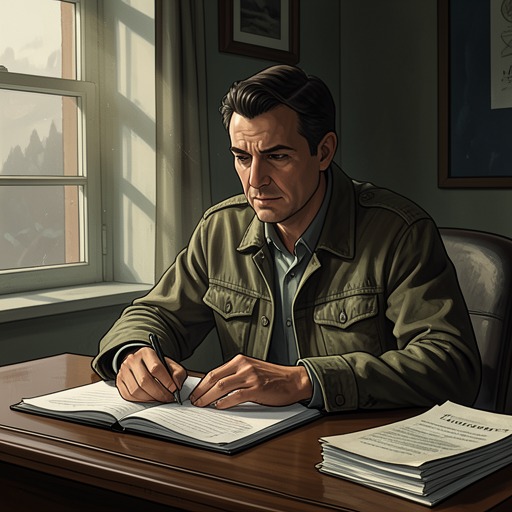
On 11 June 1956, at five in the morning, Rong Jinzhen leaves N University after a decade as a star of its mathematics department. Before going, he asks the older couple who raised him for permission to take the name Rong Jinzhen. His farewell is intimate: he kneels, knocks his head to the ground, and assures them that even at the ends of the earth he will remain their son. Yet no one knows where he is going. The only contact they are given is Box No. 36 in the provincial capital, an address that suggests proximity while concealing the destination.
The journey quickly reveals how misleading that apparent nearness is. Zheng the Gimp had taken Rong Jinzhen through repeated turns while completing his hiring paperwork and had made him wear dark glasses for ten minutes. At dawn the car leaves the city limits and reaches National Highway XX. Rong Jinzhen had expected to remain in the same city, but the highway tells him that he is being taken far away. His question about the destination receives only the answer that he is going to the unit. The reader learns that the journey leads to a secret workplace, but its location is not disclosed.
Secrecy, cryptography, and place
The narrator later insists that even now the unit’s location, work, and purpose remain unknown to her. She treats Rong Jinzhen’s silence as both his private secret and the country’s secret, comparing the hidden part of a country to the submerged portion of an iceberg. Keeping such knowledge from even one’s closest relatives is painful, she acknowledges, but she believes the danger to the country would otherwise be greater. This conviction gives China’s secrecy a domestic cost: national security explains the silence without undoing the distance it creates within a family.
Within that concealed setting, Unit 701’s work follows a difficult path. The conventional method of cryptography gathers intelligence and uses it to form hypotheses, gradually testing possible keys and locks; its slow elimination of possibilities is described as safe, effective, and especially useful against high-level ciphers. Rong Jinzhen instead studies the history of cryptography, entering territory he has been warned away from in the hope that past work will narrow the search. His approach brings the field’s buried history into the present, even though its practitioners work in isolation and cannot openly build on one another’s achievements.
The novel makes that secrecy concrete through BLACK. Unit 701 has spent years trying to find an error in the cipher, while the earlier success against PURPLE has made the adversary more cautious. The narrator considers the possibility that Jan Liseiwicz, who understands Rong Jinzhen, may have warned BLACK’s creators and helped them prepare countermeasures. The personal separation between the two men has become a strategic distance shaped by their political positions and beliefs.
The eventual solution is startlingly simple: the key to BLACK is zero, concealed in the apparent absence of a real lock. The discovery comes through a calculation made on a calculator capable of more than 40,000 calculations, in an office then located underground in a mountain cave. China thus contains two sharply contrasting kinds of place: the public city of universities, newspapers, and family ties, and the subterranean workplace where a national secret is pursued. The novel keeps the second world physically and socially withheld, making that concealment part of the country’s meaning in Rong Jinzhen’s life.