Tongzhen
DecodedTongzhen is the Rong family’s ancestral home and the site of its immense, gradually declining mansion. The village connects the family’s mercantile past to the transformations that reshape its fortunes, and its household becomes the refuge where a child whose identity is concealed is born and allowed to survive.
Ancestral Seat and Family Scale
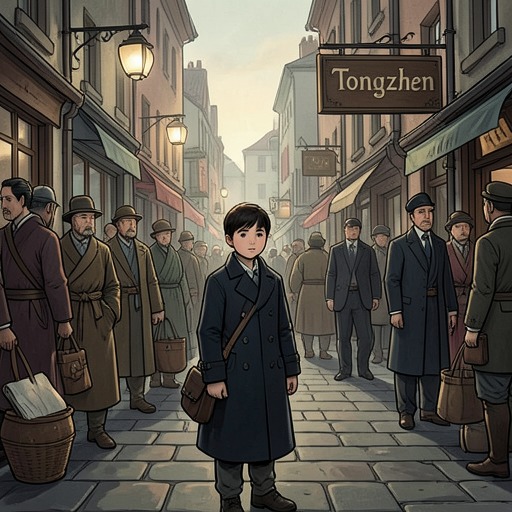
The Rong family, a prominent Jiangnan clan of salt merchants, had a mansion in Tongzhen that occupied half the village. Its buildings stood so closely together that their roofs were compared to fish scales. By the time the narrative describes them, however, the buildings were aging: paint had flaked from the pillars and eaves, leaving bare patches that made the family’s changing circumstances visible in the fabric of its home.
Tongzhen also marks a point of departure. In 1873, Rong Zilai left the village by ferry to study abroad. His later transformation into an academic and patriot began with that journey, although the family’s original reason for sending him overseas was the hope that it might prolong Grandmother Rong’s life. The departure thus links the ancestral home to a future shaped elsewhere, rather than to the continuation of the family business at home.
Decline of the Mansion and Clan
The mansion’s deterioration reflected a broader dispersal of the family. After Rong Zilai established an academy in the provincial capital, many Rongs moved there to study. Few of the younger people who left wished to return to the family trade, and the government’s salt monopoly deprived the clan of its principal source of income. Education and scientific inquiry drew family members away from the commercial life that had sustained the estate; its decline was therefore not simply architectural but also economic and generational.
Within a decade, the family had lost almost everything it once owned. A plaque above the mansion’s main gate, bearing the words “Supporter of the Northern Expedition,” made the family’s political commitment visible even as the house itself showed signs of age. The mansion stood as both a remnant of inherited wealth and a marker of how radically the family had redirected its resources and priorities.
Shelter, Birth, and Recognition
Tongzhen became a place of refuge when Rong Xiaolai brought a pregnant woman from the provincial capital to his father’s old hometown. She had sought help at N University after the Lin family rejected her claim that she was carrying the Killer’s child. Rong Zilai took her in, and Rong Xiaolai was instructed to bring her to Tongzhen. The move placed her within the Rong household, though it did not settle the question of whether her child would be accepted as family.
The woman died after giving birth at the mansion. The baby’s resemblance to the Killer exposed the concealed parentage and turned the child into a source of family shame. He was not recognized as a Rong, and for a long time people referred to him by a hostile name. Yet his resemblance to his grandmother, Miss Lillie, persuaded Mrs. Rong not to abandon him; that connection helped secure his survival and upbringing in the mansion.
A Home That Does Not Guarantee Belonging
The child’s presence in the Rong household did not immediately make him a member of the family in practice. He was cared for by an elderly servant couple, and his early name did not take hold among the villagers. Later, after Mr Auslander took him into the Pear Garden, the child came to regard the foreign gentleman as his father. When Mr Auslander died, the Rong household might have cast him out; according to the steward, he remained at the Pear Garden only after Mr Auslander appealed to the Third Master. The account also says that Mr Auslander left him his savings, on which he lived because the Rongs could not afford to support him.
Tongzhen’s significance therefore lies in the contrast between the scale of the old family estate and the uncertain place it affords this child. The mansion can shelter him, but bloodline, household recognition, and everyday care do not align neatly. His eventual place among the Rongs depends on acts of protection and attachment as much as on ancestry.