United States
DecodedThe United States appears as a place of scientific possibility, international movement, and missed opportunity. Rong Youying goes there with the Wright brothers and contributes to the design of their first successful airplane; Jan Liseiwicz visits American mathematicians and institutions; and Stanford offers Rong Jinzhen a funded doctoral place. Yet Jinzhen never reaches the country: first serious illness, then the Korean War, closes the route. Across these episodes, the United States is both a real destination and a measure of the research life that circumstances make available or deny.
Rong Youying and the early flight
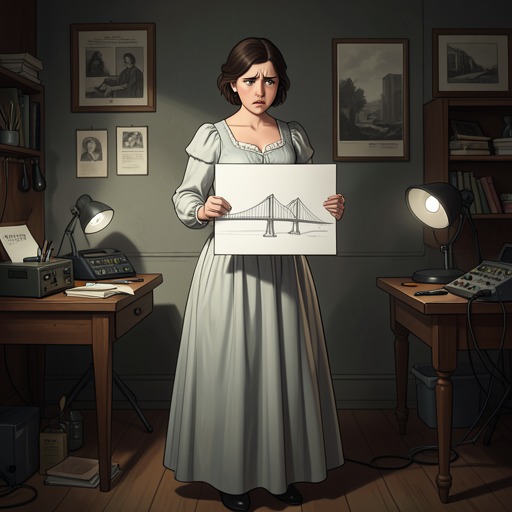
In Rong Youying’s story, the United States enters through a journey that begins at Cambridge University. In her fifth year there, aged twenty-two, she wins the Mathematical Bridge competition with a design requiring 388 nails. The following year, the Wright brothers visit her. Their vision and courage impress her, and she travels with them to America. The narrative links this journey to a decisive development in aviation: two years later, in North Carolina, their airplane makes its first successful flight over the sand dunes.
The account gives Rong Youying a specific place in that achievement. A silver-lettered inscription beneath the airplane names her in its fourth line as wing designer, identifying her as Rong ‘Abacus’ Lillie, from C City, China. Rong ‘Abacus’ Lillie is the name she uses in the West; the Rong clan genealogy records her as Rong Youying, an eighth-generation descendant. The American episode therefore joins an international public identity to her family lineage, and makes the United States the setting in which her mathematical design work becomes part of the history of flight.
Liseiwicz’s academic visit
The United States is also a professional destination for Jan Liseiwicz. In the spring of 1949, he and Rong Jinzhen finalize the rules of mathematical chess. Not long afterward, Liseiwicz receives an invitation from the journal Annals of Mathematics to attend an event at UCLA. The arrangements for Asian attendees direct them to meet at an address in Hong Kong before flying to California for the final leg.
Liseiwicz’s stay in the United States is brief, lasting perhaps a month and a half. He returns to work at the university so quickly that colleagues find it hard to believe he has made the trip. He can show evidence: job offers from universities and research institutions in Poland, Austria, and the United States, photographs of himself with John von Neumann, Lloyd Shapley, Irvin Cohen, and other mathematicians, and the question paper for that year’s Putnam Mathematical Competition. The visit gives him access to a wider academic network, but the narrative also stresses how swiftly he comes back to his work in China.
Stanford and Jinzhen’s unrealized journey
Liseiwicz wants Jinzhen to have the chance to study abroad. After testing him on the Putnam competition questions, he tells Young Lillie that Jinzhen has exceptional ability and should be given the opportunity to study overseas. Young Lillie supports the plan, but his circumstances leave him unable to finance it. The Rong family’s inherited property has been dispersed or lost, and Young Lillie’s savings have already gone toward saving his daughter’s life.
Liseiwicz’s advocacy secures a concrete offer. He writes a 3,000-word letter to Dr Gábor Szegő, head of Stanford University’s mathematics department. A few months later, Szegő accepts Jinzhen as a scholarship student and sends a money order for $110 in travel expenses, taken from departmental funds. The letter has helped turn the prospect of study into a funded PhD place and a ticket for the boat. Young Lillie is delighted by the news. Stanford, in this moment, represents not merely an admired institution but a practical opening made possible by Liseiwicz’s persistence.
That opening does not lead to a departure. As Jinzhen prepares to spend his final summer at the university before going to Stanford, he becomes terribly ill. The illness determines that he will spend the rest of his life in China. The planned voyage is thus interrupted before it begins: a scholarship and travel money exist, but they cannot overcome the immediate fact of his sickness.
War, correspondence, and scientific possibility
Jinzhen’s recovery does not restore the opportunity. When Liseiwicz later urges Young Lillie to let Jinzhen work on artificial intelligence in the United States, the Korean War has become an obstacle. Young Lillie gives Jinzhen Liseiwicz’s letter along with newspapers reporting bloody battles between the American Army and the Chinese People’s Volunteer Army. He asks Jinzhen to reply that he cannot leave because of the war, and recognizes that Jinzhen is the one who has lost the most. When Jinzhen drafts his answer, Young Lillie crosses out about half of its expressions of regret and disappointment, then asks him to include newspaper reports with the letter. The exchange makes the political conflict tangible in the form of the pages sent across the distance.
Liseiwicz’s correspondence continues to present American research as a possible future for Jinzhen. In a letter written on Christmas Eve, he reports news that Princeton University has brought several independent research units together to establish an institute devoted to artificial intelligence. He sees this as evidence that the field matters beyond his own judgment. Believing Jinzhen has nearly recovered, he argues that if China cannot provide the conditions for this work, Jinzhen should find a place where he can pursue it. The appeal rests on research facilities and the opportunity to develop Jinzhen’s abilities, not simply on the prestige of travel.
The United States consequently gathers together several different kinds of promise in the narrative: Rong Youying’s participation in aviation, Liseiwicz’s contact with an international mathematical community, and the research environment imagined for Jinzhen. Its significance is sharpened by the contrast between opportunity and access. Rong Youying reaches America and has her contribution recorded on the airplane; Liseiwicz visits and returns with professional contacts and evidence of the trip; Jinzhen receives the Stanford offer but remains in China, first because of illness and then because war makes departure impossible. For him, the country remains a real but unrealized destination, attached to work he is encouraged to pursue and a future he cannot reach.