Catholic morality
DublinersCatholic morality in Dubliners is not only a body of religious teaching but a force that enters private feeling, family negotiation, and public accountability. Its authority is most tangible when characters confront the duties of the priesthood, the burden of confession, or the expectation that sexual wrongdoing be repaired through marriage. The stories repeatedly show moral rules operating alongside social reputation and practical interests: they can guide conduct, intensify shame, and provide leverage, without guaranteeing justice or spiritual clarity.
Religious Instruction and Sacred Duty
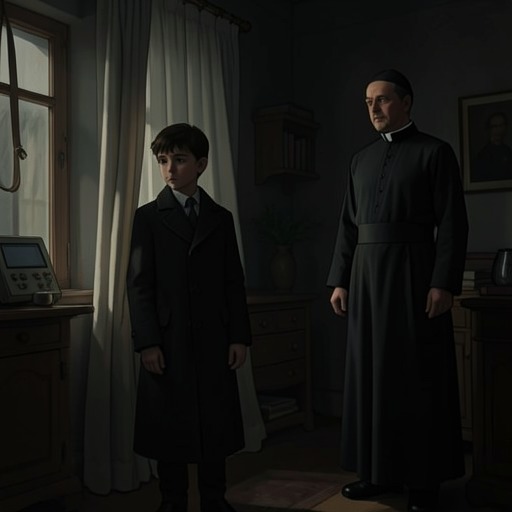
The narrator’s recollection of Father James Flynn presents Catholic teaching as intricate and demanding. Father Flynn had studied at the Irish college in Rome, taught the boy to pronounce Latin, and explained the ceremonies of the Mass and the vestments worn by priests. He also tested the boy with difficult cases, asking whether particular sins were mortal, venial, or merely imperfections. Through these lessons, the child discovers that practices he had taken for simple acts belong to a complex moral and institutional system.
Two priestly obligations especially impress the boy: the duties owed to the Eucharist and the secrecy required by the confessional. He imagines their gravity as so formidable that he wonders how anyone can undertake them. Father Flynn’s account of the Church’s thick, closely printed books on such questions makes moral judgment appear both authoritative and difficult to master. When the boy falters in answering, the priest smiles and nods; he also has him recite the responses of the Mass from memory. Instruction is thus at once intimate and disciplinary, conveyed through questions, memorization, and repeated correction.
The recollection is unsettled by the priest’s physical decline and death. The boy remembers trembling hands that spill snuff, a faded priestly garment, and a habitual smile that initially made him uneasy. He is disturbed to find himself feeling free after Father Flynn’s death, although the priest had taught him so much. That response sits beside genuine gratitude for the lessons and a growing awareness that religious office carries burdens the child cannot fully comprehend. Catholic morality enters the story through this unresolved mixture of instruction, reverence, discomfort, and relief.
Confession, Sin, and Reparation
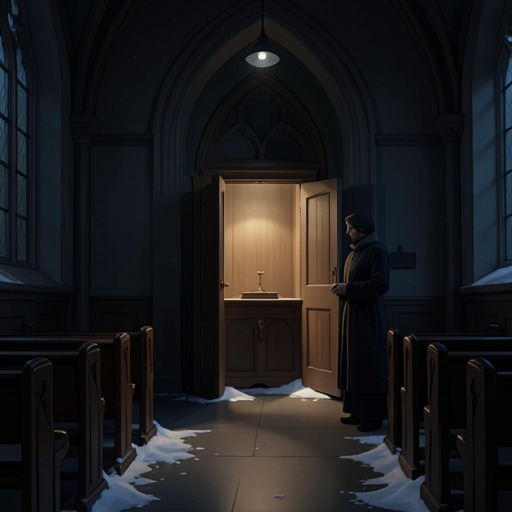
In the account of Polly Mooney and Bob Doran, confession converts a sexual relationship into an urgent moral and social crisis. On Sunday morning, Bob is anxious after confessing the previous night. The priest has drawn out the affair’s details and, in Bob’s view, magnified his sin; he is almost thankful that the confession has left him a possible means of reparation. He sees only two alternatives: marry Polly or run away. His sense of honor tells him that the wrong must be repaired, while the fear of exposure makes escape difficult to imagine.
The pressure is not purely inward or religious. Bob has worked for thirteen years in a Catholic wine-merchant’s office, and he fears that publicity could cost him his position. He imagines his employer summoning him and worries that a small city will ensure that everyone learns the story. He has money to settle down, but doubts that his family will accept Polly, whose father is disreputable and whose mother’s boarding house has acquired a reputation. Religious guilt, employment, family standing, and public talk converge; marriage appears less as the outcome of an uncomplicated romantic choice than as a demanded settlement under several overlapping forms of judgment.
Mrs Mooney makes that demand explicit. Having questioned Polly, she considers the affair a breach of the hospitality she extended when Bob lived under her roof. She dismisses money as an inadequate settlement: in her view, the only reparation for the loss of her daughter’s honor is marriage. She counts her advantages before sending Mary to summon Bob, including the force of social opinion and his likely reluctance to face publicity. Her case invokes a moral vocabulary of honor and responsibility, but also works as a deliberate negotiation in which her daughter’s future, Bob’s livelihood, and the boarding house’s reputation are at stake.
The story therefore distinguishes the moral principle of reparation from the pressures through which it is enforced. Bob accepts that harm has been done and cannot simply be denied, yet he also resents the possibility that he is being trapped and worries about Polly’s speech and social background. His hesitation does not erase the affair or the obligation he feels; it reveals how religious accountability is entangled with class prejudice and self-preservation. Catholic morality here supplies the terms of the crisis, while family authority and anticipated public disgrace help determine its practical force.
Rules in Public and Institutional Life
Catholic and social judgment are not confined to private sexual conduct. In the railway inquiry following Mrs Sinico’s death, Captain Sinico says that he and his wife had lived happily for twenty-two years before she became intemperate about two years earlier. Their daughter says that her mother had lately gone out at night to buy spirits and that she had tried to reason with her and induced her to join a league. The testimony frames drinking as both a family distress and a failing to be corrected, while the public proceedings establish the circumstances of the fatal accident.
The railway company’s representative emphasizes notices and spring gates intended to prevent people from crossing the lines except by bridges. The jury follows the medical evidence and exonerates the railway employee; the Deputy Coroner expresses sympathy for the husband and daughter, urges further precautions, and states that no blame attaches to anyone. These formal conclusions distribute responsibility without resolving the moral distress surrounding Mrs Sinico’s decline and death. The episode places institutional judgment beside family efforts at correction, showing how an official finding can settle liability while leaving private loss and moral interpretation unsettled.
A different institutional conflict arises over Kathleen Kearney’s concert contract. When the committee abandons one of the four concerts, Mrs Kearney insists that canceling it does not alter the agreement. She argues that her daughter is still owed the stipulated payment for four concerts, regardless of how many the society chooses to hold. Later, the committee offers to pay the remaining four guineas after its Tuesday meeting, but threatens to treat the contract as broken if Kathleen does not perform in the second part. Mrs Kearney answers that her daughter must receive four pounds eight or will not appear.
The dispute is contractual rather than a confession of sin, but it belongs to the same wider landscape of conduct governed by rules, obligations, and reputation. Mrs Kearney sees the committee’s treatment of her daughter as an attempt to exploit a young woman; she declares that she will insist on the agreed payment and make the city hear of the matter. Here the relevant claim is not repentance but performance and compensation. Set beside the marriage crisis and the railway inquiry, the episode shows that Dubliners’ moral world includes religious expectation alongside family honor, public opinion, workplace dependence, and formal agreements.
Moral Authority and Its Limits
Across these episodes, Catholic morality is powerful partly because it is carried by institutions and ordinary relationships rather than appearing only as abstract doctrine. The priest instructs the boy in the obligations of the Eucharist and the confessional; confession makes Bob confront the consequences of his affair; Mrs Mooney invokes honor to demand a marriage settlement. In each case, the language of duty reaches beyond the individual conscience into family life and public standing.
Yet the stories do not present moral language as a guarantee of fairness. Bob’s sense of reparation coexists with fear for his employment and a class-conscious judgment of Polly. Mrs Mooney’s defense of her daughter’s honor is also a calculated exercise of leverage. In the railway case, a verdict that assigns no blame cannot restore Mrs Sinico or settle the meaning of her decline. The contract dispute, meanwhile, shows a young performer’s payment becoming the subject of institutional bargaining. Moral obligations are real within these scenes, but their interpretation and enforcement are shaped by power, money, gender, and reputation.
The concept’s significance lies in this friction between inner accountability and external judgment. Catholic teaching gives the boy a first sense of how complicated moral responsibility can be; confession intensifies guilt by naming and recounting the act; social convention then turns reparation into a practical demand. The resulting pressures do not always produce insight or reconciliation. They expose how religious duty can be sincerely feared, strategically invoked, and carried into everyday disputes, while the people subject to judgment remain divided between obligation, shame, self-interest, and the desire to escape.