Catholic spiritual retreat and repentance
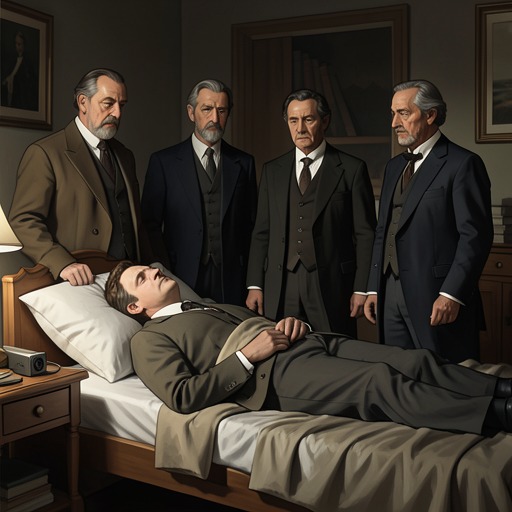
DublinersCatholic spiritual retreat and repentance in “Grace” begins as a plan by Mr Power and Mr Cunningham to bring Mr Kernan into a shared religious retreat, then takes shape as a sermon that asks its business-minded hearers to audit their spiritual lives. The movement from joking camaraderie to the formal assembly at the Jesuit Church in Gardiner Street gives repentance a double character: a serious call to confess and amend wrongdoing, and a social undertaking made approachable through familiar metaphors, group pressure, and the language of practical business.
From private persuasion to a group undertaking
At first Mr Cunningham describes the matter evasively as spiritual, until Mr Power states the plan plainly to Mr Kernan: the friends are going to make a retreat. Mr Cunningham calls it “wash the pot,” giving the religious undertaking a homely, comic shorthand. The joke does not conceal the group’s recognition that the need is real. Mr Cunningham calls them all a collection of scoundrels, insists that he means every one of them, and invites Mr Power to own up; Mr Power and Mr M'Coy each accept the admission. The retreat is thus framed not as a remedy for one uniquely wayward man but as an act of shared acknowledgment.
That collective approach also makes the invitation harder for Mr Kernan to refuse without making refusal the central issue. Mr Cunningham imagines him joining the group for a four-handed reel, turning the proposed retreat into a kind of fellowship. Later Mr Power tells Mrs Kernan that they mean to make her husband a good, pious, God-fearing Roman Catholic, and says that the whole party will make a retreat and confess their sins. Mr Kernan says he does not mind, though with some nervousness. His response is not a declaration of conversion; it is assent to a plan advanced by his friends and supported by his wife’s satisfaction.
Repentance in the language of business
The friends make the proposed religious discipline concrete through the familiar sequence of confession, renunciation, and renewed vows. Mr Cunningham says they will renounce the devil together, including his works and pomps. He explains that they will stand with lighted candles and renew their baptismal vows. Mr M'Coy’s teasing reminder about the candle exposes Mr Kernan’s discomfort with this ceremonial detail: he objects that there will be no candles and asks whether he must have one. The exchange sets his reluctance beside the group’s cheerful determination, without suggesting that his practical objections prevent his attendance.
At the retreat, Father Purdon gives the idea a more sustained interpretation. He takes as his text Christ’s words about the children of this world being wiser in their generation and making friends out of mammon. Rather than presenting the passage as a terrifying summons or demanding that his listeners abandon worldly life, he says it is suited to people who must live in the world but do not wish to live merely as worldlings. His audience is explicitly composed of business and professional men, and the sermon meets them in terms they can recognize.
Father Purdon accordingly describes himself as a spiritual accountant. He asks each man to open the books of his spiritual life and check whether the accounts tally with conscience. The metaphor turns self-examination into a procedure: review what has been done, identify discrepancies, and decide what needs correction. The retreat’s moral language does not erase the congregation’s worldly identities; it uses an idiom of record-keeping and responsibility to connect those identities to religious scrutiny.
The sermon and its measure of amendment
The sermon allows for human weakness without treating that allowance as permission to evade responsibility. Father Purdon says that Christ understands failings, the weakness of fallen human nature, and life’s temptations. Yet he asks his listeners to be straight and manly with God. If a man finds his accounts in order, he may say so; if he finds discrepancies, he should admit them frankly and resolve, with God’s grace, to rectify them. Repentance is therefore represented less as a display of terror than as honest recognition joined to a commitment to change.
The sermon’s practical assurance complements the friends’ earlier insistence that they will confess together. The social arrangement makes participation less isolating, while the accounting image gives each listener an individual task: no one else can inspect his conscience for him. The promise to set matters right also distinguishes mere acknowledgment from amendment. The undertaking requires both an admission of what is wrong and an intention to correct it, even as the sermon presents divine grace as necessary to that correction.
The retreat’s social and narrative significance
The church scene places this private moral exercise inside a recognizable civic world. The transept is nearly full of well-dressed men, and Mr Kernan gradually feels more at home as he recognizes people in the congregation, including a moneylender, a registration agent and mayor-maker, a pawnbroker, a newspaper reporter, and an old commercial acquaintance. The retreat gathers professional and commercial identities into the same religious setting; Father Purdon’s business metaphor makes that convergence explicit by addressing the congregation as men accustomed to worldly affairs.
The episode’s tonal movement preserves a tension between spiritual seriousness and social ease. The friends joke about washing the pot, the four-handed reel, and the candle, but they also openly acknowledge their own wrongdoing and agree to confess. At church, the orderly assembly and the sermon’s measured appeal replace the earlier banter without making the retreat seem wholly detached from ordinary life. Repentance in “Grace” is presented as both a religious demand and a social practice: the men go together, but each is asked to examine his own moral accounts and undertake their repair.