Irish hospitality
DublinersIrish hospitality in “The Dead” is at once a lived household practice and an ideal Gabriel Conroy articulates at the Morkan sisters’ annual dance. The party gives the value a material form—in welcome, food, music, and the work of hosting—while Gabriel’s speech turns that particular gathering into a claim about Ireland’s inheritance. His praise is warm and sincere, but the speech also exposes the strain involved in preserving communal graciousness amid changing generations, absent faces, and memories of the dead.
The Dance as a Practice of Welcome
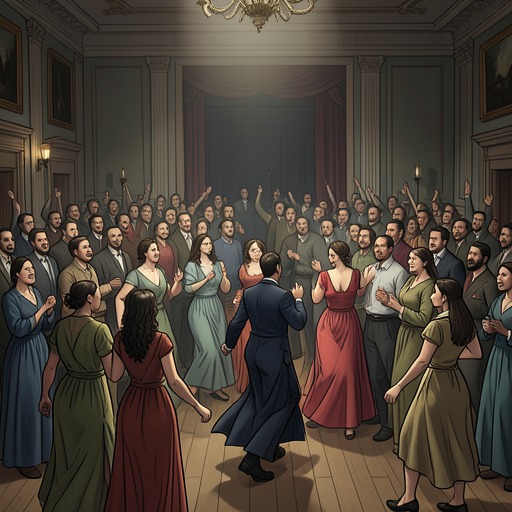
The Morkan sisters’ dance is described as a great annual affair, attended by relatives, old family friends, members of Julia’s choir, and pupils of Kate and Mary Jane. It has never fallen flat: for years it has proceeded in splendid style. The gathering is not an abstract emblem of hospitality but a recurring social occasion whose welcome depends on people making room for one another and sustaining familiar forms of celebration. That welcome is organized through domestic labor. Lily, the caretaker’s daughter, is run off her feet, carrying gentlemen into the small pantry behind the ground-floor office and helping them off with their overcoats before the bell calls her to the bare hallway again. Kate and Julia have made the upstairs bathroom into a dressing-room for the ladies; from the landing they peer over the banisters and call down to ask who has arrived. The bustling, affectionate arrangement makes hospitality visible as work, attention, and preparation rather than mere good intention. The household’s circumstances give the party its particular character. Kate and Julia left their house in Stoney Batter after their brother Pat died, taking their niece Mary Jane to live with them in the dark, gaunt house on Usher’s Island; the dance has continued there for about thirty years. Mary Jane has become the household’s main support through her organ work in Haddington Road and her annual pupils’ concert at the Antient Concert Rooms, while Julia remains a leading soprano and Kate teaches beginners on an old square piano. Their life is modest, but they believe in eating well, serving such fare as diamond-bone sirloins, three-shilling tea, and bottled stout. The scale of the welcome rests on a household that has made continuity and good provision part of its identity.
Gabriel’s Account of the Tradition
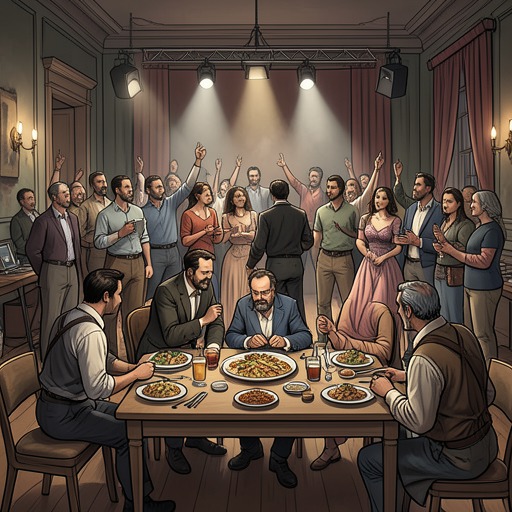
Gabriel addresses the guests by recalling that they have gathered under the same hospitable roof and around the same hospitable table before, as recipients—or, in his joking correction, victims—of the ladies’ hospitality. He gestures toward Kate, Julia, and Mary Jane, and the room responds with laughter and smiles as the three women blush. His speech begins from the actual hosts in front of him, making their long practice the ground for his broader reflection. He then calls hospitality a tradition that does Ireland particular honour and should be guarded. His experience abroad, he says, has not shown him another modern nation with the same tradition. Even if some might call it a failing rather than a virtue, he recasts it as a “princely failing” and hopes it will continue to be cultivated. He imagines the Morkan home still sheltering its “good ladies” for many years, and describes warm-hearted, courteous Irish hospitality as an inheritance passed from forebears to descendants. The speech links the intimate generosity of one family’s party to a national self-understanding: hospitality is not only what the sisters do tonight, but a value Gabriel wants the gathering to recognize and transmit. Gabriel’s formulation also depends on his audience’s assent. A hearty murmur runs around the table after his praise of the hosts, and he continues with growing confidence. Hospitality here works as a shared social language: the guests receive the tribute, the hosts are honored by it, and the speech helps the assembled company see its own gathering as evidence of a larger tradition.
Generational Change and the Missing Guest
The ideal is not presented without qualification. Gabriel acknowledges that a new generation is growing up with new ideas and principles, and describes its enthusiasm as sincere even when misdirected. He fears that a sceptical, thought-tormented age, and the education or overeducation of the young, may leave them without the humanity, hospitality, and kindly humour he associates with an older day. His argument casts the party as a place where those qualities can still be practiced, even as the terms of social life change. The tension enters the scene in a personal way when Gabriel notices that Miss Ivors is absent. She has gone away discourteously, and her departure sharpens his confidence as he continues praising the gathering. The episode makes his appeal to hospitable fellowship more than a ceremonial compliment: the speech comes after a breach in that fellowship, so its celebration of warmth and continuity sits beside an actual absence that cannot be smoothed away simply by invoking tradition. Gabriel’s nostalgia gathers force when he recalls the singers of the past. Their names make him feel that the present is a less spacious age; he calls the earlier time spacious and says that, even if it is beyond recall, its great figures should be remembered with pride and affection. Mr Browne’s loud “Hear, hear!” answers this invocation. Yet the very need to remember the past marks the distance between inheritance and present experience: the dead can be honored in speech, but they cannot return to the table.
Hospitality Beside Memory and Loss
Gabriel recognizes that gatherings like this also bring sadder thoughts: the past, youth, change, and absent faces missed that night. He describes life as strewn with such memories, but argues that dwelling on them continually would leave people unable to go on with their work among the living. His account places hospitality alongside a practical ethic of attention: sorrow is acknowledged, while living duties and living affections still make claims on those assembled. He therefore declares that he will not linger on the past or let gloomy moralizing intrude. For a brief moment, the guests have been drawn together from their everyday bustle and routine as friends, colleagues, and companions. He calls the hosts the “Three Graces of the Dublin musical world,” and the table answers with applause and laughter. The joke renews the room’s shared pleasure, while its polished allusion transforms the women’s work of hosting into public tribute. The scene’s account of hospitality is consequently both celebratory and uneasy. The annual dance shows how welcome is made through repeated labor, good food, music, and social attention; Gabriel’s speech gives those actions national and intergenerational meaning. But his insistence on remembering the past, his anxiety about the young, and the conspicuous absence of Miss Ivors prevent the ideal from seeming effortless or complete. Hospitality holds the company together for an evening, not by abolishing change and grief, but by creating a form in which warmth, memory, and their limits can all be felt.