Mortality, memory, and the dead
DublinersMortality, memory, and the dead form a connected imaginative field in Dubliners: death closes individual lives, but remembrance carries their claims into the present. The idea appears both as public commemoration of Charles Stewart Parnell and as Gretta Conroy’s private recollection of Michael Furey. In the story’s closing movement, Gabriel Conroy’s response to that memory widens from marital jealousy into pity, self-questioning, and an apprehension of the living and dead together beneath the snow.
Public Mourning and Parnell’s Memory
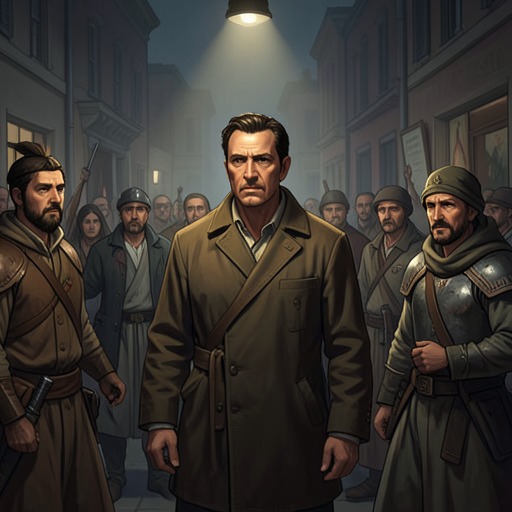
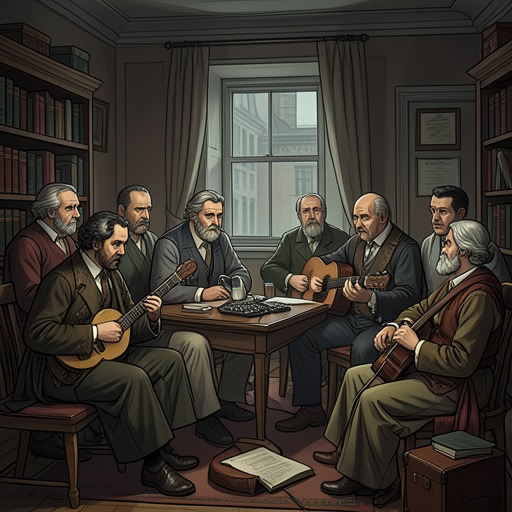
At the gathering where Joe Hynes recites “The Death of Parnell,” private drinking pauses for an act of public remembrance. The poem names Parnell “Our Uncrowned King,” declares that he is dead, and imagines death joining him with Ireland’s heroes of the past. Its date, 6 October 1891, gives the elegy a historical marker, while the closing thought turns grief into a lasting pledge: the memory of Parnell is the one sorrow that Ireland may raise in a cup of joy.
The response makes remembrance collective but not uniformly expansive. The recitation ends in applause, and even Mr Lyons joins in; afterward, the listeners drink in silence. The contrast between clapping and the quiet that follows gives the tribute the shape of a small public rite. Parnell’s death is not reversed, but the poem places him among earlier heroes, making memory the means by which an individual loss enters a national past.
Michael Furey’s Death and Gretta’s Recollection
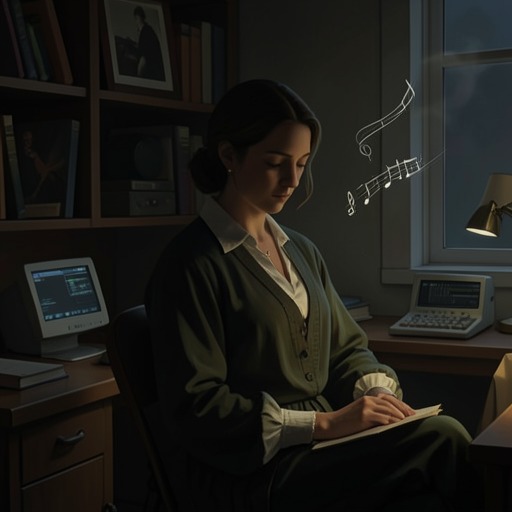
In the closing episode, Gretta tells Gabriel that Michael Furey died when he was seventeen. She recalls his illness and his last visit: he came in the rain, stood by a wall beneath a tree, and insisted that he did not want to live. Gretta had urged him to go home lest the rain kill him. He did return home, but after she had been in the convent for only a week, he died and was buried in Oughterard, where his family came from. The sequence makes the remembered scene vivid through concrete places and gestures, while the report of his death confirms what Gabriel had not understood about her past.
Gretta’s account also gives the death a meaning that cannot be reduced to its physical cause. When Gabriel asks whether Michael died of consumption, she answers that she thinks he died for her. The statement is her interpretation, not an independently established explanation of his death. Its force lies in the way she remembers the young man’s willingness to risk his life in the rain and his declaration that he did not wish to live. Her memory preserves Michael not simply as someone who died young, but as the figure of a passion that still occupies her inner life.
Gabriel’s Change in Perspective
Gabriel initially meets the story from within the assumptions of a husband who has imagined the evening leading toward intimacy. Gretta’s recollection interrupts that expectation. He feels terror at her answer, yet does not press her with further questions; he continues to hold her hand while recognizing that she will speak of herself in her own way. When she breaks down sobbing and then falls asleep, his response shifts from threatened pride toward attention and pity.
Watching Gretta asleep, Gabriel understands that she had a romance in her life and that a man had died for her sake. He can no longer think of himself as the unquestioned center of her emotional history. He recognizes how poor a part he has played in her life and imagines the young face for which Michael braved death, while also knowing that the woman beside him is no longer that girl. The thought does not simply diminish Gretta through comparison; it exposes the distance between the life she once lived and the life Gabriel assumed he knew.
The encounter draws mortality beyond Michael’s story. Gabriel remembers the haggard look on Aunt Julia’s face as she sang “Arrayed for the Bridal” and imagines the near future in which he will sit in mourning while Aunt Kate tells him Julia has died. He anticipates being unable to find words that could console her. This imagined bereavement makes death a coming family event as well as a past loss, and sets the living characters’ ordinary celebrations against the deaths already approaching them.
The Dead and the Snow
As Gabriel lies beside Gretta, he thinks that everyone is becoming a shade. He contrasts fading with the possibility of passing into the other world in the full glory of passion, and recognizes that Gretta has kept Michael’s image in her heart for years. Tears come to him—not because he has experienced the same feeling, but because he knows that such a feeling must be love. In the dark, he imagines a young man beneath a dripping tree and senses other forms nearby. The image gathers his private reckoning into a wider awareness of the dead, whose existence he can feel but not comprehend.
The final snow gives that awareness a shared, outward form. Gabriel watches flakes fall against the lamplight and thinks of snow descending across Ireland: the central plain, the treeless hills, the Bog of Allen, the Shannon, and the churchyard where Michael lies buried. It settles on crosses, headstones, gate spears, and barren thorns. The movement from the room to the country and then to the graveyard binds domestic life, national landscape, and the dead in one continuous scene. Snow does not erase the differences between people or restore the dead; it falls over all of them, living and dead alike.
Significance
The paired memories of Parnell and Michael Furey place public commemoration beside private grief. Parnell’s death is made meaningful through a poem that joins him to Ireland’s heroes; Michael’s death returns through Gretta’s remembered visit and Gabriel’s newly altered perception of his wife. In each case, recollection gives the dead a presence among the living without undoing their absence.
The ending leaves Gabriel not with a solution to the distance between himself and Gretta, but with a changed sense of its scale. Her past can no longer be folded into his expectations, and his thoughts turn toward Julia’s future death and the buried Michael. The snow’s fall gathers those separate lives into a common image of mortality: the dead remain particular in memory, even as the living come to recognize their own passage toward the same silence.