Irish nationalism and Parnellism
DublinersIrish nationalism and Parnellism in Dubliners are a divided inheritance rather than a unified program. The stories place national ideals in conversation with material interests, political maneuvering, and the memory of Charles Stewart Parnell: characters can honor the nationalist past while arguing over whether to welcome an English king, and a candidate’s supposed principles are tested against his pursuit of office. The result is a political culture in which loyalty carries emotional force but does not guarantee consistent action.
Working-Class Representation and National Honor
In the discussion of Richard J. Tierney’s election campaign, Joe Hynes contrasts a candidate he presents as an honest representative of labor with the man supported by the canvassers. His account gives nationalism a social and economic dimension: the working man, he argues, produces everything yet receives little, while those in political power seek positions for relatives. He also objects to an address of welcome for Edward Rex, treating deference to a foreign monarch as an affront to Dublin’s honor. National allegiance here is not merely a matter of symbols; it is bound to the question of who benefits from political representation and economic life.
Hynes’s appeal is challenged by the uncertainty surrounding Tierney himself. Mr O’Connor says the candidate will not vote for the address because he is running on the Nationalist ticket, but Hynes doubts that assurance and names Tierney as Tricky Dicky. O’Connor then admits that Hynes may be right, even as he wishes the candidate would arrive with the money. The brief exchange puts principle beside the practical needs of the campaign: the canvassers discuss political fidelity while waiting for the financial support that sustains their work.
The King, Capital, and Political Opportunism
Mr Henchy’s canvassing story shows how readily public principle can be reframed for electoral advantage. Seeking votes from a Conservative property owner, he describes Tierney as respectable, independent of party, wealthy, and a Poor Law Guardian. He presents the candidate’s property and businesses as reasons a voter should trust him to keep rates down, tailoring the appeal to the listener’s interests rather than to nationalist allegiance. The canvass is a performance of political flexibility in which the same candidate can be presented differently to different constituencies.
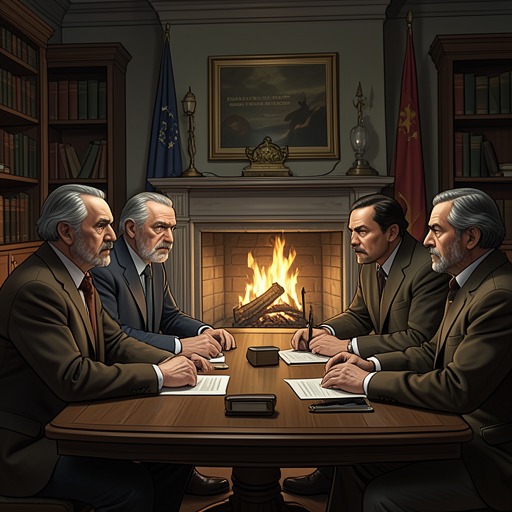
Henchy also defends welcoming the King of England on economic grounds. Dublin needs capital, he argues, and a royal visit could bring money to the country and benefit its citizens. He points to idle factories, mills, and shipbuilding yards as evidence of unused economic capacity. Mr O’Connor objects that Parnell himself would not have welcomed the King, while Mr Lyons asks why Ireland should welcome a monarch after rejecting Parnell as a leader. Henchy rejects the comparison: Parnell is dead, whereas Edward is a visiting ruler whom Henchy portrays as friendly and well-disposed. The argument turns a national question into a conflict between inherited political standards and projected material benefit.
Mr Lyons insists that the issue concerns ideals, invoking the judgment once made against Parnell to question whether welcoming Edward is consistent with nationalist principle. O’Connor, concerned that the argument might stir old divisions on Parnell’s anniversary, says that Parnell is now respected even by Conservatives. That appeal to common remembrance does not resolve the political disagreement. Rather, it shows how the dead leader can serve both as a standard against which present conduct is measured and as a commemorative figure around whom current disagreement is temporarily contained.
Parnell’s Memory and the Ivy Leaf
Joe Hynes makes Parnell’s memory visible when he displays an ivy leaf in his lapel and says that, had Parnell been alive, there would be no talk of welcoming the King. The old man and O’Connor affirm the sentiment, recalling the vitality of the political past. The leaf is a compact emblem of that continuing attachment: Parnell’s absence is registered in the very debate that tests what his principles would require of the living.
Hynes then stands, places his hat on the table, and recites “The Death of Parnell,” dated 6 October 1891. Its opening identifies Parnell as “Our Uncrowned King,” turning the nationalist leader into a symbolic sovereign. The poem remembers his death and condemns the betrayal that separated him from what he loved. Its language presents Parnellism as a story of lost leadership and treachery, giving the gathering a shared lament after its divided discussion of contemporary politics.
Political Memory and Material Life
The political arguments sit within a collection attentive to the material conditions that constrain ordinary lives. Eveline’s wages, her father’s demands, and her responsibility for keeping the household and children supplied make money and family duty immediate pressures rather than abstractions. Mrs Mooney’s boarding house, established from what remained of the family butcher business, is governed through careful judgments about credit and discipline. Maria’s modest purse, its two half-crowns and coppers, and her calculation of tram fares likewise place daily plans within narrow financial limits. Mrs Kernan’s management of a household and her practical care for her husband extend that pattern of sustaining family life through ongoing labor.
These domestic circumstances do not directly settle the political disputes over Tierney, the King, or Parnell. They do, however, sharpen the contrast between lofty public language and everyday economic dependence. Across the election scene, nationalist commitment is invoked against patronage and foreign influence, but campaigners also bargain over votes, capital, and money. The recollection of Parnell supplies a moral and emotional measure; the present repeatedly tests that measure against expediency and need.