Political patronage and opportunism
DublinersPolitical patronage and opportunism in Dubliners are clearest in the election canvass for Richard J. Tierney, where persuasion, nationalist language, private suspicions, and the need for payment continually collide. The story does not reduce politics to a single motive: its canvassers argue about working-class representation and national dignity even as they seek votes, money, and influence. Elsewhere, the unequal distribution of money and practical protection—from Eveline’s household responsibilities to Mrs Mooney’s management of her boarding house—offers a broader social context for understanding how dependence can limit choice without turning every economic relationship into political patronage.
The election and its competing claims
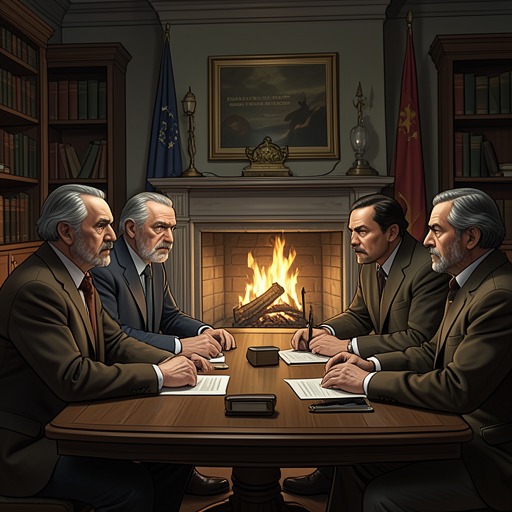
A printed appeal asks voters in the Royal Exchange Ward to support Richard J. Tierney and lend him their influence. Mr O'Connor has been engaged by Tierney’s agent to canvass part of the ward, but inclement weather and leaking boots leave him spending much of the sixth of October by the fire in a Wicklow Street committee room. The mismatch between the formal language of the appeal and the damp, improvised setting gives the campaign a material texture: political work is both public persuasion and a matter of who can afford the effort.
The canvassers do not agree about what their candidate represents. Mr Hynes argues that a working man such as Colgan has a proper claim to civic representation and contrasts that claim with candidates he describes as seeking jobs for themselves or their connections. Mr O'Connor answers that Tierney is standing on the Nationalist ticket. Their exchange makes the election a contest over the meaning of representation: class interest, national allegiance, and personal ambition are presented as overlapping, but not interchangeable, justifications.
The proposed address of welcome to Edward Rex sharpens that conflict. Mr Hynes objects to honoring an English king, while Mr O'Connor says Tierney will oppose the address. Yet Mr O'Connor immediately qualifies his confidence, admitting that Hynes may be right about Tierney and wishing that the candidate would arrive with the money. The moment links political trust to a practical expectation of payment: the canvasser’s work depends not only on public principles but also on the candidate’s ability to meet an immediate material need.
Canvassing, influence, and suspicion
The work of soliciting votes proceeds through personal contact and the cultivation of intermediaries. Mr O'Connor reports visiting Grimes, who refuses to disclose how he will vote. The canvasser nevertheless expects that the voter may be favorable because he was told the names of the nominators, including Father Burke. A name supplied in conversation becomes a form of social evidence: influence may be inferred from connections even when no explicit promise has been made.
The campaign’s methods are presented as practical rather than ceremonial. Mr Henchy later boasts that he secured several likely supporters in Dawson Street, including Parkes, Atkinson, and Ward. In persuading Ward, a Conservative, he emphasized Tierney’s respectability, property, businesses, and supposed lack of party affiliation, setting aside the Nationalist description used elsewhere. The canvass thus adapts its case to its audience: civic standing and property are made persuasive to a voter who might resist a partisan appeal.
At the same time, suspicion shadows the effort. Mr Henchy speculates that political opponents or apparently patriotic figures might be in the pay of Dublin Castle, while distinguishing Mr Hynes from the unnamed people he accuses. He also suspects that Hynes may be acting for Colgan, and urges the others to use him to discover how the rival side is faring. These are allegations voiced by interested men, not independently established facts. Their importance lies in the atmosphere they create: loyalty is treated as something to investigate, and political information itself becomes a resource that can be gathered under cover of apparent friendship.
Money, office, and the limits of principle
The men’s talk repeatedly returns to money. Mr O'Connor describes Hynes as hard up; Mr Henchy, while remembering Hynes’s father as a decent man, questions whether the son is dependable and resents what he sees as dependence on others. The distinction the speakers draw between legitimate need and opportunism is unstable: sympathy for poverty coexists with accusations of spying and suspicions that a man may be serving the opposing campaign. Material hardship can explain a person’s vulnerability without resolving the question of political allegiance.
Mr Henchy’s own account of his campaigning makes the transaction plain. He calls the day’s work good because he has obtained likely votes, while dismissing Mr Crofton as ineffective at canvassing and crediting himself with doing the talking. His confidence is practical and self-promotional, grounded in the countable prospect of support rather than in a public account of the candidate’s policies. Elsewhere, he jokes that he might become a City Father himself, after suggesting that those who owe money may be better placed to attain civic office. The joke exposes a view of public advancement in which indebtedness and office are entangled, even as the exact workings of the supposed arrangement remain his speculation.
The debate over the royal address reveals another way expediency can be made to sound like principle. Mr Henchy argues that welcoming the king could bring capital and benefit Dublin, pointing to idle factories, mills, shipbuilding yards, and other industries. Mr O'Connor invokes Parnell in challenge, but Mr Henchy replies that Parnell is dead and presents the king’s visit as a friendly opportunity. Economic benefit becomes his case for political accommodation. The argument does not settle whether the welcome is wise or disloyal; instead, it shows how the language of prosperity can be used to answer a nationalist objection.
A wider social context of dependence
The election story’s exchanges have a broader resonance in a collection where money and protection structure private life as well as public influence. Eveline gives her entire seven shillings of wages to her household and manages the Saturday-night struggle to obtain money for provisions. Her father’s control over the household purse, her responsibility for the younger children, and the absence of her brothers as regular protectors narrow her options. These details are not examples of electoral patronage, but they show how economic dependence can distribute power within a family and make departure both attractive and difficult.
Mrs Mooney’s boarding house presents a different form of economic management. After separating from her violent, indebted husband, she establishes a business in Hardwicke Street and governs its mixed population of visitors and resident clerks through calculated decisions about credit, discipline, and tolerance. Her control over lodging and household rules gives her practical authority. The arrangement also explains why the young men call her the Madam: her power rests on managing the conditions under which they live, not on a formal political position.
Maria’s circumstances similarly place care and affection alongside constrained resources. She works at the laundry, plans her tram fare and purchases carefully, and looks forward to an evening with Joe Donnelly’s family. Joe has invited her to live with his household, but she fears being in the way despite her warm relationship with him and his wife. Her purse, a gift from Joe and Alphy after a trip to Belfast, holds a small amount of money and a lasting sign of attachment. This is mutual family feeling rather than political exchange, yet it reinforces the collection’s attention to how limited means shape where people can live and how readily they can accept help.
Mrs Kernan’s long management of domestic life supplies another contrast. She has kept house for her husband for twenty-five years, cared for him through frequent drinking, and scolds and tends him after his fall. Her sons’ employment away from home and occasional remittances connect household survival to wage work and family obligation. These domestic arrangements differ from the election’s pursuit of votes and office, but together they clarify the social world in which money, service, loyalty, and practical protection are continually negotiated.
Political performance and public memory
The election’s opportunism is not presented as a simple opposition between corrupt self-interest and pure conviction. Mr Hynes speaks forcefully for labor and against deference to a foreign king; Mr O'Connor identifies his candidate with nationalism; Mr Henchy argues for industrial investment and presents the royal visit as an economic opportunity. Each position draws on a public good—representation, national dignity, or employment—while the men also contend with personal need, distrust, and the prospect of advancement.
The evening’s recitation of The Death of Parnell, announced under its title and the date 6 October 1891, shifts the argument from canvass to remembrance. Parnell’s memory stands behind the men’s disagreement about nationalism and the king, but the recitation does not erase their immediate bargains or uncertainties. Instead, the political past becomes part of the present campaign’s vocabulary: a revered dead leader can be invoked as a standard, while the living still argue over votes, money, and the uses of influence.
Taken together, these scenes define political patronage and opportunism not as a detached doctrine but as a practice enacted through names, introductions, favors, suspicions, and claims about material benefit. The campaign’s public ideals remain audible, yet their force is tested in the committee room by wet boots, unanswered promises, uncertain loyalties, and the desire for payment. The wider domestic stories extend the pattern of unequal dependence without collapsing family care into electoral exchange: in Dubliners, the need for money and protection shapes choices across both public politics and private life.