Customary Common Rights
HarvestCustomary Common Rights are the unwritten claims through which the villagers of The Village use shared land and resources and make a precarious subsistence possible. Their authority comes not from deeds but from repeated practice: collective labor, customary shares of the harvest, gleaning, and practical knowledge of the land. The rights bind the community to one another and to a familiar landscape, yet remain vulnerable when estate ownership and formal legal authority are used to reorganize that landscape for sheep farming.
Definition and Material Basis
The distinction at the heart of these rights is between legal title and lived use. Charles Kent holds the estate through inherited property claims, but cultivation depends on the villagers’ hands. Their understanding is that the land is not theirs by deed, yet they may still claim a measure of possession and access because their labor makes its produce possible and local custom attaches common rights to the ground. Ownership and use therefore coexist uneasily: the landlord’s documents establish his title, while the villagers’ work gives practical substance to the estate and supports their claim to its resources.
These rights answer immediate needs rather than abstract ideas of ownership. The village is small, its population is declining, and harvests have been meagre. In winter, cattle may have food when people do not. Under such conditions, access to fields, grazing, fuel, peat, reeds, and other resources is bound to household survival. The villagers’ claims are not unlimited access for anyone at any time. They are locally understood entitlements, worked out through customary routines and expectations about who belongs, what is shared, and how the land is used.
Harvest, Sharing, and Seasonal Practice
Harvest makes the system visible in action. Everyone able to work is expected to contribute: children clear weeds, stronger workers cut the grain, women and daughters bind sheaves, and older villagers set the stooks. The work gathers people who may not otherwise agree, and the shared effort is tied to a practical expectation that the harvest will support the community. A customary division reserves ten sheaves for the commons and one for gleaning, giving the communal store and individual gathering distinct places in the same system.
Gleaning extends the right of use beyond the cutting and storage of the crop. After the harvest, villagers may collect remaining barley for their own kitchens, using it for stew, beer, or animal fodder rather than adding it to common stores. The order of later use is also familiar: cattle first graze the stubble, geese follow, and hogs root through the field. Such sequences turn the field from a crop into several successive sources of sustenance. They also give seasonal custom a practical structure, coordinating access without requiring each use to be separately negotiated.
The harvest is not only an allocation system but a recurring communal occasion. Shared labor permits public conversation, joking, and the airing of local complaints; common ditches and collective hopes bring familiar faces into one space. The Gleaning Queen custom gives the later gleaning a recognized beginning, with the chosen queen first to bend and gather a grain. These practices renew a sense of shared entitlement by repeating it: the community works, divides, and uses the harvest according to patterns its members know.
Boundaries, Local Knowledge, and Belonging
The rights depend on a detailed, practical understanding of place. Each spring, the villagers beat the bounds together, taking stock of what they have and what they hope to grow. Boundary stones teach children where they and the community belong. The route is also a chance to anticipate disputes: a family may ask for more grazing because it has another mouth to feed, while another may object that communal waste heaps are too close to a cottage. Such grievances concern the allocation and consequences of shared use, and are expected to be voiced in a measured, public setting.
This knowledge is richer than a survey that records the estate as measured spaces. The villagers can identify where to find reeds for thatching or wood for fuel, which pond needs clearing, which oak has become unsafe, and where land should be left to recover for peat and turf. Their plain place-names often describe a direction, a family, or what grows there. For them, knowing the land means knowing how it can sustain work and life; for Philip Earle, whose charts are made for the estate, measuring and mapping make it legible in another way. The contrast matters because the map can support decisions about property without recording all the ordinary uses on which customary rights rest.
Belonging is consequently important but not simple. The villagers resist the arrival of newcomers claiming a right to settle on the commons after building a dwelling and making smoke. They fear a loss of already scarce resources and treat the newcomers’ claim as a challenge to their own established use. Yet the narrator acknowledges that some villagers, including Walter Thirsk, once arrived as outsiders themselves. Customary rights thus rely on an idea of local membership that has developed over time, even as that idea can be used to exclude recent arrivals.
Authority, Dispute, and Enclosure
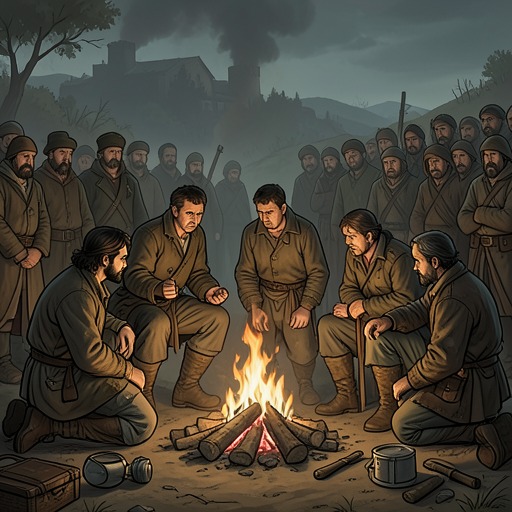
The villagers’ customary claims operate alongside, and sometimes against, other forms of authority. Charles Kent owns the estate and has a duty to act when conflict occurs, but his judgment is shaped by personal discretion as well as by law. After the stable fire, the villagers expect punishment to be proportionate: offenders may be beaten, made to leave the bounds, or required to make restitution, but their lives should not be at stake. Kent’s reluctance to take a worker’s family provider away reflects a local moral expectation that punishment should not needlessly destroy a household. That expectation is not the same as a formal legal right, and it can be overridden by a more severe view of law.
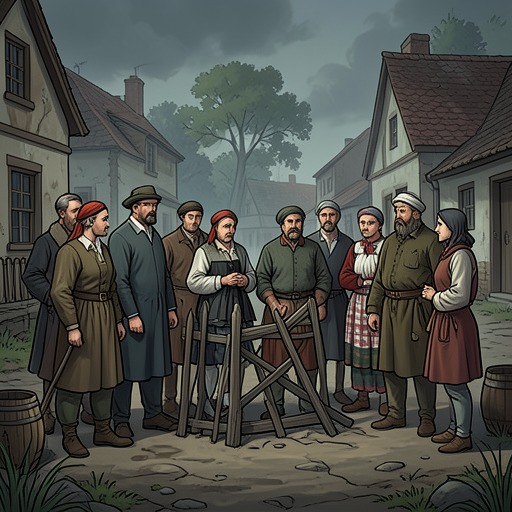
The conflict over the newcomers shows how fragile local claims become when a different legal order defines who may settle or use land. The villagers believe they can defend their boundaries, while Kent recognizes that the written law must be obeyed. Their hostility is intensified by fear of hunger and uncertainty about what the newcomers want, but it cannot settle the question of whose claim is legally enforceable. Custom supplies rules and expectations; it does not give the community the documents or authority that would make those expectations secure against an outside ruling.
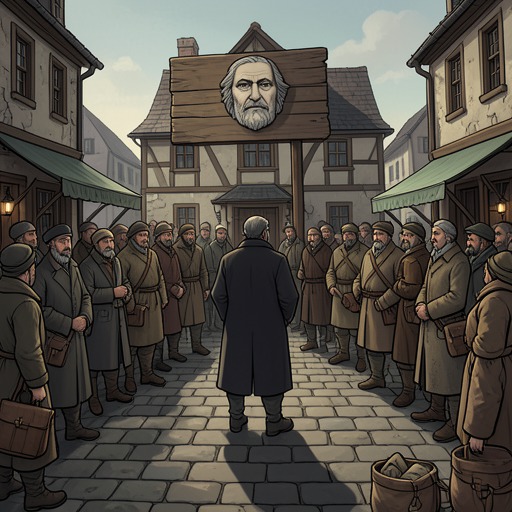
Enclosure presents a still larger threat. Edmund Jordan proposes fences, dykes, and walls, the clearance of commons and woodland, and a conversion from mixed agriculture to pasture. The plan would replace shared access and repeated seasonal uses with privately enclosed land managed for sheep and wool. Jordan’s language of social organization and economic improvement treats the villagers’ customary economy as inefficient, while their dependence on common resources makes the proposed change a direct threat to their livelihood. The map helps prepare the transformation by describing land in forms that can be divided, enclosed, and administered; the customary knowledge and claims of its users do not carry equivalent weight in that process.
Significance
Customary Common Rights are both an economic arrangement and a local account of fairness. They connect work to access, place limits on how shared produce is distributed, and make seasonal cooperation part of village life. Their strength lies in regular practice and mutual recognition, not in written title. That distinction explains why the villagers may feel genuine possession of the fields while remaining unable to prevent an estate owner or formal authority from changing their use.
The rule’s vulnerability also clarifies the stakes of enclosure. The planned conversion does not merely alter crops or property boundaries; it threatens a system in which households rely on gleaning, grazing, shared labor, and accumulated local knowledge. As the commons are claimed for a new economy, customs that once organized access can be recast as obstacles or ignored altogether. The rights therefore mark the difference between land as a source of collective subsistence and land as property to be reorganized for commercial profit.