Gleaning Queen Custom
HarvestThe Gleaning Queen Custom turns the Village’s annual gleaning into a public rite: after the barley harvest, a chosen girl steps barefoot onto the reaped field, finds a grain, and thereby opens it to the community’s gathering. The ceremony is both practical and symbolic. It marks the moment when gleaning may begin, while making the field, the villagers’ shared labor, and their customary access to its yield visible as a common inheritance. Its familiar sequence is shaken when the villagers fail to choose a Queen at the harvest dance, then resumed the next morning through the unexpected crowning of little Lizzie Carr.
Place in the Harvest Year
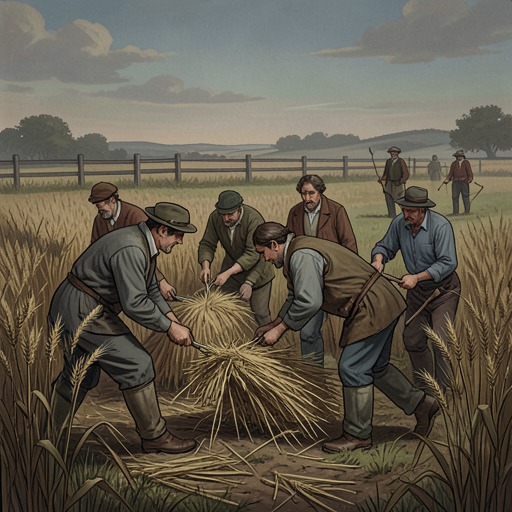
The custom comes at the end of a laborious agricultural cycle, not apart from it. The villagers reap the barley together: children weed among the standing stalks, stronger workers swing sickles and scythes, women and girls bind the sheaves, and older men build the stooks. The crop is gathered and carted away before the gleaning begins. Binding the sheaves itself reflects the custom’s shared economy: the women work on the principle of ten sheaves for the commons and one for the gleaning. The later rite therefore gives a public opening to a practice already embedded in the way harvest work and its produce are organized.
The ceremony also depends on the particular sequence of the seasons. Once the barley is cut, the villagers expect a rest day followed by Gleaning Day, when the Queen is the first to bend and pick a grain. That first gathering is modest in scale but important in meaning: the harvest is not treated as finished when the crop has been carried away. Grain left behind remains worth finding, and the right to gather it belongs to customary village life. The field that has sustained months of cultivation becomes, after reaping, a place where the community’s claim is renewed through use.
The rite brings the year’s agricultural history into view. On the morning of the ceremony, Walter Thirsk recalls plowing the field and later sowing barley by hand, after a slow spring and anxious watching for drought and gales. The Queen’s first grain is the small, tangible culmination of that shared labor and uncertainty. It connects the gleaning not only to the completed harvest but to the work that made a crop possible.
The Queen and the First Step
The choice ordinarily takes place during the celebration after the harvest. At the barn dance, Philip Earle plays the fiddle alongside Thomas Rogers’s pipe, and the music draws villagers into successive rounds of dancing. The unmarried girls eventually join in; the one judged most spirited in piety and prettiness is to become the Lady of the Harvest, or Gleaning Queen. The custom thus gives a ceremonial role to a girl selected from the village’s unmarried young women, in a communal gathering that includes children, workers, and married couples.
That evening’s selection does not go according to plan. Mistress Beldam appears at the barn entrance, and the sight of her changes the mood so sharply that the music and dancing cannot resume. The villagers imagine, for a moment, bringing her into their circle and making her Queen, a hopeful fantasy that would restore her to fellowship after her humiliation. She retreats instead. With the dance ended, the villagers go home without choosing anyone, and the next morning they recognize that they have never before begun Gleaning Day without a Queen. Charles Kent tells them that the choice can be settled at the field.
The girls and unmarried young women arrive in borrowed finery: ribbons from their mothers’ stores, and yellow flowers from gardens and hedgerows. Some decorate their cheeks and arms with petal paste. Their yellow dress makes the selection visible before it is made, turning the field’s edge into a temporary ceremonial gathering place. Charles Kent arrives on Willowjack in his best hat, decorated with cloths inherited from his late wife.
Philip Earle makes the unexpected choice of Lizzie Carr, John Carr’s niece, who is not yet five. She is gawky rather than conventionally pretty, but has decorated herself and is the yellowest of the girls. Her happiness is plain, though she steps back when Philip Earle approaches, frightened by his smile and uneven gait. Charles Kent takes over the crowning: he removes the green sash from his hat, places it on Lizzie’s head, and tells her she may keep it. The older girls are jealous, but the selection is gentle in a more important sense: it avoids choosing among them and entrusts the ceremony to a very young child.
The Grain and the Opening of the Field
Lizzie’s father and John Carr make a chair by joining their hands across one another’s wrists and carry her to the edge of the stubble. The attention makes her uneasy; she is unsure what she is expected to do, and her sister has pinched her leg. Charles Kent dismounts and helps her down. He instructs her to remove her slippers, go barefoot, and take the first step onto the field, telling her that finding a single grain is enough. The act is deliberately small: the Queen does not reap or claim the harvest for herself but begins the gleaning by entering the field and searching its leftovers.
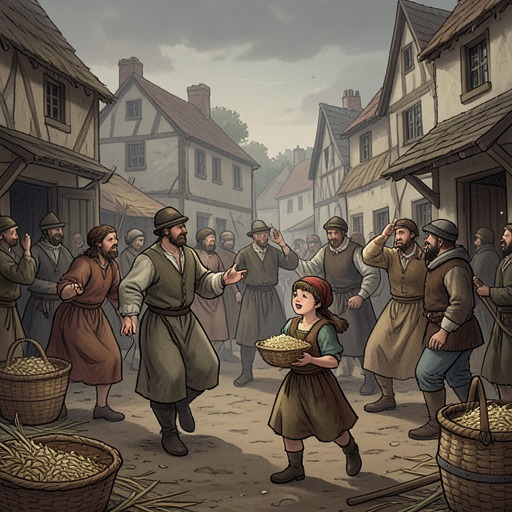
The cut stalks are initially too hard on Lizzie’s feet, so she winces as she crosses them toward a barer patch. She kneels there and finds not just an isolated grain but a complete ear of barley, intact and broad, with sharp awns. She knows how to strip the grains from the bristles, then blows away the chaff and shows the barley in her palm. The green sash has fallen from her head, a vivid patch of color against the harvested field. The villagers cheer when they see the grains: the small handful condenses the harvest into tokens of the bread and drink on which their lives depend. In the customary sequence, her discovery makes the first step both a formal opening and a compact image of the community’s material need.
Custom, Community, and Precarious Belonging
The Queen’s role is brief but collective. She is chosen before witnesses, carried to the field by her relatives, guided by Charles Kent, and celebrated by the assembled villagers. The ceremony turns gleaning from scattered individual picking into a shared beginning. Its authority comes from repetition and communal recognition rather than from a church service: the Village has no church, and its religious and communal observances gather at the wooden cross and neglected pillory beside the unbuilt church ground. There Charles Kent conducts marriages and baptisms, remembers the dead, and blesses seed corn and the plow. The harvesting customs likewise bind work, seasonal observance, and community without requiring a resident priest.
That local order is not secure. While the villagers reap, they worry that their fields may be sold and that their tenancy may not endure. They also drive pigeons and the master’s near-white doves from fallen grain, insisting that the ancient gleaning rights make those remains theirs. Against this anxiety, the Queen’s entry into the field publicly enacts a customary claim to the crop’s residue. The rite cannot resolve the conflict over land, but it shows how belonging is practiced: through work, shared knowledge of the season, and the ability to enter the field after the harvest.
Mistress Beldam’s appearance gives the custom an especially uneasy frame. The villagers briefly envision crowning her and restoring her to the dance, but their imagined reconciliation does not happen; she leaves, and the following morning Lizzie becomes Queen instead. The ceremony proceeds, yet the missed selection and the previous night’s rupture remain part of its immediate setting. By giving the first step to a child and celebrating a single ear of barley, the custom affirms continuity without proving that the old agricultural order will last. Its promise is grounded in the field and in shared practice, even as the villagers’ confidence in that future becomes increasingly fragile.