Right of Settlement by Hearth
HarvestThe Right of Settlement by Hearth is a customary claim that a person may secure a place on common ground by building a dwelling and lighting a fire. When newcomers put up a rough shelter beyond the field boundaries and raised smoke at dawn, their act announced not only their arrival but their belief that they had met the conditions for staying. The claim immediately became a test of whose law, labor, and authority could define belonging.
The custom and its signal
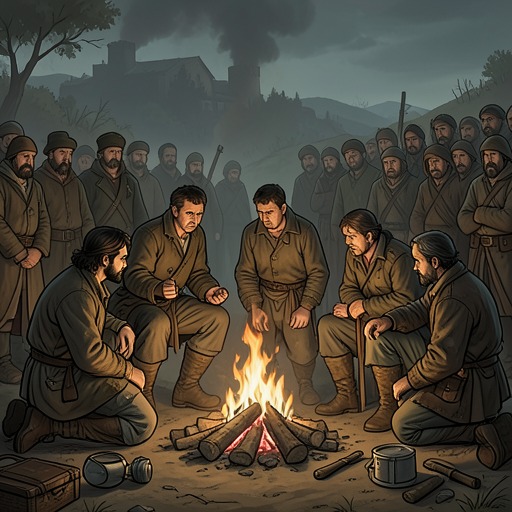
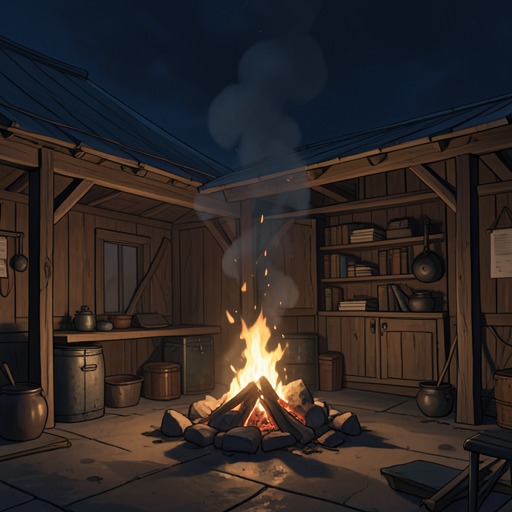
The newcomers’ first dwelling stood on common ground, in the shelter of the woods, beyond the fields’ frontier ditches. They gathered fallen timber into four rough walls, added a little roof, and lit a hearth. The fire was dampened with wet greenery so that its plume would be dark and conspicuous. To the narrator, the smoke declared that new neighbors had arrived, built a place, laid a hearth, and known the custom and the law; the first smoke, in this understanding, gave them the right to stay.
The sequence matters: the claim did not rest on a deed or a grant from the landowner, but on visible acts of settlement. A structure and a fire made a claim legible across the landscape. Yet the villagers did not agree that any shelter and hearth would necessarily suffice. The newcomers’ hut was made from uncut fallen wood, earth, leaves, and sacking, and was so low that its walls seemed better suited to a pig enclosure than a family home. Whether such a makeshift dwelling could establish a right of settlement remained uncertain to the villagers.
Competing claims to the commons
The villagers opposed the newcomers’ claim with their own customary understanding of possession. Charles Kent held the land by title and inheritance through his marriage to Lucy Kent, the daughter of the former landowner, Edmund Jordan. But the villagers argued that deeds alone did not make the fields productive: their hands performed the harvest and the other labor on which the estate depended. Though they possessed no comparable documents, they considered themselves entitled to the ground and to the common rights attached to it.
That local claim collided with a ruling from elsewhere that, in the villagers’ understanding, gave a right of settlement to anyone able to build four walls and raise smoke before being discovered. They feared that this would cede part of their already limited share to newcomers. Their anxiety was sharpened by declining numbers, poor harvests, and winters when the cattle ate while some villagers went without. They had themselves arrived from elsewhere, as the narrator acknowledges, but now treated the newcomers as a threat to a community whose resources and population were shrinking.
Enforcement, discretion, and exclusion
The rule had no uncontested local enforcer. The village was remote from a market square and had neither magistrate nor constable; Charles Kent, as landowner, was left to decide how to respond. He was described as just but hesitant about legal punishment, preferring not to deprive a family of its father, husband, or son. For wrongdoing short of a felony, the expected local penalties might include a beating, a period sleeping rough beyond the boundaries, or the taking of livestock in compensation. The right of settlement therefore operated in a landscape where formal law, the landowner’s discretion, and village practice overlapped without resolving who could finally decide.
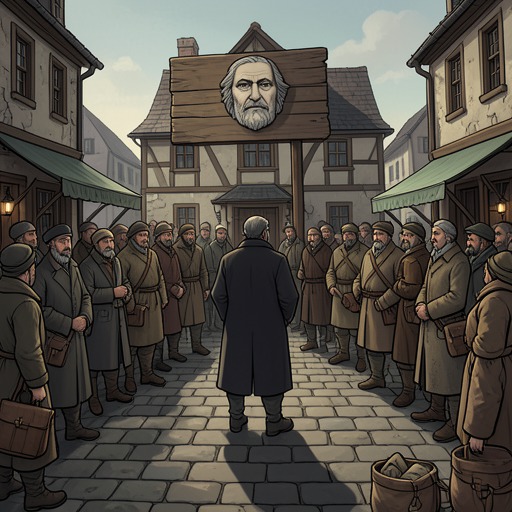
The villagers’ response also exposed the difference between acknowledging a custom and accepting the people who invoked it. They planned to walk the newcomers to the boundary and send them on their way, even as the settlement rule appeared to support the newcomers’ presence. Their suspicion was intensified by the stable fire: the narrator knew that a moonball had been used to smoke out the doves, but did not report it, reasoning that it was not evidence and that the villagers did not want their holiday spoiled. The neighbors instead focused on the newcomers and the bird remains found near their shelter. The rule was thus entangled with a dispute over blame as well as land.
Significance in the narrative
The Right of Settlement by Hearth turns a modest act of shelter-making into a challenge to the village’s boundaries. Smoke is both practical evidence of occupation and a public signal that the newcomers claim to know the law. Against it stand the villagers’ labor-based sense of possession, their fear of losing common resources, and Charles Kent’s authority as title-holder. None of these claims neatly cancels the others.
The episode also makes the villagers’ welcome conditional and self-serving. Their own arrival in the community resembles the newcomers’ claim, but settled life has taught them to treat later arrivals as dangerous outsiders. The newcomers’ makeshift home is therefore judged not only by whether it meets a customary test, but by who is making the claim and what the established community fears it may lose. In this account, the right to remain is asserted through a hearth, contested through local power, and left unresolved in the face of threatened expulsion.