Customary Sharing of Produce
HarvestCustomary Sharing of Produce is the village’s rule for making harvests and provisions serve household subsistence rather than market exchange. It joins the distribution of food to collective work, gleaning, and customary access to land: the villagers’ claim rests not on title deeds but on the labor and recurring practices through which they make a living. As Charles Kent’s estate faces conversion to sheep pasture, that arrangement becomes more than a way of allocating food. It is a competing account of who has a legitimate claim to the land and its yield.
The Rule and Its Material Basis
The narrator contrasts the village’s stores with the wider world, where flour, meat, and cheese are weighed and sized for sale instead of divided into portions for the larder. In the village, produce is understood through household need and common provision. The arrangement does not make harvests abundant or secure: the barley may be weak, and the weather, disease, and animals can threaten crops and livestock. Its purpose is to distribute what the community can obtain, not to guarantee that there will always be enough.
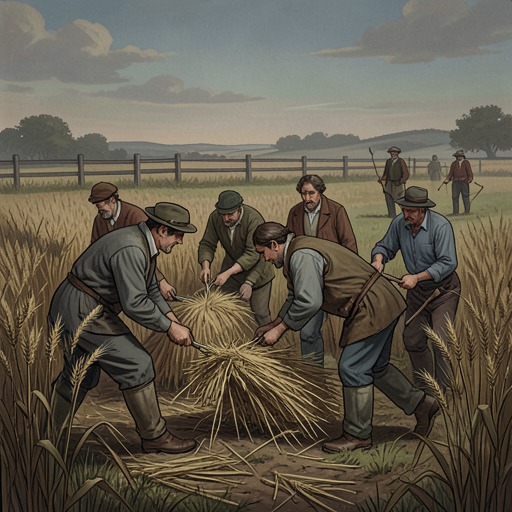
That rule is sustained by work shared across generations and capacities. At harvest, children go ahead to remove weeds and thistles; the strongest workers cut the grain; wives and daughters bind the sheaves; and older men make the stooks. The small population makes each worker’s contribution necessary. The harvest is also a public occasion, when familiar neighbors work within the same boundaries and hear one another’s talk. Distribution is therefore embedded in collective labor and social knowledge, rather than treated as an exchange between isolated producers and buyers.
Harvest, Gleaning, and Customary Access
The harvest’s division of labor also shapes who receives what remains. The sheaves are bound according to a working principle of ten for the commons and one for gleaning. After the main reaping, villagers may gather the grain left in the field, and the customary gleaning is expected to follow the rest day. Charles Kent tells the villagers that they may keep what they glean for their own kitchen pots, whether for stew, beer, or animal feed, rather than add it to the common store. The field is then used in a customary sequence: cattle feed on the stubble, followed by geese and hogs.
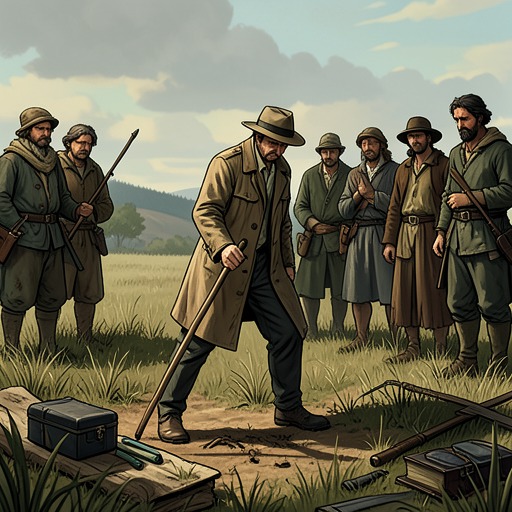
These practices make access a matter of local use as well as formal ownership. During the annual beating of the bounds, the community follows its familiar route, renews its sense of where the village belongs, and takes stock of resources and needs. The narrator describes the occasion as a time for airing grievances in company and with restraint. Complaints may concern how much common grazing a household should receive after gaining another mouth to feed, or how household waste and shared facilities affect neighbors. Such disputes show that customary provision is not simply an undifferentiated sharing of everything: it requires judgments about access, household needs, duties, and inconvenience.
Rights Without Deeds
The villagers recognize that Charles Kent owns the fields and possesses the documents that attest to that ownership. They nevertheless understand themselves as entitled to be possessive of the ground and its common rights. Their argument is practical: a landowner cannot work the estate with his own hands alone, while the community’s labor produces the harvest. The villagers may describe themselves as oxen to his halter, but the comparison also underscores their dependence and their claim to a share in the land they work.
That customary claim is strained by the arrival of newcomers who may acquire a right of settlement by building a dwelling and lighting a fire on the common outskirts. The villagers see such an entitlement as granting outsiders a portion of resources on which their households already depend. Scarcity sharpens the conflict: the population has declined, harvests have been poor, and there are winter days when the cattle eat and the people do not. The rule of sharing therefore operates within boundaries that the villagers regard as necessary to their survival, even when written rules or an external authority define those boundaries differently.
Enclosure and the Market Recast
Edmund Jordan’s reform plans challenge the customary system at its foundation. He dismisses agriculture without coin as irrational and proposes enclosing the commons, clearing trees, and replacing plowing and reaping with pasture and sheep raising. In his account, wool is more predictable than crops exposed to unreliable sun and rain, wind, mildew, disease, and birds. The proposed change would redirect land and labor from food production toward wool, cloth, and profit.
Edmund Jordan describes society as a system in which each person’s part should make the others’ part more comfortable, but his plan places the estate’s returns above the villagers’ customary provisions. His steward, Baynham, is to arrange fences, ditches, and walls and employ only the workers required for the new enterprise. Charles Kent points out that the village has fewer than sixty people to feed; Jordan answers that there may be work for some as shearers or shepherds, while economies will have to be made. Charity, a church, and a priest are offered alongside that contraction, but they do not preserve the old distribution of land and produce.
Significance and Displacement
The customary rule is neither a written code nor a guarantee of equal shares. It is a working order maintained through harvest labor, gleaning, common grazing, seasonal routines, and the settlement of local grievances. Its authority comes from repetition and shared dependence, while its limits are negotiated within the village. This helps explain why the villagers interpret the measuring of land and people as a threat: a chart that counts them as fifty-eight does not record the obligations, skills, and claims that make their common system function.
Enclosure would change not only who controls the fields but what the fields are for. Under the existing arrangement, crops and common resources support households directly; under Jordan’s scheme, land becomes pasture and wool becomes a commodity whose profits travel through merchants, manufacturers, and sellers. The conflict over produce is thus a conflict between subsistence and market valuation, and between customary participation in the land and authority grounded in estate ownership. As sheep farming threatens the plow and the common stores, the villagers’ rule loses the material basis on which it has endured.