The Custom of Securing Commons Tenure by Building a Home and Lighting a Fire
HarvestThe Custom of Securing Commons Tenure by Building a Home and Lighting a Fire makes a modest dwelling and its smoke a claim to remain on common land. It gives displaced people a way to establish a foothold, but its promise is contested: the village regards the newcomers’ settlement as an intrusion on shared resources, while their claim invokes a rule the inhabitants themselves recognize as law. The conflict exposes how belonging depends not only on who owns the land, but also on who can make a home there and whose customs will be enforced.
The rule and how it works
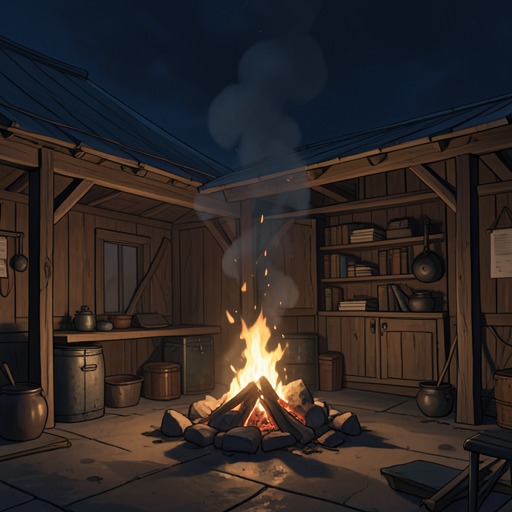
The custom turns a few visible acts into a claim of residence. A newcomer must put up a dwelling, described as four rough walls with a roof, and light a fire before being caught. The rising smoke signals that a hearth has been made and, in the narrator’s account, gives its occupants liberty to stay. The claim is practical rather than documentary: its evidence is the structure and the fire, not a title deed.
The rule is not presented as an abstract guarantee of safety. Its operation depends on reaching common ground and completing the settlement before opponents intervene. The people who rely on it must know the custom and law, and must be able to build quickly with what they have. The simplicity that makes the rule usable also makes its protection vulnerable to force.
Competing claims to the commons
The villagers resent a distant ruling that lets vagrants secure settlement by building four walls and sending up smoke before they can be stopped. They understand the land through their own customary rights: although Charles Kent holds the deeds, the inhabitants believe their labor and long use make them possessive of the ground and the resources attached to it. To them, the newcomers’ hearth does not simply mark a home; it appears to take a portion of a share already needed by the community.
That resistance is sharpened by scarcity. The village’s population has fallen, harvests have been poor, and there are winters when the cattle eat but the people do not. The villagers fear that strangers arriving as the harvest ends may be demanding a share at precisely the moment local households are counting their own provisions. Their suspicions are not proof of wrongdoing, but they help explain why a rule intended to offer shelter is treated as a threat to established communal claims.
The dispute also exposes divided authority. The villagers have no magistrate or constable, and Charles Kent is described as cautious about punishment; nevertheless, the inhabitants gather with sticks and other implements and move toward the newcomers’ smoke. Charles Kent recognizes that the newcomers have asserted a claim, but his authority as landowner does not resolve the conflict between the settlement rule and the villagers’ customary possession. The rule exists alongside estate power and local practice, rather than replacing either one.
Settlement, resistance, and displacement
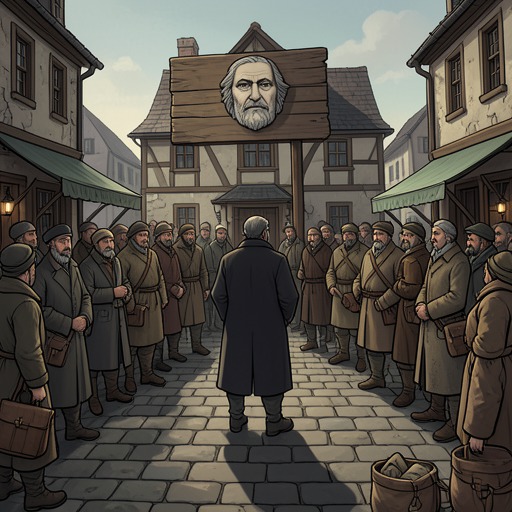
The newcomers’ first fire is associated with a home on the outskirts of the commons. Their settlement becomes a point of confrontation: the villagers challenge their presence, and the newcomers’ resistance, including their bows, makes the encounter more fraught. The newcomers are subsequently confined in the village pillory. The sequence shows the gap between having a recognized way to claim residence and being able to remain safely once that claim is challenged.
Later, Mr. Quill explains that the newcomers are fugitives from sheep, driven from their own commons after enclosure and the loss of their ancient livelihoods. The settlement custom therefore offers not a secure end to displacement but a possible next foothold for people already forced from one home. As the villagers themselves leave, Walter Thirsk imagines that those taking the forest route may reach another common, build a hut, and light a fire there. Their smoke might again secure permission to stay, though the account presents this as a hope rather than a confirmed outcome.
Significance
The custom makes the hearth a compact sign of both need and legal claim. Against deeds and estate boundaries, it asserts that making a place habitable can establish a right to remain. Yet the villagers’ own attachment to the commons complicates any simple opposition between lawful newcomers and possessive landowners: they too claim customary rights, and they fear that sharing land will endanger already fragile subsistence.
The rule’s recurring promise is shadowed by enclosure. Those displaced by the conversion of commons to sheep pasture may carry the custom with them, but each new settlement depends on finding another shared ground and reaching it before opposition closes in. The smoke that announces a home can therefore signify both the possibility of refuge and the precariousness of belonging.