The Rule Against Crossing Estate Boundaries
HarvestThe Rule Against Crossing Estate Boundaries makes a mapped or marked line carry the force of a social order. Charles Kent’s instruction, “If we stay within our bounds, there are no bounds to stay us,” promises security inside the limit while warning that a step beyond it can mean losing one’s place and everything attached to it. The rule therefore concerns not just trespass but who belongs, who may claim the land’s resources, and what awaits those pushed outside.
Authority and Limits
The rule operates where different kinds of authority overlap. Charles Kent possesses titles, deeds, and inherited claims to the estate, but village custom gives the inhabitants a strong sense of possession grounded in their work and dependence on the land. They harvest its grain, tend its fields, and rely on common rights; their customary claim is not recorded in the documents that establish ownership. To them, those who make the land productive have a stake in it that cannot be reduced to paperwork.
The difference becomes urgent when newcomers establish themselves on the common outskirts. A distant legal ruling appears to grant a right of settlement to people who build a home and make smoke, while villagers regard the same act as an intrusion and want the newcomers driven beyond their cherished boundaries. The conflict is not a simple opposition between law and lawlessness: Charles recognizes the written law when he confronts the newcomers, even as the inhabitants fear that its protection will transfer part of their customary share to strangers.
Local enforcement is also shaped by the village’s isolation. There is no magistrate or constable nearby, and Charles is reluctant to punish workers by depriving their families of a father, husband, or son. For serious offenses, the likely sanction is a beating, a period of rough sleeping beyond the boundary, and possibly the seizure of animals as recompense. Expulsion thus turns the boundary into a practical instrument of discipline, even where formal legal institutions are absent.
Custom and the Making of Belonging
The boundary is taught and renewed through communal practice. Each spring, the villagers follow the bounds together, taking stock of what they possess and hope to grow. Children are bumped against boundary stones so they will remember where they and their community belong; they are also made to taste the ground as cattle would. The ceremony joins bodily memory to local knowledge: the line is not merely something to see on a map, but something learned through repeated participation in the land.
That knowledge is practical as well as symbolic. The villagers’ customary survey considers grievances, grazing, composting places, ponds, trees, peat, reeds, firewood, walls, and fences, along with who should undertake the work of maintaining them. Philip Earle’s surveying, by contrast, records views, plants, and measurements without attending to the labor and uses that sustain village life. The contrast shows why the inhabitants distrust a boundary or map made without their participation: it can describe land while failing to register the relationships and obligations through which the community inhabits it.
The harvest makes those relationships visible. Everyone able to work is expected to reap, and the customary division of labor reserves a share for the commons and another for gleaning. The inhabitants’ alarm when Philip Earle measures the field and counts them—fifty-eight people—arises from the suspicion that their shared land and subsistence may be converted into property valued for sale. In that setting, crossing a boundary can threaten more than a dwelling; it can unsettle access to grain, grazing, and the customary arrangements that make survival collective.
Enforcement and Exclusion
The rule does not protect everyone equally. The villagers fear strangers partly because their own numbers have fallen, harvests have been poor, and winter can leave cattle fed when people are not. They resent the prospect of sharing scarce resources, although they recognize that some of them, including Walter Thirsk, once arrived as outsiders themselves. Belonging is thus made to depend on an established place in the community, not simply on the fact of having crossed into the area in search of a home.
This guarded welcome has a harsher counterpart in the villagers’ attitude toward the newcomers. They imagine the outsiders as a danger to their food and security and seek to send them beyond the village limits. Meanwhile, the customary right of settlement challenges the assumption that the existing inhabitants alone can determine who may occupy the common. The boundary becomes the point where competing claims—local memory and need, estate ownership, and a distant legal right—meet without resolving into a shared rule.
Walter Thirsk’s Departure
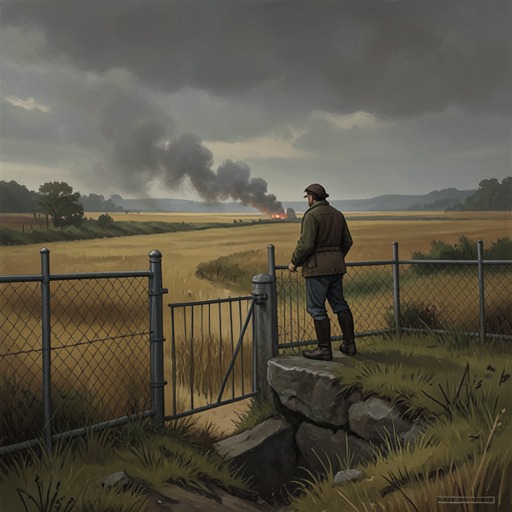
At the end, Walter carries the boundary ritual into his own departure. He reaches a waist-high merestone marked with orange lichen, snaps off grass from the village side, and tastes it as the villagers have taught their children to do. He grips the stone and bumps his head against it three times, hard enough to break the skin. The action recalls the communal lesson of belonging, but now he performs it as an adult who is about to leave.
Walter’s possessions make the crossing a record of what the boundary cannot keep. He carries four reminders marked in or made from skin: his bloodied forehead, the burn on his palm, a fading kick wound, and a piece of calfskin vellum he made himself. He has also burned Philip Earle’s charts, including one depicting the commons and village and another proposing future pastures; the vellum he keeps is blank. Facing back toward the quiet village, he sees the winter wheat he sowed growing without anyone to observe it, then gathers his modest belongings and steps beyond the limit alone, not knowing where he will find rest.
Significance
The rule’s meaning changes across the narrative. For the community, repeated boundary-walking turns the limit into a shared map of work, memory, and customary rights. Under pressure from estate plans and competing claims to settlement, the same limit becomes a means of excluding newcomers and disciplining offenders. For Walter, it finally marks the break between the village that formed his habits and a future beyond its protection. His departure exposes the rule’s double force: it offers belonging to those recognized as inside, but makes crossing outward an act of loss as well as escape.