The Seven-Day Stocks Sentence
HarvestThe Seven-Day Stocks Sentence is the punishment imposed on two newcomers, who are fastened to the village pillory for a week. Its severity lies not only in the sentence’s duration but in the pillory’s double life: a neglected instrument of discipline that has also become the village’s cross, gathering place, and site of communal rites. When Walter Thirsk is later ordered to enforce the sentence to its final hour, the rule makes obedience concrete in the exhausted body of the prisoner before him.
The Pillory as Punishment and Village Cross
The pillory had not been used for many years. Its iron bolt key, kept by Charles Kent with other keys on a bronze chain in his parlor, was rusty and had broken wards. About ten harvests earlier, two related Saxton cousins had spent a night confined there after fighting over ownership of a pig. By morning they had settled their quarrel, divided the pork carefully between them, and turned the episode into a running joke. That brief confinement stands in sharp contrast to the newcomers’ seven days.
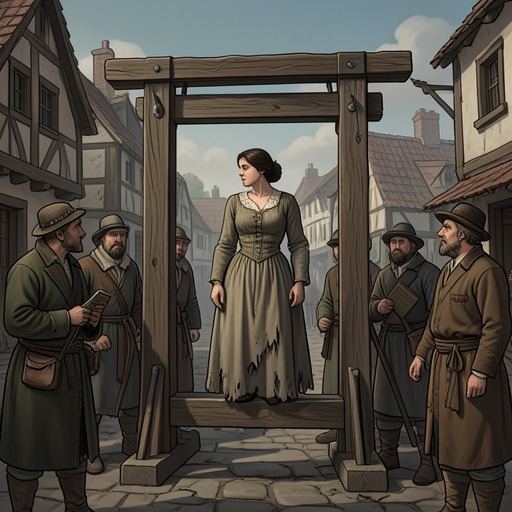
In the absence of a completed church, the pillory had become the village’s cross and one of its few shared public places. The plot reserved for a church held graves, unlaid stones, and a buried foundation block, but no church building. At the pillory, Charles Kent conducted marriages and baptisms, delivered eulogies, comforted the bereaved, and led the community in blessing seed corn, giving thanks for the harvest, and blessing the plow. Rosaries and flower chains could hang from the openings intended for prisoners’ necks and wrists. The same wooden structure thus joined communal care and penal authority in one conspicuous place.
The Sentence and Its Enforcement
The two newcomers are left hanging at the village cross for seven days. The villagers had regarded this as a mild punishment: elsewhere, the men might have faced a beating or a hanging, and their bows had also been broken and their heads clipped. Yet the sentence’s apparently moderate terms do not prevent it from becoming physically punishing. As Walter sees the confined man in daylight, the prisoner is pale and drained of blood and energy; his wrists and throat are bruised from trying to pull free, his lips are cracked, and insect bites and sores mark his swollen neck.
When Edmund Jordan prepares to leave with three prisoners, he assigns Walter to remain as his ears and eyes in the village. Jordan also makes him responsible for the remaining days of the confinement: the prisoner has three days left, and Walter is told not to show leniency but to release him only when the appointed hour arrives. Walter gives his word, though he hates himself for doing so. The sentence is therefore extended beyond the moment of its imposition: its continuation depends on a local man’s decision to honor an order he finds morally troubling.
The Human Cost and Moral Pressure
Walter’s later approach to the pillory exposes the gap between calling the penalty mild and witnessing what it has done. The prisoner, once thick-armed, now appears depleted; the bruises, cracked lips, and irritated skin make the passage of time visible on his body. He has been left with little strength after days of enforced stillness and discomfort. The formal limit of seven days does not make that suffering abstract or harmless.
Walter approaches carrying the key he says he has stolen and a blood-tipped sword. He wants to reassure the prisoner, but his face is frozen and his greeting comes out as an artificial smile. The man does not look at him. The scene places Walter between the promise he gave Jordan and the vulnerable person whose condition he can now see at close range. The sentence’s final days become a conflict between exact obedience to the rule and the impulse to relieve its consequences.