The Gleaning Queen Tradition
HarvestThe Gleaning Queen Tradition is the village custom of choosing a girl to lead the gleaning after the barley harvest. Her first step onto the stubble and search for a grain give ceremonial shape to the work of gathering what the reapers have left behind. The rite binds the seasonal cycle to shared labor and food; as the fields face conversion from grain to pasture, it also preserves a vivid image of the life the village may be losing.
Harvest Work and the Queen’s Place
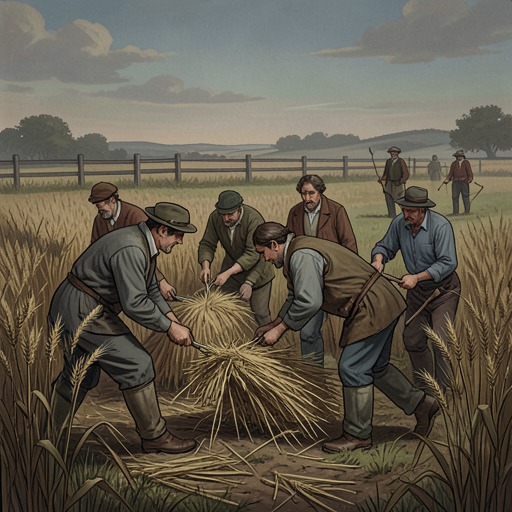
The custom belongs to a harvest in which labor is collective and participation is expected. With the village’s numbers diminished, everyone able to work has a part: children clear weeds, stronger workers reap, women and girls bind sheaves, and older men build the stooks. The work is not only a means of securing the year’s grain. It gathers neighbors in one field, where their tools move together and conversation is public. The gleaning that follows extends this shared economy beyond the reaping itself: the sheaves are bound on the understanding that most belong to the commons, while a smaller portion is left for gleaners.
The Queen gives the next stage of that work a human focus. Girls dress themselves with borrowed ribbons and flowers from gardens and hedgerows, and the village chooses one to begin gleaning. The choice is ceremonial, but the task it authorizes is practical: the Queen enters the harvested field first, searches among the stubble, and finds grain for food and drink in the colder season. Her ritual position therefore joins pageantry to the material need that governs the agricultural year.
The Interrupted Selection and Lizzie Carr’s Crowning
The choice is supposed to precede the first gleaning, but the village’s selection is interrupted when Mistress Beldam appears at the barn during an evening of dancing. Her arrival changes the mood and ends the revelry before a Queen is named. The villagers imagine that welcoming her into the dance and crowning her might repair the wrongs done to her, but she withdraws instead. The ceremony is postponed, leaving the community to approach Gleaning Day without its customary sovereign.
The next morning, the girls assemble in finery made from family stores and gathered flowers. Charles Kent arrives wearing cloths associated with his late wife, and the choice is made among the assembled girls. Philip Earle selects Lizzie Carr, John Carr’s niece, who is not yet five. She is not the expected choice among the older girls, but her visible delight makes the moment unmistakably hers. Charles Kent removes the green sash from his hat and places it on her head, giving her the cloth to keep. The sash is at once a crown and a tangible sign that the child has been invested with the role.
Lizzie’s father and John Carr carry her to the edge of the stubble in a chair made by crossing their wrists. Charles Kent helps her down and instructs her to remove her slippers, step onto the field, and find a single grain. She takes several cautious steps over the rough ground, kneels, and finds not merely one loose grain but an intact ear of barley. She separates the kernels, blows away the chaff, and presents the grains to the onlookers. The villagers answer with cheers: the harvest’s bread and drink are represented in the small handful on a child’s palm, while the Queen’s first step formally opens the gleaning.
Meaning, Belonging, and Vulnerability
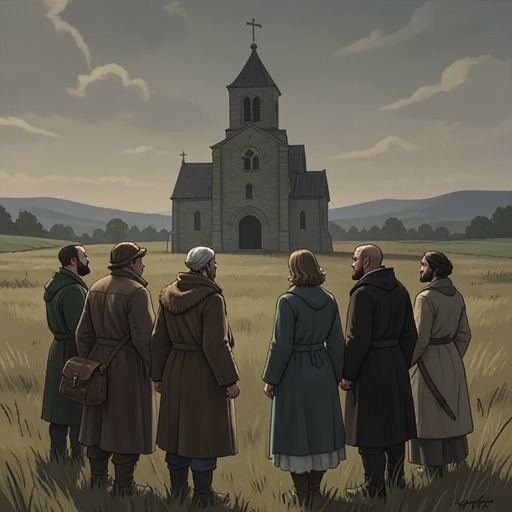
The rite’s communal meaning is sharpened by the village’s religious circumstances. There is no completed church, and the inhabitants conduct important observances at a wooden cross that also serves as the neglected pillory. At that place Charles Kent has presided over marriages and baptisms, remembered the dead, and blessed seed corn and the plow. Harvest thanksgiving and the blessing of agricultural work thus belong to a religious life practiced locally, without a resident priest or church building. The Queen’s ceremony is part of this same practical sacred order: field, food, labor, and community supply its setting and purpose.
Yet the role that makes Lizzie the center of a communal celebration also makes her appearance vulnerable to misreading. Later, while the green sash still marks her as Queen, she leaves the threshing barn to renew the flowers she wore at her crowning. Edmund Jordan’s men, already looking for clues in the search for Willowjack’s killer, regard the fine cloth and flowers as suspicious. Walter Thirsk reconstructs the encounter from what villagers say and imagines the men questioning Lizzie and taking her to Edmund Jordan; the account is therefore presented through rumor and conjecture, not as a scene he witnessed. The tradition’s emblem of honor has become, in the eyes of the searchers, a reason to scrutinize a child.
When Walter later sees Lizzie among the prisoners being led away, she still wears the sash, now dirty and torn. The contrast with her earlier crowning is stark: the girl who had been helped from a chair of crossed hands and cheered for finding grain is now frightened and separated from the neighbors who had made her Queen. The ceremony cannot protect her, and its symbols do not retain their meaning under the pressure of armed authority.
A Custom Under Threat
The Queen’s role also returns in Walter’s memory as the village’s land use changes. Looking back on the harvest ceremony, he recalls Charles Kent describing gleaning as a benefit shared by families, livestock, geese, and hogs. But the barley field is now being prepared for winter wheat, and the announced conversion of the estate toward sheep farming casts doubt on whether another grain harvest will follow. Edmund Jordan has told the villagers they will no longer need the plow. Walter remembers that promise while the field is being opened by the plow once more, leaving the future unresolved rather than settled.
The Gleaning Queen Tradition consequently stands between two economies. Its sequence depends on grain being cut, stubble remaining for gleaners, and a community still able to share the field’s yield. The later vision of winter wheat and sheep pasture threatens those conditions, while Lizzie’s capture exposes the gap between ceremonial belonging and actual security. The custom survives in memory as more than a charming festival: it records how the village organized labor, acknowledged dependence on the harvest, and gave even its youngest member a temporary, public place within the community.