Gleaning Rights
HarvestGleaning Rights allow the villagers to gather grain left in the field after the main harvest, turning what remains among the stubble into food and winter provisions. The custom is part of a wider system of shared labor and common use: it depends on the harvest being brought in collectively, and it gives the village a claim to the field’s leftovers even when birds or estate plans threaten that claim.
Place in the Harvest
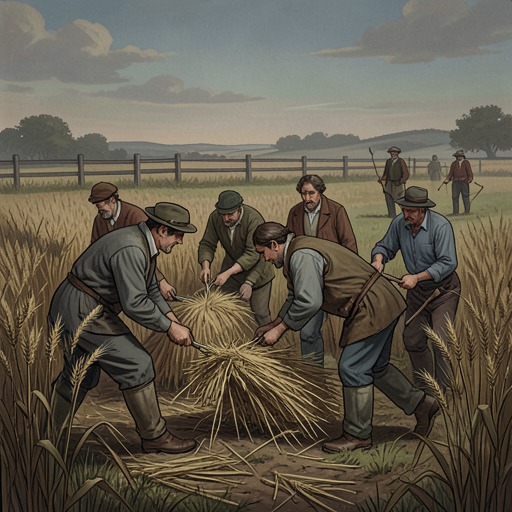
Gleaning takes place after the barley has been cut and gathered, not instead of the harvest work that makes it possible. The village’s reaping is organized across generations and abilities: children weed among the standing grain, the strongest workers use sickles and scythes, women bind sheaves, and older villagers set the stooks. In one account of the practice, the sheaves are bundled according to a ten-to-one principle: ten for the commons and one for gleaning. The division places gleaning within an arrangement that serves both shared stores and the customary gathering of what remains.
The harvest is demanding, especially in a year when the crop is uneven and the village has too few people to spare any useful worker. The barley on the lower, shaded ground and neglected slopes is short and poor, while the higher field ripens more promisingly. Its color, dryness, and brittleness tell the villagers when the grain is ready. Their knowledge of the crop is practical as well as seasonal: reaping must be done in time to secure food for the year, and the gleaning that follows is valuable because scarcity makes every remaining grain matter.
Claims to the Stubble
The custom gives material meaning to the villagers’ understanding of the commons. They know that their landowner holds deeds and titles, but they also understand the ground through the work that makes it yield: planting, tending, and harvesting. In this account, customary rights are not abstract privileges. They attach to a field at a particular moment, after the main crop has been gathered, and enable people to claim barley that would otherwise be lost or taken by others.
That claim becomes visible when Pigeons and other birds descend on the stubble. The villagers regard the fallen grain as theirs by ancient gleaning rights, so the birds’ feeding is treated as a direct encroachment on their bread and ale. Children are sent to drive them off with slings, handfuls of grit, or shouts. The noise and movement across the field are more than a response to hungry birds: they also demonstrate that the villagers are present and continuing to exercise their customary claim.
The distinction between ownership by document and possession through use remains unsettled. The villagers know that Charles Kent owns the fields, yet they consider their rights attached to the land despite having no written title of their own. Gleaning therefore belongs to a larger customary order in which shared access and labor complicate the neatness of estate ownership. It does not erase the landowner’s authority, but it marks limits on what that authority means in everyday practice.
The Queen and the First Grain
The village’s Gleaning Queen ceremony gives the custom a public beginning. After a day of rest, the villagers expect their chosen Queen to bend first and pick a grain. Charles Kent confirms that gleanings may be kept for household use rather than added to the common stores. He names practical purposes for the barley: it can go into kitchen pots for stew or beer, or be used as animal feed. In this instance, the villagers’ customary right is not merely assumed; the landowner expressly recognizes it.
The ceremony makes an individual act—the first picking—stand for the community’s harvest and its shared hopes for food and drink. When Philip Earle chooses Lizzie Carr, she is not yet five. Charles Kent gives her the green sash from his hat as a crown, and her father and John Carr carry her to the edge of the stubble. Guided by Charles Kent, she removes her slippers and steps barefoot into the field. She kneels to search, finds a whole ear of barley rather than a single loose grain, separates the kernels in her hands, and displays them to the villagers, who cheer. The chosen child’s small handful condenses the larger labor into something visible: grain recovered, shown, and valued by the people who depend on it.
Pressure and Significance
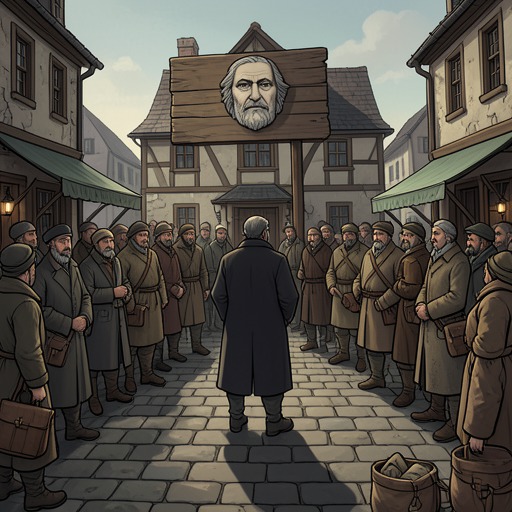
The harvest customs operate under pressure from both immediate scarcity and possible changes to land use. The villagers’ alarm grows when Philip Earle returns to count them and measure the land. They fear that his charts may signal a sale or a transformation of the fields. They quiet their usual harvest joking and grow more watchful; the presence of Pigeons taking grain from the stubble gives them a concrete occasion to defend the tenancy they fear losing.
Later, Charles Kent describes a more prosperous future based on sheep, wool, and weaving, presenting it as relief from the uncertain work of growing crops. But the prospect also implies that reaping may give way to shepherding and that the routines which sustain gleaning may not continue. At a subsequent Gleaning Day, he again permits villagers to keep the remaining barley, while his account of what follows includes cattle, geese, and hogs. His silence about the plowing that had customarily followed the hogs unsettles Walter Thirsk, who suspects that the field may not be plowed again for crops. The ceremony and the right it enacts persist even as the future of arable farming appears uncertain.
Gleaning Rights thus connect customary justice to material survival: they specify who may gather the leftover crop, when that access begins, and how it is publicly affirmed. Their force rests on shared practice rather than documents alone, and on a community whose members work the fields together. As the estate’s plans threaten to alter the use of the land, the grain collected from the stubble becomes a measure of what the villagers may still claim—and of how much depends on the continuation of the old agricultural year.