Sheep Enclosure Policy
HarvestThe Sheep Enclosure Policy is the plan to fence and reorganize The Village’s land for sheep raising, replacing common cultivation and subsistence farming with a wool economy. Its significance lies not only in the proposed change of crops: enclosure would also displace customary access to fields and resources, recast residents as a reduced labor force, and transfer control of the landscape from communal practice to estate management. The policy is introduced through Charles Kent’s hopeful language of shared prosperity, then stated more bluntly by Edmund Jordan as a scheme for profit.
The Commons Before Enclosure
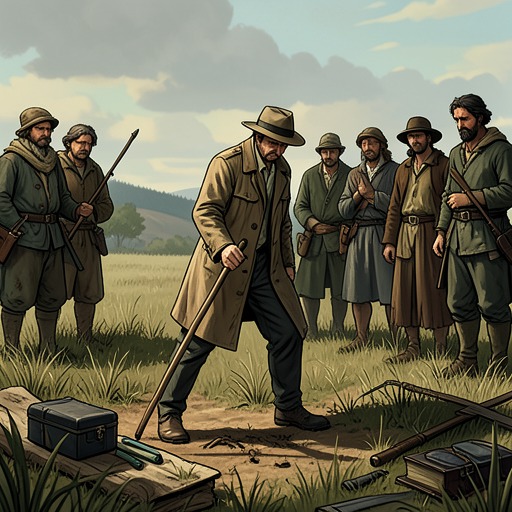
The policy confronts an established working order in which land is valuable through the food, fuel, and materials that people collectively draw from it. Harvest is organized around village labor: children weed among the standing grain, workers reap, families bind sheaves, and older residents make stooks. The customary division allows a portion of the crop to enter the commons and a further portion to be gleaned. Gleaning gives villagers a recognized claim to grain left in the field after the reaping, rather than treating every fallen ear as the landowner’s private property.
This economy depends on more than the harvest itself. Common access is connected to seasonal decisions about grazing and the uses of particular places. During the annual beating of the bounds, residents take stock of what is available and expected to grow, teach children where the community’s boundaries lie, and air local grievances. Their knowledge includes where to gather peat and turf, which reeds are suitable for thatching, where to find firewood, and which walls or fences need repair. Such practices make the land a shared resource maintained through recurring work, customary expectations, and local negotiation.
The villagers’ rights are not secured by the same documents as Charles Kent’s ownership. They distinguish his deeds and titles from their own claim, grounded in long use and the labor needed to make the estate productive. That claim is material as well as customary: without the people who plow and reap, the landowner could not sustain his property through his own labor alone. Enclosure therefore threatens an existing relationship between ownership and use, not an empty landscape awaiting improvement.
From a Reassuring Dream to a Policy
Charles Kent first presents the proposed transformation as a dream of relief from agricultural uncertainty. Crops can fail through poor weather, disease, or birds; wool, he argues, is more dependable and does not rely on sunshine to grow. In his imagined future, residents would tend sheep, shear them, and make cloth at home rather than endure the strenuous work of plowing and reaping. Woollen goods could travel from the estate to distant buyers, while villagers supposedly gained more leisure and a share in prosperity.
That account softens the change by describing its hoped-for benefits without initially naming its central replacement: sheep for grain. The promise is especially persuasive at the harvest feast, when food and drink have been provided by Charles Kent and the villagers are occupied with celebration. Yet the prospect is already disturbing to the narrator, who understands that enclosure means walls, hedges, ditches, and gates; the clearing of common land and trees; and a conversion from producing food to supplying wool. The difference between the reassuring dream and the material plan becomes clear when future prosperity is measured against the loss of familiar uses of the land.
The harvest customs make the change tangible before the full announcement. On the day of gleaning, Charles Kent confirms that villagers may take remaining barley for their own kitchens instead of adding it to the common store. He describes the customary order for animals entering the field: cattle first, then geese, and finally hogs. But he omits the usual reference to oxen and plows. Because the field is expected to be plowed for winter wheat, that silence suggests that the ordinary cycle may not continue. The policy enters daily life as a change in what residents can reasonably expect to do next season, before the new boundaries have been built.
Jordan’s Program and Its Administration
Edmund Jordan frames the transformation as progress, a final testament to be observed, and a tidier arrangement of life. His account is less conciliatory than Charles Kent’s. Rather than promising that residents will become prosperous and leisurely, Jordan argues that the existing system benefits commoners only in productive years and appears irrational to observers who expect agriculture to generate coin. He treats the estate as part of a commercial chain: wool is to reach a warehouse, hired workers are to make cloth, and finished goods are to be sold for profit.
The policy is assigned a practical administrator. Jordan introduces Baynham as a steward experienced in preparing land for sheep and says he will be guided by the maps already being made. Before the first snow, Baynham is to organize the land within the estate’s bounds with fences, dykes, and walls. Jordan also proposes clearing woodland, including cutting down trees that he judges unprofitable because they provide shade rather than edible fruit. He announces that the commons will be cleared and privately enclosed, that the land will become pasture, and that the plow will no longer be needed. These details turn an abstract preference for sheep into a program of boundary-making, landscape alteration, and redirected labor.
The maps give this administrative project a form of knowledge and authority. Philip Earle’s charts present the territory through lines and measured spaces, while Jordan directs Baynham to use them in reorganizing the land. The charts do not record the full working knowledge residents bring to the bounds walk: the locations of useful plants, fuel, turf, reeds, and repair work. By making measured land the basis for new fences and pasture, the policy privileges the estate’s plans over the community’s detailed customary uses.
Labor, Provision, and Unequal Costs
Jordan acknowledges that the village has fewer than sixty people to feed, but treats the question of who will remain employed as a matter for Baynham. Sheep boys and shearers may be needed, he says, but only some residents may find work, and economies will be necessary. The wool system is therefore not simply a change in production; it threatens to reduce the number and kinds of hands the estate requires. The residents’ security under a diverse subsistence economy is replaced by uncertain employment in a more specialized enterprise.
The contrast between the two systems is visible in their different measures of value. The existing economy joins labor, harvest, and customary sharing: grain can feed households, and gleaning rights preserve access to what remains in the field. Jordan’s scheme values land according to its contribution to commercial production, judging a tree by whether its timber can be sold and the commons by whether it can serve as pasture. The same ground that supports a community’s food and practical needs is reclassified as grass for sheep and a source of wool for distant markets.
Jordan presents expenditure as evidence that the transformation will also bring public benefit. He promises charity and gratuities, and says he will fund a church and employ a priest, describing the institution as a spiritual counterpart to the sheep economy. The offer does not answer the question raised by the threatened loss of work: the church and its bell are promised alongside an acknowledgment that only a few may remain. The proposed improvement thus combines public provision with enclosure and exclusion rather than resolving the conflict between them.
Meaning and Limits of the Policy
The Sheep Enclosure Policy is a collision between two ways of organizing land. The village’s customary order relies on shared work, local knowledge, seasonal use, and claims maintained by practice; Jordan’s order relies on measured boundaries, private enclosure, specialized management, and commercial return. Neither the maps nor the rhetoric of progress makes the villagers’ dependence on the commons disappear. Instead, the policy makes that dependence newly vulnerable by changing who controls access and what the land is for.
The narrative presents the plan as an announced and organized intention, not as a completed transformation in the scenes describing it. Jordan says that Baynham will set about enclosing the land before the first snow, while the altered order is foreshadowed in the harvest field and in Charles Kent’s changed description of what will follow the gleaners. This distinction matters: the policy’s immediate force is already present in its promises, its maps, and the uncertainty imposed on residents, even before the proposed fences and sheep pasture have become the settled landscape.