Keeble’s miniature perpetual-motion engine
HomunculusWilliam Keeble’s miniature perpetual-motion engine is both a working mechanical demonstration and a birthday gift: inside a wooden box, The clockwork alligator devours four tiny birds, only for them to return and be devoured again. Its repeating action makes Keeble’s claim of perpetual motion visible on a small scale, while its resemblance to other Keeble-made boxes gives the object a place in the story’s wider traffic of inventions, inheritances, and mistaken identities.
Construction and Operation
Keeble presents the device to Langdon St. Ives as evidence that perpetual motion can be miniaturized. It is a wooden box with visible joints, painted with symbols resembling Egyptian hieroglyphs: walking birds, amphibians, and eyes looking from pyramids. No hinge or latch is apparent. St. Ives initially imagines a concealed opening mechanism, but Keeble sets the box on the bench and rotates it roughly forty-five degrees; the lid opens by itself.
A miniature cayman rises from within, opening and closing its long toothed snout. Four small birds appear, one at each corner. The cayman snaps up the birds one by one, then sinks back into its den. After a pause of ten seconds, it rises again with the birds restored, and the sequence begins anew. Keeble closes the lid and turns the box a few degrees farther. The account establishes the action and its recurrence, but does not explain the mechanism that produces them. The effect is instead presented as a compact, repeatable demonstration: destruction appears to be reversed, and the cycle proceeds without an evident end.
Keeble says that perfecting the engine took twelve years, though he believes it could now be made more quickly. The limiting factor is expense. He compares its workability to Birdlip’s engine, making the little box more than an elaborate toy: it is a miniature instance of a principle already embodied in a much larger machine. St. Ives is disappointed by the time required, a reaction that measures the distance between the device’s striking performance and the faster progress he hopes to make in his own work.
Invention, Gift, and Commercial Interest
The device’s first stated purpose is personal. Keeble has made it for Jack Owlesby’s birthday. Jack will soon be eighteen and has been with Keeble for fifteen years; Keeble regards him as the one person who sees such inventions with the right kind of understanding. When the birthday gathering takes place, Keeble brings out a square parcel about the size and shape of a jack-in-the-box. St. Ives recognizes it as the engine whose clockwork cayman he had seen recently. The gift carries Keeble’s long labour into Jack’s private life, rather than leaving the invention solely as a subject of scientific discussion or commercial exploitation.
That commercial possibility has already surfaced. Kelso Drake has approached Keeble about the patent, imagining perpetual-motion devices driving entire factories. Drake later insists that the machine itself will suffice; his workmen can work out how it functions without being given the plans. His interest therefore shifts the engine from a costly, painstakingly perfected invention to a potential means of industrial power and control. Keeble’s reluctance to surrender it is not elaborated as a formal refusal, but Drake’s demand and the Captain’s angry intervention make clear that the object is being contested.
A Spectacle and a Distraction
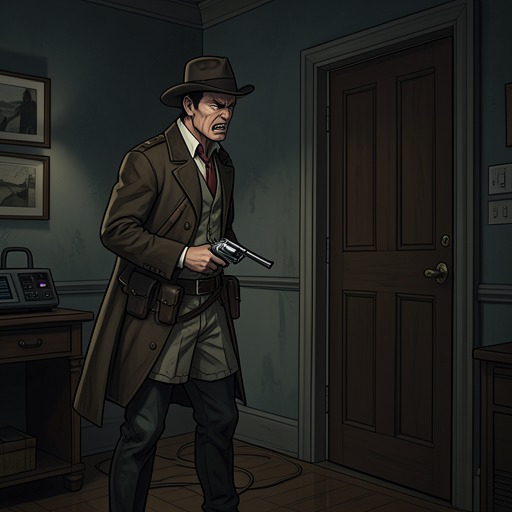
The birthday demonstration also changes what is happening around it. Bill Kraken, in the adjoining room, sees Jack display the box and watches the beast consume the birds before sinking out of sight. The toy draws the company’s attention and gives Kraken an opening to enter the dark room containing the sea chest. There he searches among its contents and finds a hidden box. Hearing a distant voice from that box, he becomes frightened and escapes through the window with it.
The distinction matters: the engine’s performance distracts the gathering, but the object Kraken takes is the hidden box, not the birthday device. When Drake arrives and presses Keeble for the machine, the theft is discovered in the aftermath. The Captain finds the window open and the chest disturbed; the emerald box is missing. The scene places the engine at the hinge of two competing actions: it is the visible marvel around which people gather, while their attention to it allows a different, concealed object to disappear.
The Keeble Boxes and Their Uncertain Identities
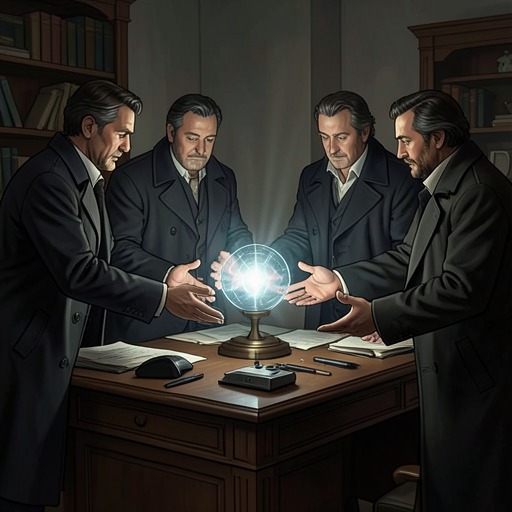
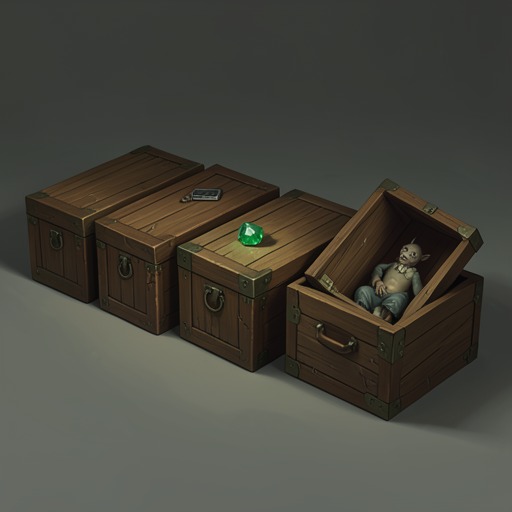
The plot repeatedly makes Keeble’s boxes difficult to distinguish from one another. Sebastian Owlesby had asked Keeble to build a box for a great emerald, Jack’s inheritance, and the memoirs describe it as almost identical to the lead-lined cube that held the Homunculus. Much later, when the whereabouts of the boxes become urgent, Keeble confirms that the emerald box and the Homunculus’s box are identical apart from the eccentricities of their carving and painting. Nell Owlesby acknowledges that she might have confused them, and that Dr. Birdlip may have the emerald rather than the Homunculus.
This uncertainty should not collapse the birthday engine, the emerald box, and the Homunculus’s box into one object. The evidence identifies the engine by its recurring mechanical performance and its gift to Jack; the other boxes are distinguished by what they contain, even when their construction makes them easy to mistake. A Keeble box placed atop the aquarium attracts Shiloh’s notice, and Ignacio Narbondo quickly takes it from him, but the episode does not establish that it is the birthday engine. Across these appearances, the box form becomes a source of practical uncertainty: knowing that a box is Keeble-made does not settle which consequential object it holds.
Narrative Significance
The engine’s central image is a cycle in which apparent loss does not last: the birds are eaten, restored, and eaten again. Its demonstrated recurrence gives material form to the book’s interest in arrested decay and perpetual motion without making the toy itself a proven explanation of either. Keeble’s workmanship makes the wonder repeatable, yet its operation remains unexplained; the spectacle offers an observable result while withholding the knowledge that would make the device reproducible by Drake’s workmen.
The object’s story also turns on the difference between what it does and what people want from it. For Keeble it is the culmination of twelve years’ work and a gift to Jack; for Drake it is a patentable power source; for the birthday company it is a marvel; and for Kraken it is an accidental screen behind which he can reach the sea chest. In the epilogue, Captain Powers holds open a Keeble box containing the great emerald, a final reminder that the recognizable form of the invention does not by itself identify its contents. The engine’s mechanical repetition and the boxes’ repeated reappearance thus create contrasting kinds of uncertainty: one endlessly renews the same scene, while the others make identity and possession difficult to secure.