Birdlip’s dirigible
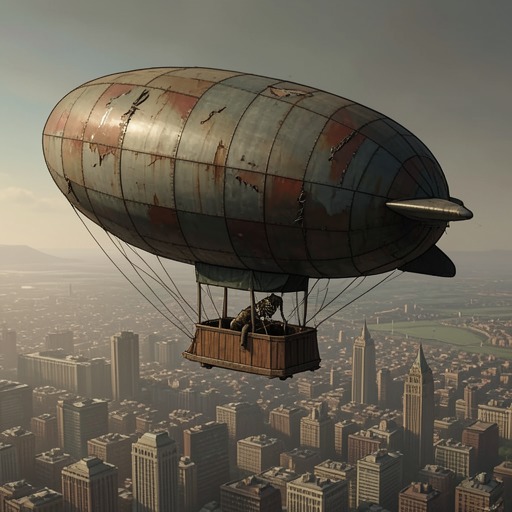
HomunculusBirdlip’s dirigible is a remarkable flying craft whose appearances over London join scientific speculation to public spectacle. Its weathered gondola, propellers, and strange occupant make it seem less like an ordinary balloon than a vessel from another world; yet the explanation offered for its course is partly mechanical. William Keeble believes its engine is running down and that a homing element may be guiding it toward Hampstead, where it was launched. The craft’s uncertain future draws the Royal Academy’s attention and brings Langdon St. Ives’s knowledge of it into the orbit of official science.
Appearance and the 1870 London Sighting
In 1870, an oval shadow is first seen drifting southeast from Iceland across the North Atlantic toward Greater London. Before dawn, the craft passes over a market and briefly out above the Victoria Embankment, heading toward Billingsgate and Petticoat Lane. As it crosses beneath the dying moon, its slat-sided gondola becomes visible against the clouds. The dirigible creaks and shudders, while the hum of its spinning propellers carries across the wind. The contrast between the craft’s audible machinery and its uncanny silhouette makes the sighting at once materially specific and difficult to explain.
The gondola’s occupant intensifies that ambiguity. A rigid figure in a cocked hat grips the wheel, legs planted wide as if bracing against a swell. The wind pulls at the figure’s tattered coat, revealing a ribcage with no flesh; its wrists are manacled to the wheel, which is lashed to a strut between glassless windows. The dirigible rights itself and continues east. At dawn it is seen above Billingsgate, where the gondola rocks like a ship and its occupant stares sightlessly down at the market. The passing craft draws a salute from a fish seller, while the ordinary work below carries on. By the time the sun illuminates it over Petticoat Lane, it has lost some of its earlier mystery, though people still turn to look and point.
Course and Recurrence
The London passage is not presented as an isolated flight. Five years before the conversation between Keeble and St. Ives, the dirigible had passed low and far to the north of its later course. Keeble says the craft was sighted again over the Denmark Strait, high in the stratosphere, swinging toward Iceland on a route expected to bring it once more over Greater London. The recurrence gives the sightings a pattern without making the destination certain: observers can trace its broad circuit, but cannot say whether it will safely descend, land, or fall.
Keeble’s explanation is a qualified one. He suspects that the dirigible’s engine is declining, and recalls that during its earlier passage it was already flying dangerously low. He thinks it may be tending toward Hampstead, the launch site, because the engine contains a homing element. He describes that feature as an unintended consequence of the design, not as a purpose he deliberately built into it. The proposed return is therefore neither a controlled landing nor a certainty: Keeble allows that the craft may instead drop into the sea.
Scientific Interest and the Engine’s Decline
The engine’s condition changes the meaning of the craft’s flight. What might otherwise be read as a marvel of sustained navigation becomes a machine nearing the limit of its power. Keeble places the dirigible’s engine alongside the broader problem of perpetual motion, which he calls a dream, while distinguishing the craft’s working mechanism as something that is now running down. Its extraordinary endurance is real within the story, but it is not proof that the machine can fly forever.
St. Ives asks whether the engine can be miniaturized, considering the possibility of using such a device for space travel. Keeble answers that it can and brings out a wooden box painted with symbols, but the supplied scene does not establish that this particular box is itself a miniature of the dirigible’s engine. The exchange nevertheless shows how the airship’s existence has practical scientific consequences: it prompts questions not only about its present route, but about whether its principle can be adapted for other forms of travel.
Public Spectacle and Institutional Consequences
The dirigible’s return attracts the Royal Academy. On the strength of St. Ives’s knowledge of Birdlip and his friendship with William Keeble, the Academy invites him to take part in programs studying the craft. Balloon expeditions are being prepared in Reykjavik, and the Academy anticipates that the dirigible may descend or land in the following weeks. It even considers the possibility that it could fall onto London rooftops. These plans make the craft more than an object of wonder: its unpredictable arrival creates a practical problem for observers trying to learn from it before it comes down.
For St. Ives, the invitation has an institutional price. The Academy expects him to suspend his own work, close his laboratory, and send Hasbro away, offering in return a more serious hearing for his scientific standing. His knowledge of the dirigible, once an unusual personal interest, becomes leverage in a negotiation over access to official recognition. The craft thus connects private research to public authority, while its uncertain course resists both. It can be watched, studied, and plotted across the sky, but Keeble’s account leaves open whether its failing engine will guide it home or bring it down elsewhere.