Dr. Birdlip’s blimp
HomunculusDr. Birdlip’s blimp is both a remarkable flying machine and the unresolved center of a struggle over who can explain, claim, or interpret it. Its prolonged, circuitous journey brings it back toward London, where the Royal Academy sees a scientific problem, followers of Shiloh anticipate a sacred sign, and the public gathers to witness its arrival. At Hampstead Heath, its return culminates not in a stable landing or an orderly investigation but in the exposure of its uncanny pilot and the destruction of the craft by the crowd.
The craft and the dispute over its origin
The blimp’s flight has made it an object of speculation well before its arrival over Hampstead Heath. Dr. Birdlip is associated with the craft, but Langdon St. Ives understands that Birdlip was not the genius behind its perpetual propulsion. The Royal Academy likewise doubts that Birdlip built the engine, and turns its attention to William Keeble, the toymaker it believes can explain the mechanism. That distinction separates the visible pilot from the concealed source of the blimp’s technological power.
The Academy’s interest is practical as well as theoretical. Its members want access to the knowledge behind the engine and ask St. Ives to persuade Keeble to cooperate. They frame the request as a matter of scientific inquiry and public safety: the craft is losing altitude, and their calculations place its descent within Greater London. A crash could cause extensive destruction, they fear, or the blimp could fall into the Atlantic and disappear. The threatened return thus turns a marvel into a projected civic danger, while giving the Academy a reason to press for control of the technology.
The craft also attracts religious attention. Parsons reports rumors that it carries a sacred talisman or device, described by the cultists as a god inside a curious box. He says Scotland Yard has infiltrated the organization and that its members may mean either to destroy the blimp or to make it a temple. The uncertainty is part of the danger: the same unexplained machine can be treated as a scientific instrument, a religious object, or a target. St. Ives rejects the Academy’s assumption that his friendship with Birdlip should give way to institutional demands. He believes Birdlip is pursuing a truth that cannot be charted and graphed, and that the blimp’s wandering course belongs to that larger, obscure mission.
A return anticipated by the city
The blimp’s approach becomes a public event before it is visible above the Heath. Reports from two men in a balloon who tracked it over the Sandwich Islands suggest that it has been steadily losing altitude. The Academy predicts that it will touch down somewhere in Greater London, and Parsons imagines the possible consequences of an uncontrolled descent. His warnings lend urgency to the scientists’ effort to obtain Keeble’s cooperation, but they also expose how little the institution knows about the craft it hopes to manage.
By the time St. Ives reaches Hampstead Heath, the surrounding area is crowded with people. Many have traveled from London; others have gathered in Hampstead Village or Camden Town, sometimes with little understanding of what is approaching. The gathering has the disorder and energy of a carnival, with people filling taverns, climbing trees, and moving through muddy streets. Nearby, the Royal Academy has set up a roped-off area with lawn chairs, an attempt to create a controlled vantage point within the swelling crowd. Its members look upward rather than attend to Parsons’s efforts to address them.
The crowd’s expectations are further shaped by Shiloh and his followers. The evangelist appears carrying a glass cube containing Joanna Southcote’s head, while people assemble around him and look to the sky. When a bright point descends, Shiloh names it Wormwood. The blimp’s arrival is therefore folded into an apocalyptic performance even before its identity and purpose can be made clear. Its return does not settle the competing interpretations; instead, it gives them a shared spectacle around which they gather.
The pilot above Hampstead Heath
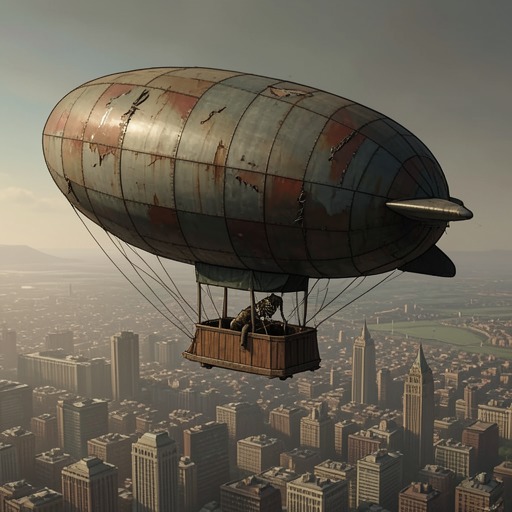
As the blimp comes into view, it seems to move with intention rather than drift toward an arbitrary landing place. It hovers about fifty feet above the Heath and follows the curve of the hill toward a particular spot. Its controlled approach suggests that it is still being piloted, although the nature of that guidance remains mysterious.
The scene is described in terms that contrast the craft’s slow movement with the stillness of the watchers. The moon lights the swaying blimp and its creaking gondola as people look on from the green, nearby trees, windows, and roads leading out of London. At the helm stands Dr. Birdlip, now skeletal, his coat hanging in tatters and the moonlight showing through it. The sight makes the pilot’s continued presence as strange as the machine’s long flight: Birdlip is presented not as a conventional living aviator but as a figure whose persistence has outlasted ordinary expectations.
The blimp’s homeward course remains unresolved even as it nears the ground. St. Ives wonders what Birdlip has pursued during years of wandering through the atmosphere, and whether the object of that pursuit has been found or has continued to elude him. The craft’s arrival answers the practical question of where it has gone, but not the more consequential question of what its journey meant. Its path has led it back to the Heath without making its purpose legible to the Academy or the crowd.
Arrival, departure, and destruction
The blimp reaches the Heath amid the commotion surrounding St. Ives’s own arrival in the homunculus’s spacecraft. The Royal Academy’s attention shifts quickly toward the incoming dirigible, diminishing the spectacle of the starship. St. Ives recognizes that the airship carries Jack Owlesby’s inheritance and the prospect of independence for Jack and Dorothy Keeble, while also fearing that the villains gathered nearby may try to seize it or its valuable contents. The blimp’s return therefore has consequences beyond the scientific question of its engine: it brings a contested legacy into a crowd full of competing interests.
After the events on the green, the homunculus pilots the spacecraft away from Earth, while the blimp remains behind. Its departure removes the extraordinary pilot from the Heath, but does not preserve the airship. The blimp begins to list; its mooring lines snap, and it topples over as people hurry clear. Its fabric tears and its gondola breaks apart. Onlookers then rush in to take pieces as souvenirs, stripping the wreckage until the craft has effectively vanished beneath the crowd. When the people finally leave, no fragment remains on the Heath.
The fate of the engine is also dispersed rather than secured. William Keeble wonders where it has gone, since it has been carried away in pieces by green-grocers, costermongers, and beggars who do not understand what it once contained. What the Royal Academy had hoped to study and claim is thus scattered among the public. The blimp’s final state reverses the institution’s imagined project of orderly scientific possession: the machine that drew a crowd as an object of wonder is dismantled by that same crowd, and its technical heart disappears into ordinary hands.
Significance
The blimp joins three forms of uncertainty: technological, religious, and historical. The Academy can recognize the importance of its engine but cannot explain the craft’s full operation or Birdlip’s purpose. Shiloh’s followers interpret its return through prophecy, while the immense gathering turns it into a shared public event that neither scientists nor evangelists can control. The blimp’s meaning remains contested even as its physical form is destroyed.
Its long passage through the sky also gives the conclusion a shape different from a conventional scientific demonstration. The craft does not return to be inspected, explained, and preserved. Instead, Birdlip’s appearance makes the mystery more immediate, and the blimp’s destruction makes its knowledge less accessible. Its scattered engine and vanished wreckage leave behind no stable exhibit, only competing memories of what the crowd witnessed. The airship’s return is therefore both a homecoming and a loss: it reaches the place toward which its wandering course was directed, but it cannot remain intact long enough for anyone to possess or fully understand it.