The homunculus’s spacecraft
HomunculusThe homunculus’s spacecraft is the absent machine at the center of several characters’ plans: Langdon St. Ives hopes to find it, while Sebastian Owlesby imagines trading access to it for power over death and time. Though the evidence places the craft in London as a strong suspicion rather than a confirmed discovery, its possible location connects the Homunculus, the Keeble devices, and the rival ambitions of St. Ives, Owlesby, and Ignacio Narbondo. The ship’s importance lies as much in what people believe it can provide as in what the novel actually reveals about it.
Identity and Uncertain Whereabouts
The spacecraft is identified as belonging to the Homunculus, but the novel does not furnish a detailed account of its construction, appearance, or operation. Early in St. Ives’s inquiry, he distinguishes the question of a machine from that of a ship, marking the vessel as a practical problem as well as a scientific mystery. Later, he becomes convinced that the craft is somewhere in London. That conviction gives his search a location and urgency, but the evidence does not confirm that he finds it there.
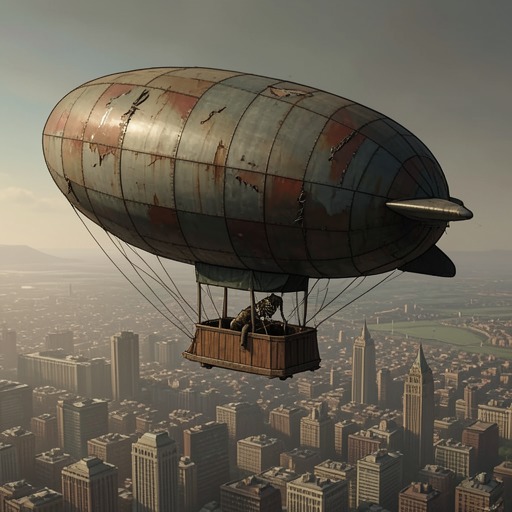
The craft must also be kept separate from the blimp associated with Dr. Birdlip and from St. Ives’s own planned vessel. The reported descent of Birdlip’s blimp and the possibility that the Homunculus is aboard make the blimp important to St. Ives’s investigation, but do not establish it as the Homunculus’s spacecraft. St. Ives considers finding the alien craft his first priority; if that fails, he plans to return to Harrogate and equip his own craft with an oxygenator box William Keeble is building. The distinction matters: one ship is the object of the search, while another is St. Ives’s intended means of travel.
The Craft as Bargain and Objective
Owlesby’s interest in the spacecraft is bound to his exchange with the Homunculus. A screen fitted to Keeble’s structure allows communication, and the passage describes a trade of knowledge for freedom. Finding the craft and a sufficiently capable pilot appears to offer a route away among the stars, but the exchange remains obstructed by the other party’s conditions. The spacecraft therefore represents a possible escape, yet access to it depends on negotiation and on finding someone able to navigate it.
Owlesby’s own motive is more acquisitive. He hopes to locate the spacecraft and, in effect, sell it back to the Homunculus in exchange for power over death and time. The novel leaves the source of his deterioration unresolved: it may arise from scientific greed or from gradual poisoning through contact with the Homunculus, and Owlesby himself does not know. That uncertainty prevents the craft from serving as a simple explanation for his decline. It is instead one element in a relationship where knowledge, freedom, and power are entangled, while the human cost of pursuing them remains difficult to separate from the effects of contact.
Boxes, Substitution, and Misidentification
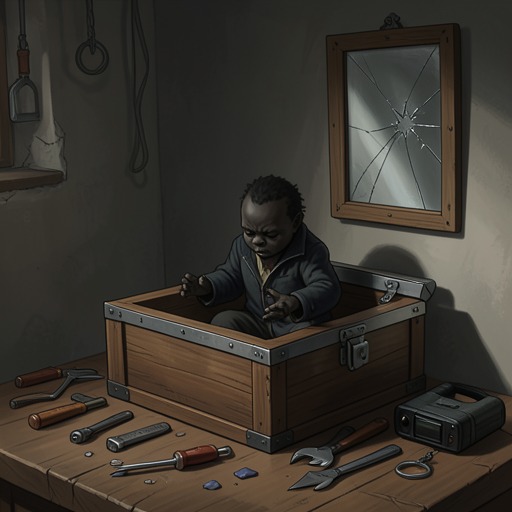
The spacecraft’s pursuit runs alongside a separate confusion over two nearly identical boxes. During a period of relative rationality, Owlesby withdraws his interests in the West African Gem Company as a great emerald intended for his son, Jack Owlesby’s inheritance. He has Keeble construct a box for the emerald that is almost identical to the lead-lined cube holding the Homunculus. These containers are not the spacecraft, but their similarity makes it harder for the characters to establish which valuable object is where.
The uncertainty becomes explicit when St. Ives hears that a box may be aboard Birdlip’s blimp. He wonders whether it is the emerald box or the Homunculus’s box, and whether anyone besides himself knows its location. His suspicion that Narbondo would be intensely interested in the answer connects the box mystery to the wider contest over the Homunculus and its craft. The possibility that the wrong box has been carried away is not incidental: the objects’ outward likeness turns custody into a question of identification, and mistaken identity can redirect the characters’ plans.
Nell Owlesby later admits that, while agitated, she might have confused the two boxes; Birdlip may consequently have the emerald rather than the Homunculus. William Keeble confirms that the boxes are identical apart from their carved and painted details. This clarification makes the uncertainty material rather than merely a failure of memory: even the toymaker says the containers share the same basic form. Nell’s question about whether the little man could speak further links the problem of identifying the box to the possibility that its occupant might communicate.
Consequences and Narrative Significance
Other episodes reinforce the gap between a box’s apparent contents and what its holder can understand. Bill Kraken retrieves a hidden box and hears a small, distant voice he cannot make out; the experience leaves him unsure whether the voice comes from within the box or his own mind. The episode does not identify that box as the spacecraft, nor does it settle which of the two Keeble containers it is. Its relevance is the way an object becomes more than concealed property: an inaccessible voice makes the question of what is enclosed—and what it might be—impossible to dismiss.
The emerald’s movements provide a contrasting resolution. Captain Powers discovers that the emerald box has disappeared from his chest, while the later account confirms that Nell’s mix-up may have placed the emerald with Birdlip. At the story’s close, Dorothy Keeble is recovered and stands with Jack as Captain Powers displays an open Keeble box containing the great emerald. This settles the emerald’s presence at that moment, not the whereabouts of the Homunculus’s spacecraft. By ending on a recovered jewel rather than a recovered ship, the narrative gives one chain of object-confusion a visible resolution while preserving the craft as an unanswered question. Its repeated absence keeps scientific ambition and the promised power of escape in the realm of pursuit, conjecture, and contested knowledge.