The emerald box
HomunculusThe emerald box is a wooden container built to protect Sebastian Owlesby’s great emerald, a family inheritance intended for Jack Owlesby. Its near-identity to the box that holds the Homunculus gives it a significance beyond its practical purpose: the two containers can be confused, and the emerald’s apparent identity and location become uncertain. The box moves from concealed family property to stolen object and, finally, to a container whose contents help resolve that confusion.
Design and Intended Use
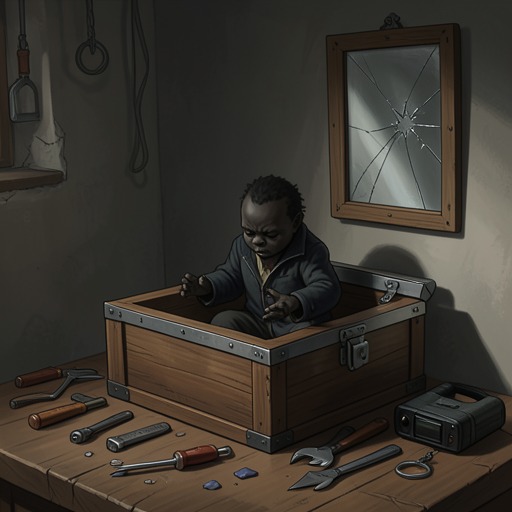
Sebastian Owlesby had withdrawn his interests in the West African Gem Company in the form of a great emerald, securing the stone as his son Jack’s inheritance. During a period of relative rationality, he prevailed upon William Keeble to build a box for it. The design closely imitated the lead-lined cube used to contain the Homunculus. The resemblance is not merely decorative: it makes two objects intended for wholly different purposes difficult to tell apart, turning a protective likeness into a practical hazard.
The box is presented as a crafted wooden object, smooth and painted with pictures. Its construction belongs to the same world of careful workmanship as Keeble’s other boxes, but its purpose is comparatively straightforward: to house and preserve the emerald until Jack can receive it. The Captain’s assurance that he has kept it for years, and that Jack will have it within days or a week, places the box within a chain of safekeeping and inheritance. Its value derives both from the stone it contains and from the promise that the stone will pass to the next generation.
Concealment and Theft
Captain Powers conceals the box in a sea chest behind a false bottom made from oak plank. The chest also holds a brass spyglass, a sextant, sabers, a carved rosewood idol, and an ivory pig’s head; these objects have to be moved before the hidden compartment can be reached. The box is therefore protected not by a conspicuous lock alone but by concealment within a cluttered, layered hiding place. The Captain’s methodical return of the objects and replacement of the plank underscores his long practice of keeping the secret.
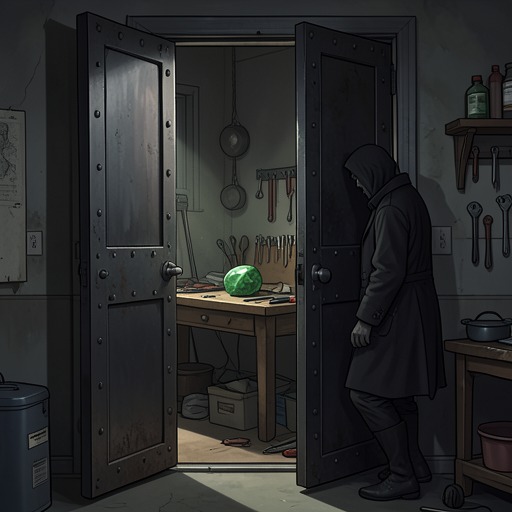
Bill Kraken later searches the chest without being entirely sure what he is looking for. While working the flat, circular iron hasp, he hurts his fingers and fears that discovery will make him appear to be a common thief or an ally of the Captain’s enemies. He eventually reaches into the compartment and takes the hidden box. In that moment, the object’s careful concealment fails: the chest has preserved it from ordinary view, but not from someone willing to search it.
Holding the box, Kraken hears a tiny, distant voice that he cannot understand. He is unsure whether he wants to understand it and briefly fears that it may be speaking from inside his own head. The episode attaches an uncanny uncertainty to the stolen object without establishing that the emerald box itself contains the Homunculus. Its near-duplicate does, however, make the confusion consequential: a box associated with a valuable stone can be mistaken for one associated with a living captive.
Resemblance and Uncertain Custody
After discovering the theft, Captain Powers finds the chest disturbed: the spyglass and sextant are on the floor, and the oak planks have been displaced. He checks the hiding place and realizes the emerald box is gone. He opens the window and looks into the alley, but sees nothing. The loss is thus registered through the failure of the hiding arrangement, with no immediate recovery or clear account of where the box has gone.
Much later, the similarity between the emerald box and the Homunculus box becomes an explicit problem of identification. William Keeble, woken after severe fatigue, confirms that the two boxes are identical apart from the eccentricities of their carving and painting. Nell Owlesby acknowledges that, in her agitated state, she could have mixed them up; she allows that Dr. Birdlip might have the emerald. This admission does not by itself prove which box Birdlip has. It does establish that the containers’ resemblance has made a mistaken transfer plausible, and that the emerald’s whereabouts cannot be inferred simply from the box’s presumed custody.
The confusion also places the box amid overlapping claims and uncertainties. Jack is the intended heir to the emerald; Captain Powers has kept the box hidden for years; Nell may have confused it with the Homunculus’s container; and Dr. Birdlip is raised as a possible holder of the emerald. These circumstances turn the box into more than a convenient receptacle. Its physical similarity to another container disrupts the reliability of possession: characters may hold a box without knowing which object, or which responsibility, it represents.
Recovery and Narrative Significance
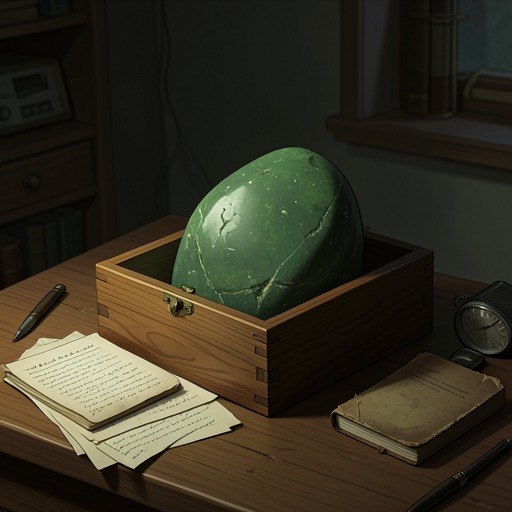
At the close, Captain Powers holds open a Keeble box before Dorothy Keeble and Jack. Inside lies the enormous emerald, described as fist-sized, and Jack and Dorothy smile at the Captain. The scene brings the stone into view in the context of Jack’s inheritance and the group’s reunion. It offers a concrete contrast to the earlier hidden compartment and the period of uncertainty: what had been concealed, stolen, and possibly confused is now displayed openly in a box.
The emerald box’s narrative importance rests on this movement between concealment and recognition. Initially, its purpose is to secure a valuable inheritance; the false bottom and the Captain’s years of secrecy protect that purpose. Once the box is stolen, however, the resemblance to the Homunculus’s container makes the object’s identity difficult to separate from the other box’s significance. The final appearance of the emerald in a Keeble box restores the inheritance to view, while the earlier mix-up shows how a crafted object can carry consequences beyond its contents. In this plot, keeping the box safe is not enough: its owner, location, and identity must also be known.