Birdlip’s perpetual-motion engine
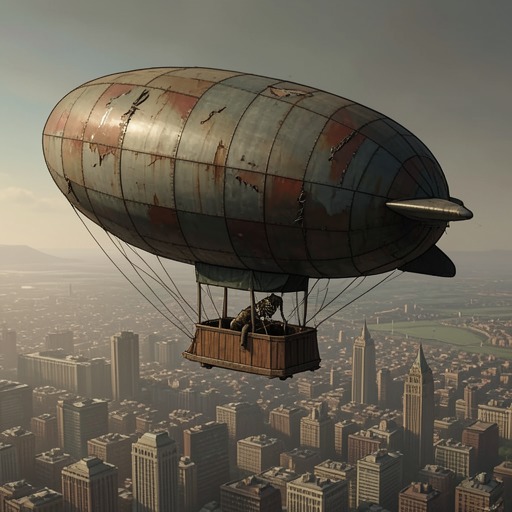
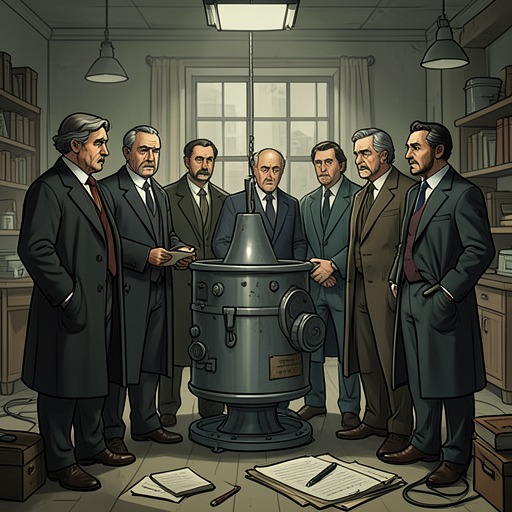
HomunculusBirdlip’s perpetual-motion engine sustains Dr. Birdlip’s extraordinary airship, but it is not truly perpetual: William Keeble believes it is losing power and may be nearing the end of its flight. Its threatened failure gives the machine a double significance. It is a model for Langdon St. Ives’s ambitions beyond Earth, and a reminder that even an apparently self-sustaining invention can have limits built into its history and design.
Principle and Limits
Keeble describes perpetual motion as a difficult and relative matter, distinguishing the engine’s practical achievement from the ideal of motion without end. He recalls a claim that the alchemist Gustatorius produced perpetual motion in the Balkans in 1410 to turn a kaleidoscope’s back lens, but treats that story as an eccentric claim rather than proof that true perpetual motion is attainable. Against this uncertain history, Birdlip’s engine is concrete: it has run for years, yet Keeble says it is now declining.
The engine’s apparent longevity therefore does not mean it can continue indefinitely. Keeble judges that it was already running low when the airship passed five years earlier, and that its latest course lies farther north than its 1865 passage. He fears this spring may be the airship’s last appearance. The discrepancy between a device named for perpetual motion and its diminishing operation makes its eventual failure a limit of the invention, not a refutation of what it has achieved.
Miniaturization and St. Ives’s Plans
St. Ives asks whether Birdlip’s engine can be duplicated on a smaller scale because he is planning a spacecraft of his own. He believes that, within the time the airship has already spent aloft, he could travel to Mars or even Saturn and return. Keeble answers that miniaturization is possible and brings out a wooden box as he turns to demonstrate his work. The exchange places the engine within a practical chain of experimentation: Birdlip’s large-scale mechanism offers a precedent for adapting machinery to St. Ives’s proposed voyage.
The demonstration belongs to Keeble’s work on compact apparatus, including the oxygenator St. Ives intends to fit to his craft. The evidence does not establish that the various Keeble boxes later mistaken for one another are themselves Birdlip’s engine. Rather, the connection is one of shared invention and scale: St. Ives seeks to carry life-support equipment and a version of the airship’s sustaining mechanism into a much smaller vehicle.
A Homing Feature and a Changing Course
Keeble suspects that the airship is tending toward Hampstead Heath, where it was launched. He proposes that the engine contains a homing element, but stresses that this would be an accidental consequence of its design, not an intended function. The possibility gives the mechanism an influence beyond simply keeping the airship aloft: its design may also help determine where the craft goes as its power wanes.
The engine’s condition thus becomes part of the uncertainty surrounding the airship’s movements. Keeble expects it may fall into the sea, while also reading its northward course as a tendency back toward its launch site. These are predictions, not a definitive account of how the engine works; the novel leaves the proposed homing effect as Keeble’s informed suspicion.
The Airship’s End and the Engine’s Legacy
The airship ultimately comes down on Hampstead Heath and is torn apart as onlookers strip it for souvenirs. This ending accords with Keeble’s earlier concern that the engine was failing and with his prediction that the craft might return toward its launch ground, although the account does not explicitly identify the engine as the immediate cause of the wreck. The contrast is stark: a machine that kept an airship aloft for fifteen years ends amid scattered wreckage, while the possibility of reproducing its principle remains part of St. Ives’s plans.
Keeble’s warning also gives the engine a different kind of legacy from a flawless perpetual-motion device. Its value lies in what it has made possible and what others may learn to reproduce, not in endless operation. The airship’s destruction closes its own long flight, but does not close St. Ives’s larger project of adapting its technology for travel beyond Earth.