Langdon St. Ives’s spacecraft
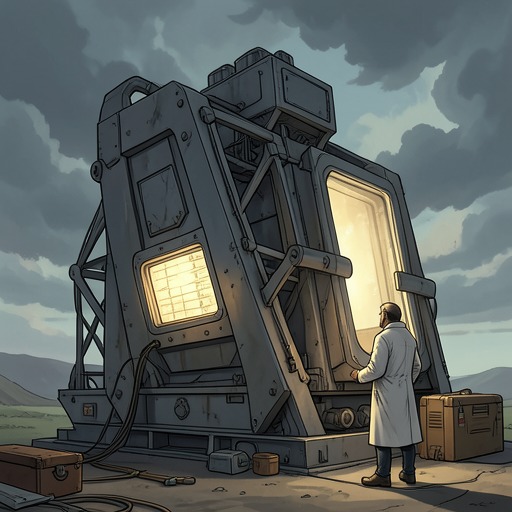
HomunculusLangdon St. Ives’s spacecraft is the practical culmination of his scientific ambitions: a nearly completed vessel intended to carry him on a journey to Mars, Saturn, and back. Its construction depends on an oxygenator that St. Ives develops with William Keeble, while the possibility of adapting the engine of Dr. Birdlip’s dirigible offers a route to the sustained propulsion such a voyage would require. The ship is close to readiness before its departure is assured; the evidence records plans and preparation, not a completed launch.
Construction and Remaining Work
At an early stage, the spacecraft is still being assembled in Harrogate and is only four-fifths built. St. Ives thinks of it as valuable enough to sell his soul for, a striking measure of how completely the project commands his attention. Even his immediate bodily appetite competes with the work: tired and hungry, he imagines exchanging the ship for sausages. The passing joke does not diminish the vessel’s importance; it makes clear that this is not an abstract scientific interest but a material undertaking that has absorbed his hopes and resources.
When St. Ives brings his plans to Keeble, the ship’s construction has advanced substantially. He calls the oxygenator finished, or nearly so, and explains that it is the last major component still required; the rest of the vessel is ready. The two men discuss a launch in May, conditional on the weather clearing. The change from a craft four-fifths complete to one awaiting its final system establishes the oxygenator as the threshold between prolonged construction and a possible departure.
The Oxygenator and Engine
The oxygenator’s design is described in practical terms. St. Ives specifies helium and powdered chlorophyll, an intake, a spray mechanism, and a filter. Clockwork sits in the base, and he judges a seven-day mechanism sufficient for the first flight. The account presents the spacecraft not simply as a finished marvel but as a collection of systems whose limits and functions must be considered before it can be trusted in flight. Its life-support apparatus is still being drawn, discussed, and fitted into the larger machine.
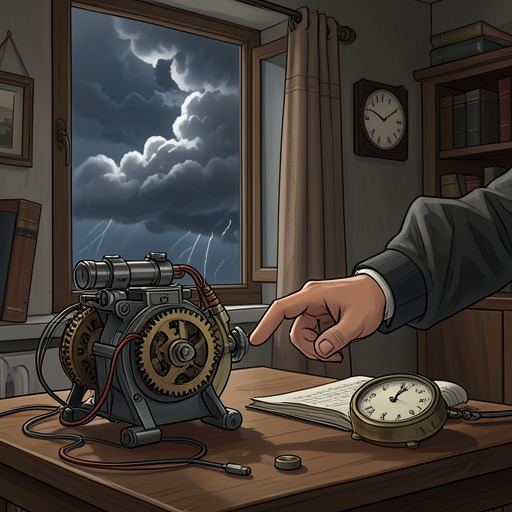
Propulsion remains a separate question. St. Ives asks whether the engine associated with Dr. Birdlip’s dirigible can be duplicated at a smaller scale, then presses Keeble on whether it can be miniaturized. Keeble answers affirmatively. The exchange connects the spacecraft to an existing, extraordinary piece of machinery while keeping the distinction between adaptation and completion: the engine’s suitability is being investigated, not described as already installed. Keeble’s confidence gives St. Ives reason to pursue the design, but the passages do not establish the finished spacecraft’s precise engine or its eventual performance.
Intended Journey and Scientific Priorities
St. Ives measures the promise of miniaturization in terms of distance and time. He calculates that, during the fifteen years Dr. Birdlip’s dirigible has been aloft, he could reach Mars, travel onward to Saturn, and return. The comparison makes the spacecraft’s ambition legible: the long duration of Birdlip’s flight becomes, for St. Ives, a window within which a faster and more purposeful expedition might be completed. His interest is not merely in duplicating an impressive engine; it is in making interplanetary travel practicable for himself.
That ambition persists even when Keeble’s report about the declining dirigible engine offers another urgent scientific problem. St. Ives hears that the craft may descend into the sea and may be tending toward Hampstead, but he refuses to let the revelation displace his original question about miniaturization. The episode sets two forms of inquiry beside one another: the uncertain fate of a machine already in flight and the planned capabilities of a ship still being built. St. Ives acknowledges the first without surrendering the second.
Departure Plans and Unresolved Outcome
The spacecraft also marks the boundary St. Ives draws between his scientific work and his temporary involvement in London’s affairs. After nearly a month in London, he has not seen the reputed alien vessel, and he doubts what practical use such a discovery would offer even if his investigation succeeds. By contrast, his own craft is almost spaceworthy, and he expects the oxygenator to be completed soon. He regards himself as a scientist before an amateur detective and believes the Trismegistus Club can continue its work without him.
Once Keeble confirms that the oxygenator is finished, St. Ives says his train from King’s Cross Station leaves at ten the next morning. He cannot afford to postpone his return, because conditions for his plans are nearly right. This is a definite departure from London toward his work, not evidence that the spacecraft itself has launched. The vessel’s decisive significance lies in that distinction: it is close enough to readiness to shape St. Ives’s choices, yet its journey remains prospective in the account. It embodies a scientific future that competes with the immediate dangers and distractions around him, and gives his resolve to return to Harrogate a concrete purpose.