The homunculus’s box
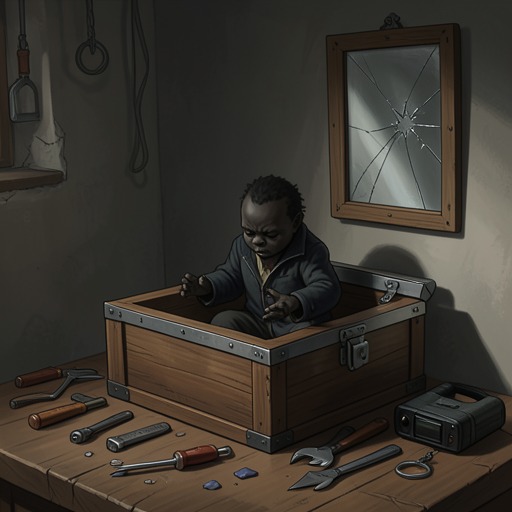
HomunculusThe homunculus’s box is both a practical enclosure and a contested object whose uncertain identity redirects the novel’s investigations. Its contents can resist the passage of time, but cannot simply be left without air; meanwhile, a nearly identical box made for an emerald makes the homunculus’s whereabouts difficult to establish. As the boxes change hands or are mistaken for one another, a problem of identification becomes a problem of custody, scientific ambition, and risk.
Construction and Purpose
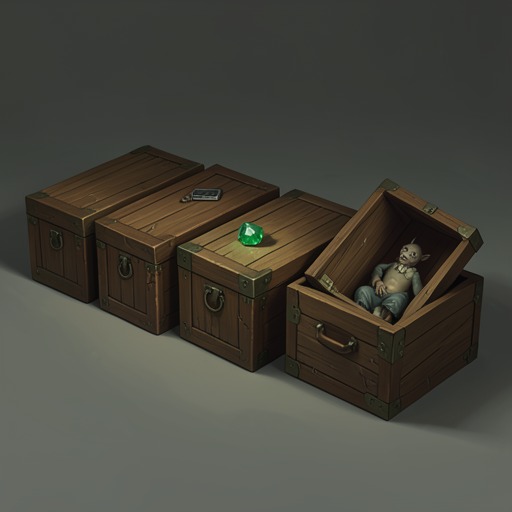
The distinction between the two boxes begins with their intended contents. During a period of relative rationality, Sebastian Owlesby withdrew his interests in the West African Gem Company as a large emerald, the inheritance of his son, Jack Owlesby. He persuaded William Keeble to construct a box for the stone. This new box closely resembled the lead-lined cube already used to contain the homunculus, although the two differed in their carving and paintwork. Their likeness was not incidental: it created the possibility that a person handling them could confuse a valuable inheritance with a living captive.
The homunculus’s enclosure is necessary because of the being within it, not because the box itself is described as a machine. Sebastian explains that the homunculus can arrest entropy and produce extraordinary effects, yet must remain in a box. The account links its resistance to time with its reduced size, while making clear that confinement is a condition of its continued presence in the human world. The box thus marks a boundary around a being whose capacities exceed ordinary experience, without making that being independent of material conditions.
A Container That Must Breathe
The box does not provide sealed or self-sufficient confinement. William Keeble says that it is not airtight and reasons that the homunculus must breathe. He has seen the little man himself, so his concern is based on direct knowledge rather than speculation. At the same time, the enclosure has been modified: Sebastian fitted Keeble’s structure with a screen through which he could communicate with its occupant. That adaptation opened a channel between captor and captive, and Sebastian says the exchange of knowledge for freedom may have contributed to his own decline. The box therefore contains the homunculus while also enabling a relationship that unsettles the idea of simple, passive containment.
Keeble considers what should be done if the box comes within reach of the people pursuing it. He proposes taking it when Birdlip’s dirigible lands, then securing it in a bag of stones and dropping it into the river during a flood. His reasoning emphasizes the enclosure’s dependence on breathing: regardless of the homunculus’s powers, it is a living being with a physical requirement. Keeble also connects his hostility to the harm done to Sebastian. The proposal is not carried out in the evidence here, but it shows how the box turns an abstract dispute over extraordinary knowledge into a question of who controls the homunculus and what responsibility that control entails.
Confusion, Discovery, and Experiment
The near-identity of the boxes repeatedly frustrates attempts to determine what is where. Langdon St. Ives learns of a box associated with Birdlip and cannot tell whether the dirigible carries the emerald or the homunculus. He suspects that Ignacio Narbondo would be especially interested in its location, but the uncertainty remains entangled with his own search for the homunculus’s spacecraft. The box is consequently more than a clue: until its contents are identified, it cannot settle what Birdlip’s arrival means.
A later discovery makes the enclosure’s contents newly immediate. Bill Kraken finds a hidden box and hears a faint voice from within, though he cannot understand it and fears that it may be speaking inside his own head. The scene gives the box an unsettling presence without resolving its identity for him. Elsewhere, during Narbondo’s preparations for an experiment, Shiloh lifts a Keeble box from atop an aquarium. The heap of remains on a nearby slab appears to shift slightly after the box is moved, interrupting Shiloh’s attention. The episode associates the box with an unstable experimental setting, but does not establish that moving it caused the change.
Misidentification and Resolution
The uncertainty is finally addressed when William Keeble, exhausted but conscious, confirms that the emerald box and homunculus box are identical apart from their decorative differences. Nell Owlesby admits that, while agitated, she could have mixed them up; she says Birdlip might therefore have the emerald. Her admission does not immediately reveal which box contains the homunculus, but it explains how sincere reports of its location could conflict. The likeness between the objects has made misidentification a concrete possibility, not merely a failure of observation.
At the story’s close, an open Keeble box is shown to contain the great emerald. Dorothy Keeble stands recovered beside Jack, while Captain Powers holds the box before them in the firelight. This final identification gives the emerald its place as Jack’s inheritance and distinguishes it from the enclosure sought by those concerned with the homunculus. The objects’ resemblance had sustained uncertainty across several lines of action; the revealed stone brings that particular confusion to an end, even as St. Ives looks toward further voyages.
Narrative Significance
The box’s importance lies in the contrast between what it appears to be and what it contains. Outwardly, it is a crafted container, closely resembling another made for a precious stone. In practice, it is a fragile means of custody for a living being whose unusual powers do not erase its bodily needs. Its screen permits communication, its lack of airtightness limits how it can be used, and its resemblance to the emerald box makes reliable possession difficult to establish.
That material history connects scientific inquiry to inheritance, criminal interest, and the ethics of confinement. Sebastian treats the box as a means of communicating and bargaining with the homunculus; Keeble imagines it as something that must be intercepted; St. Ives sees its uncertain location as part of a larger mystery; and Nell’s possible mix-up shows how the object’s appearance can defeat intention. The box never functions as a neutral backdrop to those choices. Its construction, limitations, and likeness to its double help determine what people can know, claim, or do.