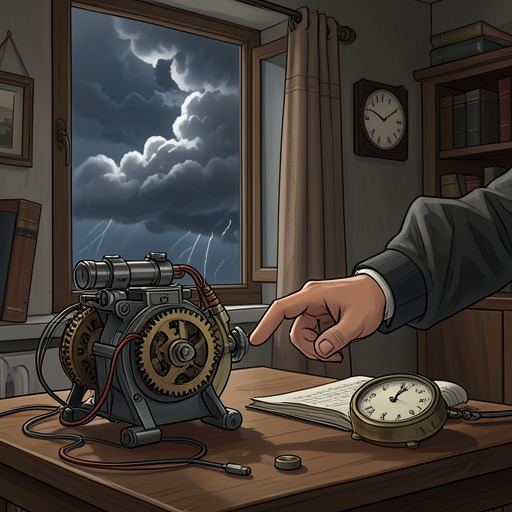
St. Ives’s oxygenator
HomunculusSt. Ives’s oxygenator is the life-support apparatus that Langdon St. Ives develops with William Keeble for his spacecraft. More than a finished component, it is a compact engineering plan whose progress depends on their collaboration: St. Ives brings the design and the demands of the coming flight, while Keeble is asked to complete the work. Its eventual completion moves the spacecraft from preparation toward launch, though the account does not establish how the apparatus performs in flight.
Purpose and Place in the Spacecraft
St. Ives presents the oxygenator as the last outstanding part of a vessel otherwise ready for launch. His plan is to launch in May, weather permitting, and he tells Keeble that the device is finished—or so he believes—while relying on him for the remaining work. The exchange establishes the oxygenator’s practical importance: without it, the spacecraft may be assembled, but its preparations are not complete. St. Ives later treats the apparatus as something he must fit to his own craft, linking Keeble’s workshop labor to the prospect of an actual voyage rather than an abstract technical exercise.
The device should not be confused with either Birdlip’s perpetual-motion engine or the various Keeble boxes that figure in the struggle over the emerald and the homunculus. Those objects have their own functions and plot histories. The oxygenator belongs to St. Ives’s spacecraft project; its distinguishing feature is the proposed system for managing the air supply. The text calls it an oxygenator but does not provide test results or a detailed account of its operation, so its intended function is clearer than its demonstrated performance.
Proposed Design
St. Ives unrolls a drawing on the workbench and explains a design involving helium and powdered chlorophyll. The apparatus is to include an intake, a spray mechanism, and a filter, with clockworks housed in the base. He proposes a seven-day mechanism as adequate, at least for the first flight. These specifications make the oxygenator a coordinated assembly rather than a single ingredient or isolated invention: its materials, air-handling components, and timed mechanism are all part of the design St. Ives lays before Keeble.
The seven-day duration is explicitly provisional. St. Ives presents it as sufficient for an initial voyage, not as a universal operating life or a proven limit. Likewise, the account gives no exact dimensions, performance measurements, or description of how the helium and chlorophyll interact. What it does show is a design framed around a defined need and a bounded first mission. The proposed clockwork schedule gives the plan a concrete operational horizon, while the intake, spray, and filter indicate a sequence of functions without explaining each stage in technical detail.
St. Ives also asks whether Birdlip’s perpetual-motion engine could be duplicated on this scale. The question places the oxygenator project beside another demanding mechanical problem, but does not establish that the engine is part of the oxygenator or that Keeble agrees to reproduce it. Keeble describes perpetual motion as difficult and cautions that Birdlip’s engine is running down. The two devices therefore mark different parts of the wider technological context: the oxygenator is a system St. Ives is actively preparing for his craft, while the engine is a separate, precarious source of power whose miniature duplication remains uncertain.
Design Work and Interruption
The collaboration is practical and personal. St. Ives arrives with a drawing, asks Keeble to supply what remains, and watches him examine the figures closely. Their discussion turns from the oxygenator’s components to the more speculative engine question, showing how the immediate task sits beside larger ambitions in their work. The apparatus is thus presented not as a miraculous object appearing fully formed, but as a design passed between colleagues and dependent on careful construction.
That work is abruptly interrupted when a bang at the casement startles Keeble and causes him to drop a heavy chisel. Liquor from the chisel’s hollow handle spills across the oxygenator drawing. A flash of lightning then reveals a face at the window, followed by rain and the sound of someone scrambling across the roof. St. Ives climbs out after the intruder. The episode does not say that the design is destroyed or that the spill damages the apparatus itself; what is directly affected is the drawing on which the men are working. The scene nevertheless places the plans amid the book’s atmosphere of intrusion and danger: even a technical consultation can be broken into before the machine has been completed.
Completion and Narrative Significance
Later, St. Ives says that the oxygenator is finished and that he will leave by train from King’s Cross Station the next morning at ten. He explains that he cannot postpone his departure because conditions are nearly right. Earlier in the investigation, he had considered returning to Harrogate to outfit his craft with the oxygenator Keeble was still working on; the later announcement of completion marks the change from pending workshop labor to a device ready for installation. The planned May launch and the subsequent departure are distinct steps, and the text does not equate the oxygenator’s completion with the launch itself.
The apparatus gives the spacecraft project a material timetable. Its seven-day clockwork, the intended May launch, and St. Ives’s fixed train departure turn the distant prospect of flight into a sequence of immediate tasks. At the same time, the oxygenator remains less fully described than the extraordinary problems surrounding it: its components are named, its intended role is apparent, but the narration does not pause to verify its scientific success. That restraint keeps its significance grounded in what it changes for St. Ives. The finished device makes outfitting his craft possible and allows him to act on the opportunity he believes is at hand.