Sebastian Owlesby’s notebooks
HomunculusSebastian Owlesby’s notebooks turn a lost scientific record into evidence of how research into arrested decay became a chain of crime, fear, and loss. Sent to Langdon St. Ives after fifteen years, the surviving pages document Owlesby’s decline under Ignacio Narbondo’s influence, reveal the human cost of their experiments, and leave a consequential uncertainty about which of two nearly identical boxes Nell Owlesby entrusted to Birdlip.
Discovery and physical form
St. Ives had been wondering what became of Owlesby’s notebooks when a packet arrived at his bedroom in London. Its sender was unknown, though the envelope had been posted in the city. Inside were roughly 150 pages of foolscap covered in handwriting St. Ives recognized. The papers were loose extracts rather than a complete, bound volume, and they had been missing for fifteen years.
The document’s incomplete form shapes what it can establish. Its dated entries offer a day-by-day record of Owlesby’s changing state and experiments, but the surviving pages do not explain every cause or settle every question about the boxes. At the end, a different, feminine hand adds only that the writer gave a box to Birdlip. The brief note turns a private journal into a clue whose referent remains uncertain even as it suggests the history of the Homunculus’s escape.
Research, crime, and decline
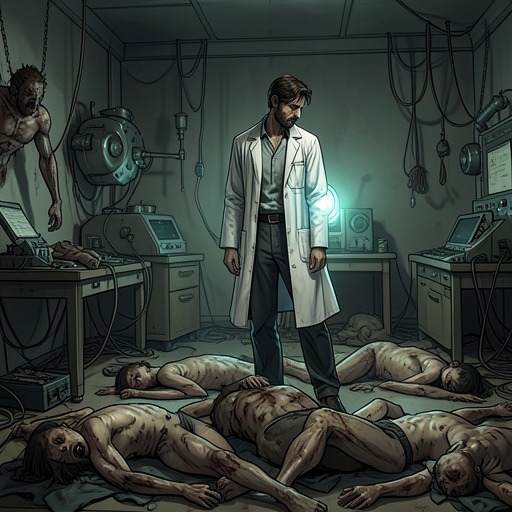
The entries describe vivisection and attempts to animate corpses. The experiments depended on fresh bodies and carp glands, which Owlesby and his associates sought through theft and other crimes. In one episode, the notebooks recount how a cadaver taken from a gibbet remained lifeless without a fresh carp and gland. Owlesby recognizes that the work has moved beyond its supposed scientific purpose: what began as research is already entangled with murder and horror, and he feels too far along to return.
The notebooks also record the decisive escalation in late May 1861. Narbondo urged Owlesby toward an experiment requiring the brain of a living man. They attacked a sleeping indigent in St. James’ Park and carried the victim’s head away. In another Limehouse episode, Narbondo pursued a young costerlad while Owlesby accompanied him; Owlesby later records that the boy was killed. He describes his own moment of recognition as a moral turning point, but the recognition did not undo his participation or end the experiments. A body taken from the gibbet remained unusable, and the entries conclude with the continued need to obtain the serum.
Owlesby believed the Homunculus could arrest entropy and reverse, at least superficially, decay. His notes connect that belief to his own deterioration, while leaving its causes only partly understood. He records periods of rationality amid growing irrationality and, near the end of his life, asks Nell to kill him if he falls into madness again. He also writes of becoming deformed and fears that the thing in its box has caused his decline. St. Ives reads the record not simply as the history of failed experiments but as the account of a man whose pursuit of power and compromise with Narbondo eroded his sanity.
The boxes and the last entry
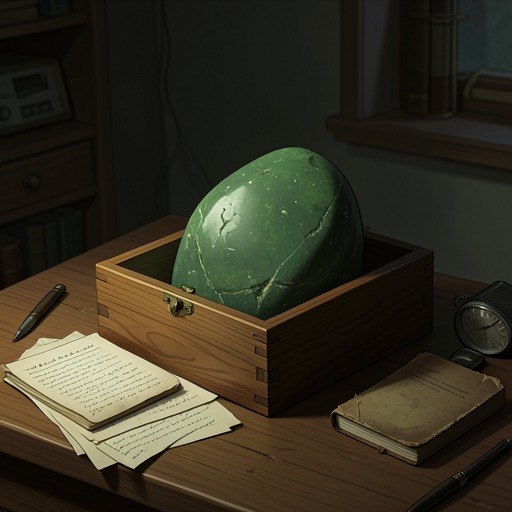
One entry explains the origin of the emerald box. Owlesby had withdrawn his interests in the West African Gem Company as a great emerald intended for his son, Jack Owlesby’s inheritance. He persuaded William Keeble to build a box for it, a box almost identical to the lead-lined cube used to contain the Homunculus. The distinction between their contents was consequential: each box could be mistaken for the other, and each attracted attention for a different reason.
The notebooks’ final note says that a woman gave a box to Birdlip, but does not identify which one. St. Ives wonders whether the emerald or the Homunculus had gone aloft in Birdlip’s blimp and recognizes that Narbondo would want to learn the box’s location. Later, William Keeble confirms that the emerald and Homunculus boxes are alike apart from differences in carving and paint. Nell admits she could have confused them when she was agitated, making it possible that Birdlip received the emerald rather than the Homunculus. At the epilogue, Captain Powers displays a Keeble box containing the large emerald, while the uncertainty associated with the earlier transfer has made the boxes’ resemblance a continuing source of suspense.
Reading and consequence
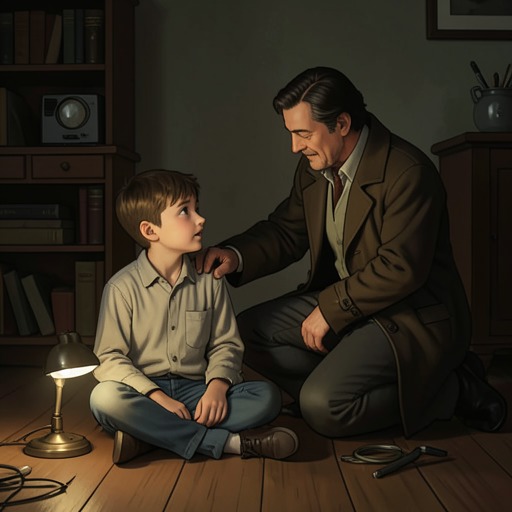
St. Ives first reads the papers alone, then presents them to the Trismegistus Club. He had kept the discovery to himself until the gathering and says that the last pages are the most revealing. William Keeble leans forward, while Jack Owlesby appears apprehensive about what the record may disclose about his father. The notebooks therefore function both as scientific evidence and as a family history, exposing what Owlesby’s research meant for those who survived him.
Reading the account aloud changes St. Ives’s understanding of Nell. He concludes that she was not responsible for her brother’s corruption and regards her as heroic for shooting Sebastian, taking the Homunculus away, and giving it to Birdlip to carry perpetually aloft. He also sees her exile and remorse as a tragedy. The notebooks do not erase the uncertainty of the final note, but they supply the context that makes the act of transferring a box an act of protection as well as a plot mystery. Their power lies in this double movement: they preserve the record of wrongdoing, yet revise the judgment of the person who tried to break its chain.