Keeble box
HomunculusThe Keeble box is a finely made container whose changing uses and uncertain contents make it far more consequential than its appearance suggests. Built to house Jack Owlesby’s emerald, it was made almost identical to the lead-lined cube holding the Homunculus. That likeness turns the box into an instrument of mistaken identity: depending on who handles it, it may be an heirloom, part of a life-support apparatus, a suspected prison for a living being, or a device releasing green gas.
Origin and Design
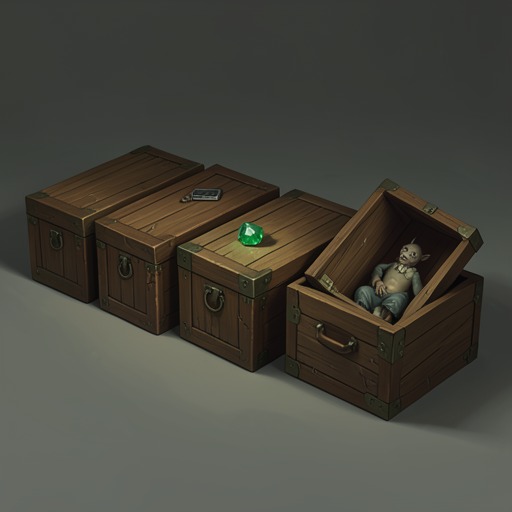
The box’s origin is tied to Sebastian Owlesby’s periods of rationality and his concern for Jack’s inheritance. Sebastian had withdrawn his interests in the West African Gem Company in the form of a great emerald. He prevailed upon William Keeble to build a box for it, deliberately making the container almost identical to the lead-lined cube in which the Homunculus was held. The two boxes thus share a practical purpose—keeping valuable or unusual contents enclosed—but their contents and significance are not the same.
Keeble’s workmanship gives the box a distinctive exterior without making identification secure. In the rosewood top, carved hippos and apes grin out as recognizable Keeble trademarks. The ornament is elaborate, but it does not resolve the central difficulty: the emerald box and the Homunculus box are otherwise identical enough that even Nell Owlesby later acknowledges she might have mixed them up. Their likeness makes a crafted object an unreliable guide to what it contains.
A Component of St. Ives’s Craft
On Langdon St. Ives’s spacecraft, a Keeble box is anchored to the cabin wall among plants and machinery. St. Ives tests it as part of the craft’s aerating equipment while preparing the ship. When he presses the tester button, the apparatus sends out a small spray of green chlorophyll dust carried in a helium-and-oxygen mixture. The gauge briefly rises, then settles as the oxygen dissipates through the cabin. In this setting the box is not merely storage: it participates in the practical work of sustaining the enclosed environment.
The box’s placement and decoration carry Keeble’s style into a machine designed for an extraordinary voyage. Its carved animals remain visible amid the spacecraft’s technical fittings and potted plants. This conjunction makes the object legible in two ways at once: as an eccentric piece of craftsmanship and as equipment whose operation matters to the ship. Its function is revealed through testing, not through its outward appearance alone.
Removal and Dangerous Uncertainty
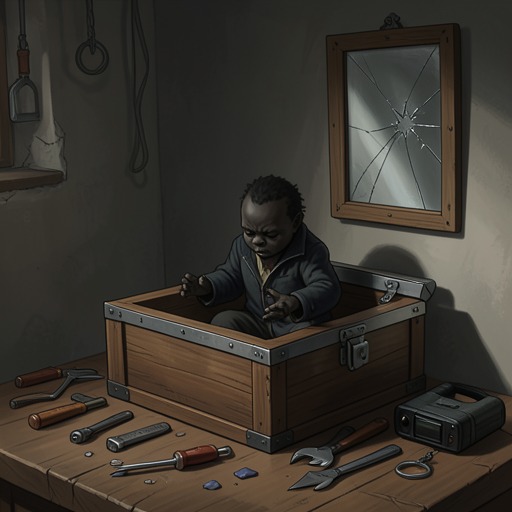
Billy Deener finds a Keeble box fixed to the wall of the craft. He knows the box is what Kelso Drake wants, but he does not know what it contains. He has a prybar and a ball-peen hammer and initially considers smashing the carved figures; fear of Drake’s response restrains him. Instead, he works the prybar beneath the box and catches it when it comes away from the wall. It makes no sound when he shakes it, and he finds no latch. The carvings and the concealed mechanism frustrate any easy reading of its purpose.
Willis Pule also handles a Keeble box whose origin is described as a man on a train. After shaking it repeatedly and finding no obvious lid, he wonders whether its construction is meant to defeat an uninstructed attempt to open it. The spout and crank suggest a dangerous machine to him, although the painted animals seem to argue against that impression. When gas escapes, he believes he has been poisoned; a further release sends a large cloud of green dust out of the spout and envelops him. The episode makes the box’s hidden operation a direct hazard, while leaving its surface design an ambiguous clue rather than a dependable warning.
Circulation, Misidentification, and the Emerald
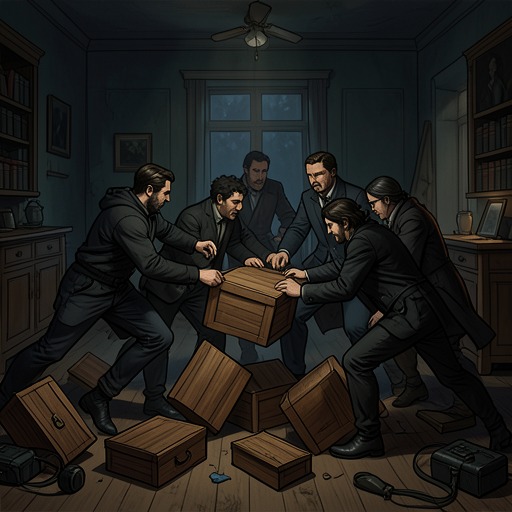
The boxes’ likeness also shapes the events surrounding the Homunculus. Nell Owlesby gives a box to Dr. Birdlip on the night of her brother’s death, and the information later reaches those trying to understand where the Homunculus is. At Narbondo’s laboratory, Shiloh notices a box that Narbondo has set on the piano. The movement of the box coincides with a change in the corpse on the slab; Shiloh wonders whether the box might contain the Homunculus. His suspicion is not proof of its contents, but it shows how the box’s resemblance and unexplained presence invite competing interpretations.
The uncertainty is eventually made explicit. William Keeble confirms that the emerald box and the Homunculus box are identical apart from the eccentricities of their carving and painting. Nell admits that, in her agitated state, she could have confused them, and says Dr. Birdlip may have the emerald instead. This possibility reverses the apparent meaning of the box’s journey: what seemed to be the transfer of the Homunculus may have been the transfer of Jack’s inheritance. The distinction cannot be settled by appearance alone; it depends on identifying the contents.
Loss, Recovery, and Significance
A hidden box also becomes the focus of theft and alarm. The person who extracts it hears a tiny, distant voice and cannot tell what it says; the sound seems to come from inside the box, then feels to him as though it might be inside his own head. Fear overwhelms rational judgment. Later, Captain Powers discovers that the emerald box is missing from his chest. He searches the rain-dark alley but sees no one and can only gesture helplessly to his companions. The loss gives the container immediate material value, while the earlier voice leaves open the possibility that a box associated with the emerald may be confused with one holding the Homunculus.
The story’s final image restores the emerald box to view without erasing the confusion that preceded it. An open Keeble box holds a tremendous emerald, described as fist-sized and bright in the firelight, while Dorothy Keeble stands recovered beside Jack Owlesby and Captain Powers presents the jewel. The box has served as inheritance-holder, spacecraft equipment, coveted prize, and possible container for a living being; its repeated reappearances make possession and identification as important as its construction. Its defining feature is therefore not a single stable function, but the gap between an identical-looking case and the radically different contents people believe it to conceal.