Sebastian Owlesby's manuscript
HomunculusSebastian Owlesby's manuscript is the surviving record of Sebastian Owlesby's worsening mental state and experiments, but it also functions as a map of concealed property and a catalyst for renewed pursuit. Its account links the emerald intended for Jack Owlesby to a box made by William Keeble, and its final note points toward Dr. Birdlip without establishing which of two nearly identical boxes went with him.
Record and Contents
The manuscript documents Owlesby's decline day by day, including his periods of rationality and his fear that he would fall back into madness. In those lucid intervals, he asked his sister Nell to kill him if the madness returned. The entries also record how his experiments, encouraged by Ignacio Narbondo, moved from the study of corpse animation toward murder: in late May 1861, Owlesby and an unnamed accomplice killed a sleeping indigent in St. James' Park as part of an experiment.
The manuscript says Owlesby believed the homunculus could arrest entropy and at least superficially reverse decay. St. Ives reads the account as evidence that this fixation came at the cost of Owlesby's sanity. He goes further, interpreting the decline as a decay of Owlesby's soul; that is St. Ives's explanation, not a conclusion the manuscript itself establishes.
As the entries become increasingly irrational, they refer to a second murder, a brush with Scotland Yard, and the departure of Bill Kraken. They also describe Owlesby's later search for youthful glands and a journey to Limehouse with Narbondo. There, Narbondo was thrown into the Thames but survived. The journal ends the day before Owlesby's death, leaving its account unfinished.
The Emerald and the Two Boxes
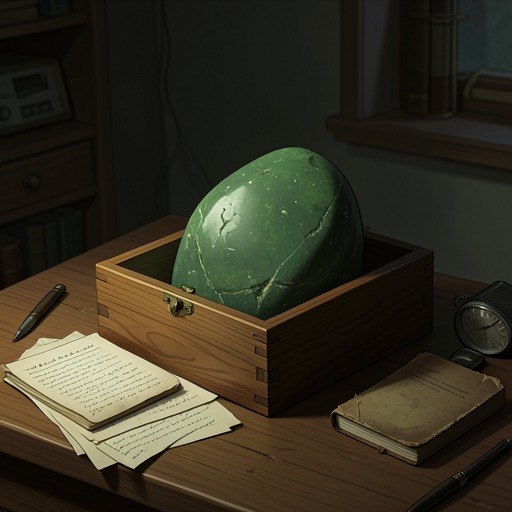
Among the manuscript's more consequential disclosures is that Owlesby withdrew his interest in the West African Gem Company as a great emerald intended as his son Jack's inheritance. He had William Keeble build a box for the stone, nearly identical to the lead-lined cube that held the homunculus. The two boxes' resemblance turns a family inheritance and the creature's confinement into a problem of identification as well as possession.
At the end of the journal, a woman's hand adds that she gave a box to Dr. Birdlip. The brief note does not say which box she meant. St. Ives recognizes the resulting uncertainty: the emerald box and the homunculus's box are alike enough that either could have been carried aboard Dr. Birdlip's dirigible. The manuscript thus offers a crucial lead while withholding the certainty needed to resolve it.
That uncertainty later proves practical, not merely theoretical. William Keeble confirms that the boxes are identical apart from their carving and paint, and Nell admits she might have confused them. She also recalls believing, while feverish in Jamaica, that the emerald box spoke to her; she had hidden it beside her bed and feared the voice meant she was going mad. Her recollection does not settle which box went to Dr. Birdlip, but it shows how easily the boxes' identities and the experiences associated with them could become entangled.
Concealment and Pursuit
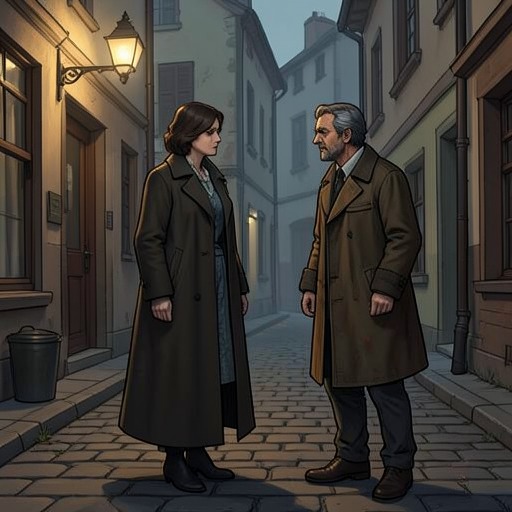
St. Ives keeps the manuscript concealed at his manor behind his copy of Squires' Complications. When a prowler breaks into the study, scatters papers, empties drawers, and damages a plaster bust of Kepler, St. Ives hurries to check the hiding place. The manuscript remains undiscovered. He concludes that the intruder must have been looking for Owlesby's account, and the description supplied by Hasbro leads him to identify the fleeing man as Willis Pule, Narbondo's assistant.
St. Ives and Hasbro follow Pule's tracks along the River Nidd, but the trail disappears into the water and they lose him. The attempt shows that the manuscript's contents remain dangerous beyond their revelation: someone connected to Narbondo is actively seeking the papers, while St. Ives is forced to defend a secret he had hoped to leave behind in London.
The manuscript's account also shapes the choices made over the emerald. Captain Powers and Theophilus Godall judge that involving the police would expose Nell and invite questions about the stone's provenance, its inheritance, and Narbondo's possession of it. They instead plan a private attempt to recover the box from Narbondo. In this way, the manuscript's disclosures help define both what the characters know and why they avoid formal recourse.
Resolution and Significance
The manuscript does not itself recover the emerald or prove which box Dr. Birdlip received. Its effect is to make the boxes' resemblance consequential: a written account of past experiments becomes the basis for present-day suspicion, searches, and plans. The closing image returns the inheritance to Jack and Dorothy, with Captain Powers holding open a Keeble box containing the great emerald. That resolution confirms the stone's place in the family story without retrospectively removing the uncertainty created by the manuscript's final note.
As an object, the manuscript moves between private record and contested evidence. Owlesby used it to document a decline he only partly understood; St. Ives reads it to reconstruct events and assess the danger posed by Narbondo; and Pule's search reveals that its knowledge is valuable to others as well. Its unfinished ending preserves a gap between what the past record discloses and what the living characters can establish.